“What’s in a name?”
Shakespeare presented us with this philosophical quandary over 400 years ago in Romeo and Juliet, with the play’s tragic heroine asserting that names are just meaningless monikers that don’t reflect people’s truest selves, and only serve to construct artificial barriers between one another. But I think this is a bit of an oversimplification, since names do play a significant part in shaping our sense of identity and helping us figure out where we fit in with the rest of the world. Some people carry their names with pride because they represent something valuable within their family and/or culture, while others make a point of changing their names to better align with their faith, gender, morals, etc. And when it comes to fiction, authors frequently choose symbolic names for their characters to help the audience connect with them on a deeper level, as well as better understand the fantastical worlds they call home.
This point definitely holds true for countless characters in the Zelda series, as their names help paint a more vivid picture of who they are within the vast land of Hyrule and how they connect to parts of our own world. We’ve come to associate names that begin with “Dar” with a proud lineage of heroic Goron warriors, and we know that the law decreeing that all future Hylian princesses be named “Zelda” is meant to honor the courageous sacrifice of Princess Zelda I. Epona is appropriately named for the Celtic patron saint of equines, while Impa’s name is derived from the word “impart,” symbolizing her role as a crucial source of knowledge and wisdom for both the hero and the princess. These clever little details breathe so much life into the characters we adore, and unearthing them always fills me with childlike elation.
But every once in a while, I guess the writers like to mess with our heads (or maybe just my head) a little bit and throw an Easter Egg into a character’s name that seems completely irrelevant to their personality, heritage, or any other part of their identity. This is the case for two prominent figures in Breath of the Wild, and I sit here scratching my head, wondering if these are just random references for specific Zelda fans to get a chuckle out of, or if there really is a deeper connection to be found. To figure that out, we need to start at the very beginning (a very good place to start) with a lesson on basic music theory.
If you’ve ever seen the Broadway sensation The Sound of Music on stage or on the big screen, or even if you’ve just stumbled across a few of the more iconic numbers from the soundtrack, then chances are good that you have at least a passing familiarity with the song “Do-Re-Mi.” This joyous, lively piece was brilliantly conceived as a fun way to learn about solfège, a Western musical education technique designed to help people develop a sense of pitch and practice sight-reading sheet music. Specific syllables are assigned to each of the seven notes in a major or minor scale, always in the same order: do, re, mi, fa, so(l), la, and ti. Since these syllables are most commonly applied to the C major scale (C-D-E-F-G-A-B), that would mean that C is do, D is re, E is mi, and so on.
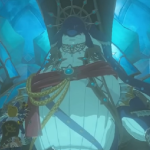
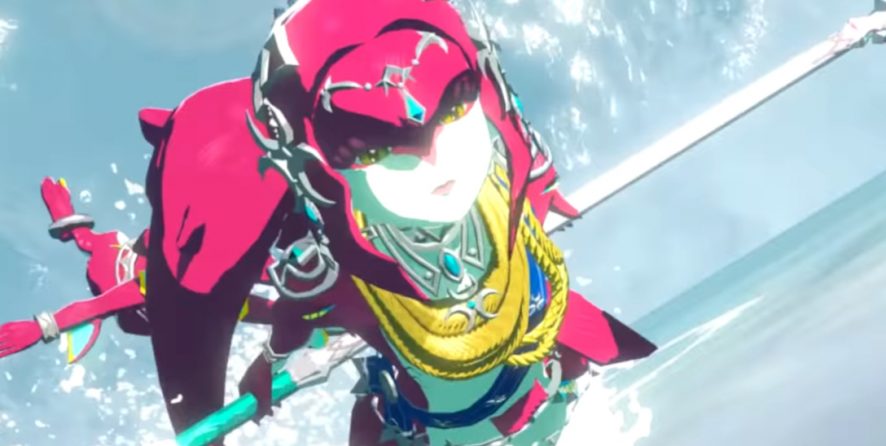
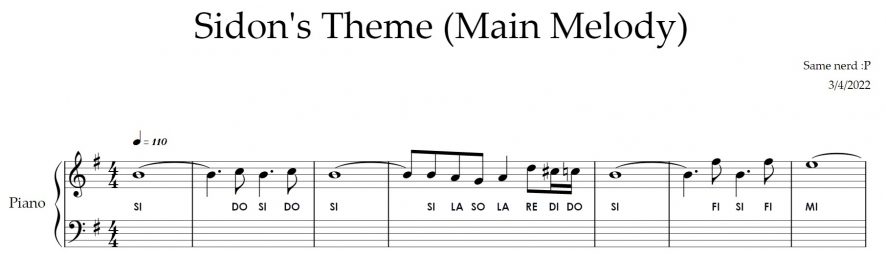
So what does any of this have to do with Breath of the Wild? Well, as it turns out, the lovely Zora Champion Mipha and her eternally-optimistic brother Sidon were both christened with names derived from solfège syllables. They aren’t the first characters in the Zelda series to receive this treatment, since Mido and Fado from Ocarina of Time also pay subtle tribute to this solmization system. But Mipha and Sidon actually take it one step further, with their names directly tying to their respective theme songs. The syllables mi and fa correspond to the notes E and F on the C major scale, and as is demonstrated in the sheet music below, “Mipha’s Theme” begins by alternating between those two notes.

Meanwhile, ti and do correspond to B and C, the first two notes of “Sidon’s Theme.” This may seem like a contradiction, since the beloved prince’s name obviously isn’t “Tidon”, but since the Japanese solfège system tends to replace ti with si, we do ultimately end up with si-do.
But that’s not all! It would be one thing if Mipha and Sidon were the only ones who possessed names with musical connotations, but after digging a little deeper, I discovered that quite a few of their aquatic fellows share this trait. Others include: King Dorephan, where the syllables do-re-fa correspond to the notes C-D-F; Bazz and Cleff, whose combined names reference the bass clef, a symbol used in sheet music to denote low notes; Kodah, where the final passage that concludes a piece of music is known as a coda; and Kayden, or cadence, a sequence of notes or chords that “resolves” a musical phrase (much like the ending punctuation in a sentence).
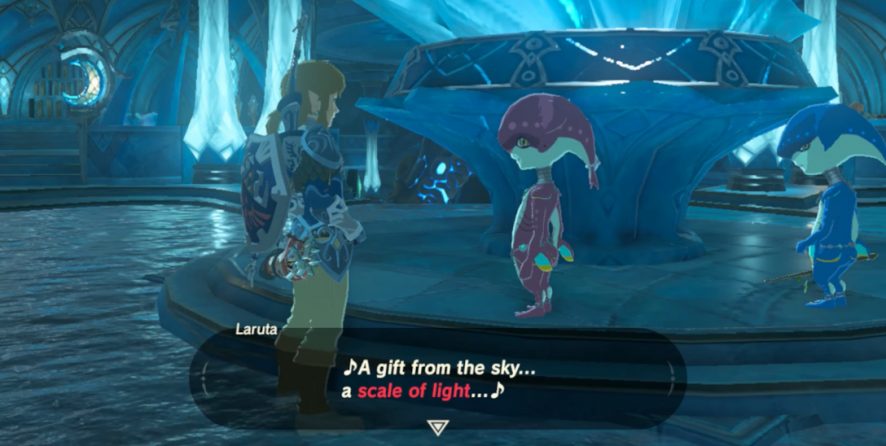
So, now I feel compelled to ask: why make such a point of injecting musical terminology into the names of Zora tribe members? Mido and Fado’s names at least make sense considering the Kokiri’s strong connection to music, but as far as I can tell, music doesn’t really play a role in everyday life at Zora’s Domain. In fact, the only individual I know of that sings and dances is Laruta, the little girl who initiates the “Ceremonial Song” Shrine Quest. If music isn’t an intrinsic part of the Zoras’ identity, then what was the purpose?
After agonizing over this question for hours (no, I’m not exaggerating), I’ve come to a rather unexpected conclusion: I don’t think the Breath of the Wild development team had a reason beyond simply wanting to have some fun with the naming scheme. The Zoras have been subject to playful musical references in the past, with the tadpole musical notes and Zora Hall Easter Eggs in Majora’s Mask, so it could be that the creators of this game just threw in a neat little throwback for long-time fans of the series. In my relentless pursuit of hidden secrets and lore that will enrich the Zelda narrative, I often fail to appreciate the Easter Eggs that are scattered across the Hyrulian landscape just to make the audience smile, laugh, reminisce about the past, or learn something brand new. Music may have very little to do with the Zoras themselves, but I’ll bet a lot of music-loving Zelda fans out there took great delight in all these hidden references, and that’s all that counts at the end of the day.
Besides, Juliet was right about one thing: ultimately, a name is not what determines the essence of a person’s soul. That which we call a Zora by any other name would be as graceful, dignified, and compassionate as ever before, and nothing can ever take that away from them.