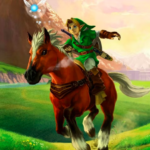
About 20 years ago, I was flipping through a children’s encyclopedia when I came upon a fact that blew my little mind at the time: Epona was a Celtic goddess.
That’s right, Epona, my Epona, was named after a goddess. There was something magical about seeing her name on the page of a book, particularly one that wasn’t an instruction manual. This was pre-Wikipedia, and before googling everything was commonplace. Something about seeing this little fact in writing really shook me.

Maybe it’s because I loved riding Epona around Hyrule Field, or because I cried the first time I saw her trapped, fenced in, at Romani Ranch. She should never have been fenced in when she was so clearly born to run.
I’m not alone in this feeling and I’m pretty confident that, if you clicked on this article, there’s a small place in your heart for our noblest and most steadfast of companions throughout the Zelda series. She’s a frequent character in many Zelda Universe articles, from recalling the quest to find her to deep studies of her character, or a quirky adventure with her in Breath of the Wild.
But I never dug in to who the goddess Epona was, and what she stood for. And while researching this, I came across some pretty incredible academic sources looking into the goddess, the people who worshipped her, and the legacy she left behind.
According to the Encyclopedia Britanica, Epon was the Celtic patron saint of horses, asses, mules, and donkeys. Her name comes from the Gaulish language and the prefix epo- is the Gaulish equivalent to the Roman equo-, which literally means “horse.”

Not only was she the patron of horses, she was often depicted sitting with a hand on a horse (symbolising that she was the tamer of horses) or occasionally riding one. She was also frequently depicted with symbols of fertility, such as grains and young foals.
While she was originally worshipped by the Celts, she was adopted by the Roman Empire and is the only Celtic god or goddess to be adopted into their pantheon. Her likeness would adorn stables and barns, and she became the patroness of the Roman cavalry.
Which brings us back to our Epona. We first meet her as a foal, the most outstanding one at Lon Lon Ranch, with her striking mane and feathering (which is apparently what you call the tufty hair around her hooves, another fact I discovered researching this!). She is clearly the most regal out of all the horses present, and the fastest too. To begin with, she is wild and untamed, which is a trope often seen with creatures of mythological origins.
Epona, the horse, is named after one of the lesser-known but no less powerful horse deities. Sure, the Ocarina of Time team could have named her after the Greek god of horses, Poseidon, or the Welsh goddess Rhiannon, but Epona really works for her. It’s short and unlikely to be a name you’ve heard before, and therefore won’t conjure up a preconceived notion of what she’s like.
Reading up on this topic, I also kept finding references to the “cult of Epona.” I feel that’s pretty fitting for our finest mare, as she certainly has a cult following now.
The next step is carving her likeness in the lintel above our doors. Easy.