There’s nothing like a map to make a fantasy story seem more tangible. You open a massive tome and there, in the early pages before you’ve even met your characters, or even in the endpapers right within the cover, you’ve already experienced a sprawling continent or entire world of nations, city-states, mysterious regions and magical biomes to captivate your imagination. You may not have met the simple farm boy turned into lost heir of prophecy yet, but at least you already know he’s probably going to visit the isolated kingdom of the swamp people at some point, because there it is, right there on the map.
Maps in video games are even more promising, though. Given the expectations of a game, if it’s on the map, it’s almost certain you can go there at some point. A novel might put in a few extra locations, just for that bit of “worldbuilding” to make it seem more realistic. After all, you can’t expect to go everywhere, can you? Well, in a video game you can. It’s a contract between game and player that if you can see it, it’s probably accessible to some degree.
As a burgeoning fantasy fan in childhood, I loved maps. The giant fold-out maps in the back of my library’s hardback editions of The Lord of the Rings captivated me. I pored over them, wondering what might lie in the places Frodo and Sam never reached but were labeled so expectantly on the edges of Middle-Earth. I even had a full map of the known world of The Wheel of Time books, acquired along with a cheap calendar one New Year’s, tacked to my wall.
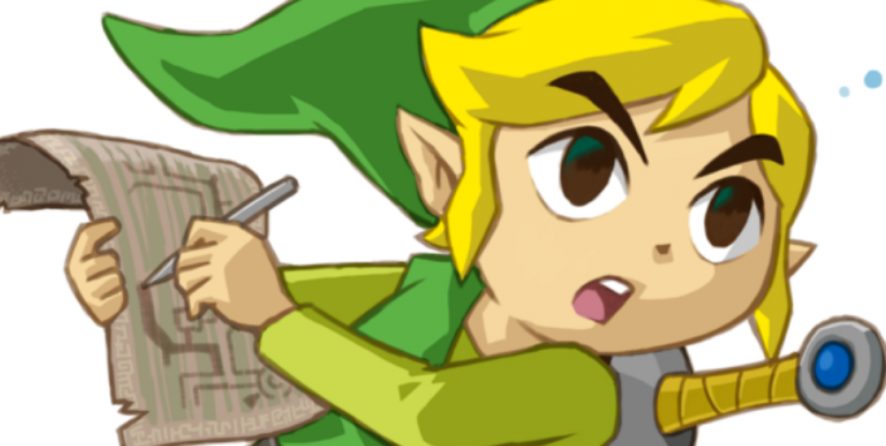
And there was The Legend of Zelda series, which always offered enticing maps of whichever version of Hyrule would be on display this time around.
My love of Zelda was probably fueled by a map, really. My copy of A Link to the Past, enclosed as the pack-in game with my brand new Super Nintendo console, came with a fold-out map of Hyrule (at least the version in the Light World, as I would discover hours down the line). It was fairly accurate to the map I could access with the push of a button in the game itself, but I could gaze at the map, also pinned to the wall in my bedroom for quite some time, even when I couldn’t play the game. I would look at the nooks and crannies of Hyrule and wonder how I might reach some inaccessible spot given enough ingenuity.

Names like Death Mountain, Lake Hylia and the Desert of Mystery were emblazoned on the map, invoking questions about where such names came from and what lore they might represent. A Link to the Past was my first Zelda game, so I was only dimly aware that places like Spectacle Rock or the Lost Woods were repetitions of previous Zelda landmarks.
Looking back at the map now (yes, I still have it stashed away, threadbare at the edges from constant usage years earlier), I can question some of the naming decision like the Tower of Hera (what is a Greek goddess’ name doing in Hyrule?) But at the time, the map was simply unbridled adventure captured in a single image.

I’ve continued to admire Zelda maps in the games that arose since. Exploring Koholint Island one square at a time became an obsession as I tried to fill in every single block on the map screen. The map in Ocarina of Time threw me when it first came out, as I tried to figure out how the Lost Woods might have migrated from one corner of the world to another, or how Lake Hylia change orientation entirely, but galloping across the then-seemingly endless expanse of Hyrule Field overruled most objections. I loved mapping the Great Ocean of The Wind Waker and filling in map sections in Breath of the Wild one tower at a time.

Even previous maps captured my imagination, particularly the gargantuan Hyrule represented in The Adventure of Link, with multiple named villages, an ocean to cross and the stunning revelation that a tiny corner of the map represented the entirely of Hyrule, as experienced in the previous Zelda adventure.
Maps still represent adventure to me — I have a full map poster of Middle-Earth on my wall even now — and I look forward to exploring ever new representations of Hyrule with each new trip to its borders. I just hope the next game comes with another fold-out map. I have a great spot on my wall to put it.