The release of Skyward Sword HD for the original game’s 10th anniversary has come at an interesting time for The Legend ofZelda series. The franchise headed down a brand-new direction in 2017 with the release of Breath of the Wild. As we await its sequel, the biggest questions fans have are to what degree Breath of the Wild represents a completely new standard for the series and to what degree we are instead likely to see old elements become mixed in.
In the midst of all this speculation, Nintendo has remastered Skyward Sword, a game that presents an entirely different thesis on what it means to be a Zelda game. So how does it hold up as a 10-year-old game, and which parts of it are worthy of re-incorporation into the new formula for the series? These are some of the questions I set out to answer as I played Skyward Sword again for the first time in years.
Full Disclosure:
Nintendo graciously gave Zelda Universe a review code for The Legend of Zelda: Skyward Sword HD.
Reviving History
First, let’s talk about the changes between the original Skyward Sword for the Wii and the new Skyward Sword HD for the Switch. In my view, the most notable change, which didn’t make it into the official marketing material but does have a large impact, is the ability to freely control the camera. As you might recall, the old Wii Remote and Nunchuck controller combo did not include dual analog sticks, so Nintendo instead opted for a camera system that largely involved pressing the “L” button a lot to center the camera behind Link. This change is a big quality-of-life improvement and makes moving across the world generally smoother.
Controller options for controlling your Destiny
The other major change to the controls is the addition of a button controls option. These were a necessity for a Switch remaster to work, both because a large chunk of the player base uses the Switch primarily as a handheld device and because the Switch Lite does not have detachable Joy-Con controllers in the first place. Owners of the smaller console would not be able to play a motion-controlled version of the game.
The button controls work well and in many ways are more precise (it sure makes it easier to rack up high scores on that bamboo cutting mini-game, for one), so if the motion controls of the original were an accessibility issue or simply just an annoyance for you, this is a solid alternative.
What is this — some kind of Skyward Sword!?
My only complaint is that, since the motion of the sword is relegated to the right analog stick, the aforementioned free control of the camera in this mode requires you to first hold down the “L” button to make it work. This button mapping setup repeatedly caused me to use the sword by accident due to years of ingrained muscle memory. I’m sure you could move past it after a few hours of sticking with that control system (I went back to the Joy-Con controls), but I think it would have benefited from an option to switch these around and have the sword be the ability activated by holding “L”, as I’m moving the camera far more often than my sword.
The motion controls of the original game are still available and are in some ways better than ever, as the Joy-Con controllers feel like they have improved functionality compared to the old Wii Motion Plus controller. The only potential difficulty I would note is that you may find yourself needing to recalibrate more often, which may have partly been an issue of my particular posture and the chair I was playing on, but I suspect is more generally related to the differences in the ways the two motion control systems work.
The Wii had a sensor bar on top of the TV to help you consistently center your hand position, whereas the Joy-Con controllers use purely gyro technology and can be pointed anywhere. This allows you more flexibility in posture but also means that you’ll inevitably be off-center as you shift around.
It’s very easy to instantly recalibrate your controller at any time and feels natural for the most part, though it did become more noticeable in a couple of time-sensitive fights, such as where I had to quickly whip out the Bow to shoot some giant monster in the eye (the most important of Zelda traditions), since a de-calibrated controller meant that switching to the Bow’s aiming view would jolt my camera to that side.
Refreshing improvements abound
Other minor tweaks to the HD version, such as your companion Fi appearing less often to state the obvious to you, faster-scrolling text, or not having to listen to all the collectible descriptions every time you load the game, are all welcome changes that address some consistently-voiced frustrations with the original game.
The titular “HD” graphical upgrade is also nice, and the game looks consistently pretty. The game’s art style already held up well, but getting rid of the Wii era’s blur is the icing on the cake. There is one other update that uses an amiibo to give you slightly easier access back to Skyloft (saving you a couple of minutes occasionally by letting you head back up from anywhere on the Surface rather than at a Bird Statue). Unfortunately, I did not have access to the required new amiibo in time for this review.
Getting to the heart of the adventure
Skyward Sword‘s version of the Zelda formula is intriguing to look back on now, in the wake of the large changes that came to that formula in recent years. Skyward Sword and Breath of the Wild have some large ideological differences in game design that become apparent quickly upon starting each game. In contrast to the “grab a stick and let’s go” opening approach of Breath of the Wild, the Wii era of Zelda games are notoriously slow starters by the series’ standards.
Twilight Princess starts by making you herd goats and catch fish for a while before getting into the game’s main mechanics. Skyward Sword starts you out in Skyloft, the game’s primary hub area, where you’ll be chatting to school teachers, dealing with local bullies, and learning to fly on your Loftwing, which is this game’s overworld travel mechanic.
I can see that, Fi.
A Dungeon Crawler 24/7
After a couple of hours though, the game gets into gear and starts to show its real point of difference with Breath of the Wild, a game that boldly declared that the cornerstone of the Zelda series was exploration and a feeling of adventure. Skyward Sword goes in hard on the idea that the Zelda series is primarily about dungeons.
As soon as you step down from the sky onto the grassy plains of Grooseland Hyrule, you enter a constant series of dungeons, and I don’t just mean in the traditional Zelda sense, which involves entering some variety of ancient temple that you found in a field somewhere. Those temples still exist — what’s changed is that the fields themselves operate more like dungeons. This was an intentional change as part of early efforts to shake up the Zelda formula after an acknowledgment that it had been heading in the same direction for a while. In a 2010 interview with Gamespot, series director Eiji Aonuma spelled out the upcoming changes he wanted to make:
“If you look at the Legend of Zelda as a series, there are some things that are fairly traditional in the structure of the game in that you have a traditional field area and then a dungeon area. So, maybe we won’t have the dungeon area be that place where you go and you fight enemies and you solve a puzzle and beat the boss, but maybe we can make some field areas that operate sort of like dungeons.”
What resulted was a game that goes all-in on being linear. The new game cycle goes like this: You airdrop into the entrance of an outdoor area — a kind of open-air dungeon that presents a series of challenges with essentially one way to solve it. From there, you might need to explore the area once more to find some type of collectible, which you can search for with Fi’s dowsing feature. Then, you enter the real dungeon, and upon completing this you return to the hub for some upgrades and then airdrop down into the next outdoor dungeon.
For obvious reasons, this is an approach that splits fans. For fans of dungeons, this is a dream come true. It’s a kind of non-stop action with the middle-man cut out! On the other hand, for fans of the more open style of play provided by games such as the original Legend of Zelda, it often felt like something was missing. In comparison to a game like Breath of the Wild, which revels in its downtime and celebrates it as a core part of its appeal, Skyward Sword is a game in which you are always scheduled for dungeon duty.
The good news for this approach is that the dungeons themselves are a highlight of the game and are some of the best in the series. There are a variety of interestingly themed puzzles, such as a ship that travels thousands of years back and forth in time and requires you to make use of both eras to complete the dungeon. This aspect of the game is one that I would be glad to see make a bigger return in the future. I did enjoy the puzzles in Breath of the Wild, but I also missed the visual creativity of different dungeon designs provided by a game like Skyward Sword.
What is this — some kind of Breath of the Wild!?
Soaring over an often boring Skyloft
It’s not entirely true to say that Skyward Sword has no overworld, as it does have a Hyrule Field equivalent — the skies around Skyloft, which contain a variety of floating rocks as well as a few NPCs. In practice, though, you’ll mostly just find yourself using the hub world to airdrop to one of the game’s three zones.
Any overworld exploration you would want to do for treasure chests and such are locked behind activating them first on the Surface below, at which point they will be marked on your map when you go back up to Skyloft. Again, this is a point of preference to an extent — there are Zelda fans out there who also felt that previous overworlds such as Hyrule Field or TheWind Waker’sGreat Sea were also just padding to get to the real part.
But in that case, I would have preferred that the game go all the way. Rather than phasing out the importance of the overworld while still keeping the trappings of it by making you fly between each zone entrance point, I might have preferred something like a simple menu selection (or something like Four Swords Adventures‘ overworld) to speed the whole process up. I can understand why there would be people who would see this as similar to previous field areas, but to me, the overworlds of previous games like Ocarina of Time are truly different from Skyloft’s flight zone.
In Ocarina of Time, I could wander into unknown areas such as the Gerudo Valley, where I couldn’t quite move the story forward yet, and the result was a sense of thrill. I was exploring a world full of exciting things that I hadn’t seen before. For Skyward Sword, though, I felt like the veneer on the overworld was paper-thin enough to be distracting. The concept itself of a sky world is not a bad idea and has unrealized potential, but we will have to look to the future to see whether something similar can be reworked under the series’ new format.
“Boss” Boss Battles
Skyward Sword also makes use of its unique control system to create some very entertaining fights, and the game’s combat controls can feel very rewarding (aside from those few moments when a controller de-sync distracts from the immersion of 1:1 controls). One fight in particular, in which you grab one of the boss’s gigantic swords and satisfyingly use it to hack its owner down to size, feels extremely satisfying thanks to the motion controls.
The game’s variability when it comes to boss battles is another area that I’d love to see brought back into the series for the Breath of the Wild sequel, as while Breath of the Wild excelled in providing flexibility to its outdoor encounters with regular enemies, the boss encounters themselves tended to be less memorable.
Hit-or-miss gear
Link’s items and equipment contain some highlights too, though certain items got a lot more use than others. I found the Beetle to be particularly fun, and I routinely used it for bombing runs, item collection, and scouting throughout the game. Some of the other items, though, such as the Slingshot and the Whip, tended to phase out and not get much use.
I would have loved to see some of these items used to a greater potential. For example, at one point the game introduced the interesting idea of using the Whip to steal keys from a guard. Unfortunately, that mechanic never really showed up again, and hitting later enemies with the Whip mostly just made them flinch without dealing any damage or stealing any items.
Presented without comment.
A foundational formula
There is a tendency among some of Skyward Sword’s detractors to suggest that Skyward Sword is an example of the series going stale. While I in some ways tend to agree that it doubles down on a few of the more stagnant aspects of the previous 3D era of Zelda games, I also recognize a lot of the experimental changes that it did make.
Changes that were a core part of Breath of the Wildmake their first series appearance here, including the Stamina Meter, equipment durability (in this case, shields that wore out if you failed to perform a perfect block), and the ability to collect miscellaneous items for use in equipment upgrades. Breath of the Wild’s Paraglider was foreshadowed by this game’s Sailcloth, which allows Link to land safely from great heights. However, since it does not have Breath of the Wild’s physics system, Link will simply jump a set amount forward and the sailcloth will take him straight down, rather allowing him to glide through the air.
Every Adventure Has Its Blunders
The game’s pacing has been partially improved by the game’s functional enhancements, such as the faster-scrolling text or the ability to skip cutscenes, but unlike the fixes that Nintendo made to The Wind Waker’s late-game Triforce hunt in its HD remaster, Skyward Sword HD doesn’t make any meaningful changes to the original game’s pacing issues.
Most of the pacing problems are just an issue of repetition: Sometimes you get sent back to the same zone map one too many times (usually for some sort of collectible hunt), whereas on other occasions it can feel like the game is just delaying your quest without good reason. The game’s repetition is not always a negative, and sometimes the re-contextualized return to old areas can be quite interesting. I enjoyed one segment where all my weapons and items were taken away and I had to make do with what was offered to me to sneak across the map. This concept was revisited with great success in Breath of the Wild.
On the other hand, I was frustrated by the game’s attempt at re-treading in one of the other zones, which starts by making you fight a particularly annoying boss for the third time and then ends by trolling you by way of an ungrateful dragon. This dragon spreads the song you need into 50 separate notes and scatters them throughout an old zone that has now become a massive water level (delaying you for no good reason aside from her own amusement). Yes, this is about you, Faron — you are bad at your job and should retire.
Yet another brilliant move from the dragon who was so upset about some Bokoblins showing up, she flooded the entire forest and created a shark infestation.
Characters raise the story skyward
The game’s story is interesting in a few ways, both in terms of lore implications and just generally wanting to know what will happen next in the plot. But mainly I think it stands out by creating and developing some interesting characters. Link himself does have some quirks, but as usual, he is not the most memorable character in his own series. He does have a few unique traits compared to other Links, though. As someone who is getting old these days, I share his appreciation for being able to sit down on benches and stools (which will restore you to full health), but outside of some fun expressions in reacting to dialogue, he is just the same Link archetype you know and love.
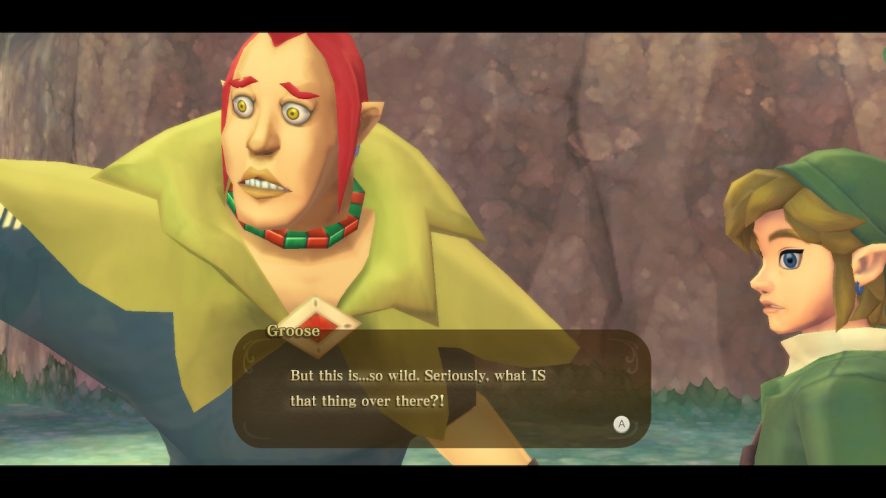
A lot of that character development time goes toward other characters, such as Zelda herself, who is a much more active character in this game’s story than the kidnapped princess from many other games in the series. She also has a personal character dynamic with Link that many fanfiction writers must be thrilled about. The real stand-out character, though, is Groose, whose iconic hair and unique personality have made him a fan-favorite character.
Verdict
Overall, Skyward Sword HD is a solid video game and is the version of the game you should buy if you want to experience Skyward Sword. It features a range of positive improvements from the original. There are points where I don’t entirely agree with its thesis on what the Zelda series should be, which places it below some of the more open-world Zelda games on my personal list as a result, but as a video game, it excels in the areas that it wants to focus on.
If the Breath of the Wild sequel ends up taking away one thing from this game, I hope that it would be the creative style of the dungeons and its puzzles, which at times varied wildly in theme while still belonging to the core Zelda motif. What you personally want out of a Legend of Zelda game is up to you, but if you didn’t previously play this entry, despite enjoying other games in the series such as Twilight Princess, I think Skyward Sword HD is well worth your time.
Score: 8.5/10
Cody Davies
Cody has been involved with Zelda Universe since joining the forums in 2003, and now spends most of his time making bad polls on Zelda Universe's Twitter account.


 by Cody Davies on July 23, 2021