Here we are, at my absolute favorite episode of The Legend of Zelda TV series.
The cartoon is often criticized for not feeling “Zelda” enough. It’s true that there are some elements that feel jarring to fans of the games, such as Link’s dialogue, Ganon’s clowning, and the addition of non-canon characters such as Spryte. There are even a few episodes where, if you were to alter the title sequence and change some of the character names, you could mistake the show for just some strange fantasy cartoon that has no relation to Nintendo.
“Underworld Connections” is not one of those episodes. If you only watch one episode of the TV series as a fan of the Zelda games — and the original Legend of Zelda in particular — this is the one.
Happy NES
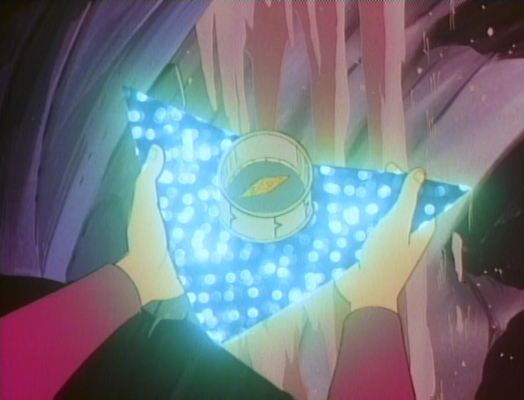
By firing sword beams into a fragment of the Triforce of Wisdom, Link and Zelda defeat the Vires that carry the other two pieces.
At the beginning of the episode, Vires, after bringing chaos to the castle in “Sing for the Unicorn,” appear once again in order to interrupt Link and Zelda’s kiss, and this time, they’ve come equipped. Vires are winged devils that, in the original game, split into the bat-like Keese creatures upon defeat. Moments before their arrival, Zelda catches Link sleepwalking toward her tower, leaving the Triforce of Wisdom unprotected. The creatures take this opportunity to enter Link’s unguarded chamber. The Vires aren’t strong enough to carry the Triforce back to their master, Ganon, but, by placing a bomb underneath it, the relic shatters into three pieces upon detonation. The devious devils each take a piece, and take flight to go back to the Underworld.
Link manages to stop one of them and retrieve one of the pieces, but the other two are long gone before our heroes have a chance to stop them. What’s worse, the Vires were smart enough to split up and navigate the Underworld via different routes. Zelda, being an expert on the intricacies of the Triforce, however, devises a plan. She reveals that, while the Triforce may be broken, the fragments are still “magically linked,” and she instructs Link to fire some sword zaps at their fragment. The beams travel through it and out of the other shards, hitting and eliminating the Vires and causing them to drop the fragments before they can reach their master. With the dropped shards in two different areas of the Underworld, Zelda touches the sides of her fragment where the others had broken off, noting that one side of their Triforce fragment feels wet and the other feels hot. This gives her and Link clues as to the whereabouts of the remaining pieces: One lies in water, while the other lies in heat.
out of all of the episodes of the TV series, this one feels the most faithful to the original Legend of Zelda game.
What makes this episode such a stand-out is that, out of all of the episodes of the TV series, this one feels the most faithful to the original Legend of Zelda game. The first game centered around the Triforce being split into eight shards, with Link’s main objective to find them all. This episode is a condensed, 15-minute version of that concept, and Link and Zelda are even pushed toward exploration like a player would be in a Zelda game. The “find somewhere wet and somewhere hot” setup is similar to the vague clues you would receive in old-school adventure video games, nudging you in the right direction without telling you exactly where your destination is.
The Magic Compass is a welcome sight for The Legend of Zelda fans.
To make things even better, Zelda uses a “Magic Compass” to locate the two Triforce fragments in the Underworld. The compass is not only another classic throwback to the original game, but has since become a main staple of the Zelda series as a whole. Only the first two Zelda games were released at the time of The Legend of Zelda TV series’ original airing, but 30 years later, the compass is still an iconic element of the franchise, and its inclusion in this episode embodies the spirit of classic dungeon exploration from the game series.
A world down under
The Black Falls is the only area of the Underworld given its own name.
One of the highlights of the previous episode, “Doppelganger,” was watching Link and Zelda navigate the endlessly winding paths of the Underworld. “Underworld Connections” takes this a step further, making the Underworld seem infinitely expansive with more variety than ever across its many areas.
Zelda demonstrates her magical powers again in this episode when she leads Link to a seemingly normal pond in Hyrule. She uses the Triforce shard to cast a spell, draining the water and revealing an underground stairway. It’s always fun to see the different Underworld entrances and how the characters manipulate them, as they echo the secret caves and crevices you can find in the overworld of a typical Zelda game. As Link and Zelda descend, the chaotic design of the Underworld impresses once again with narrow pathways, countless stairs, and unending amounts of doors everywhere.
Link discovers the second fragment of the Triforce of Wisdom in the depths of the Black Falls, but the Aquamentus that lurks here isn’t about to make things easy for him.
As Zelda predicted, the first Triforce fragment is in a wet place. The first major location Link and Zelda reach is the Black Falls, which is notable for being the only area of the Underworld that is named in the show. It is a dark, damp, cave-like place with a bustling waterfall cascading into a giant pool of water. Zelda pushes Link into it, and we’re treated to the first underwater sequence of the series. The depths of the Black Falls are revealed to be much more vast than they first appear as Link dives in and then swims through a very colorful and vibrant environment.
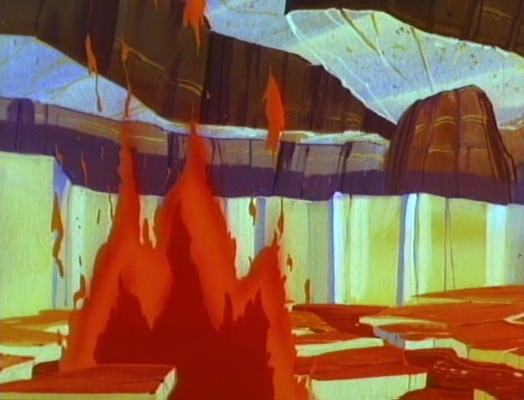
The final Triforce fragment lies in this volcanic area of the Underworld, where flames rise and roar at Link from all angles.
The compass then takes them to a volcanic area, which looks like it would fit perfectly as a fire-based dungeon in a Zelda game. Fire spews ferociously through the cracks of the rocky floor as Link leaps toward the location of the final Triforce fragment, and he even jumps atop his shield to surf over a particularly large flame in his path.
With a whole episode dedicated to exploring it, the Underworld finally receives the representation it deserves, with “Underworld Connections” making it seem like a sprawling series of interconnected Zelda dungeons. Zelda fans will feel right at home watching Link and Zelda explore its depths, especially with all of the familiar monstrosities that lie in their path.
Show our heroes the Ropes
The Ropes are quick to debilitate Link by rapidly wrapping around his body.
That’s right, this episode hasn’t forgotten the most exciting element of The Legend of Zelda cartoon: the enemies. The fact that the Vires once again appear at night lends credence to their bat-like qualities, along with their sharp fangs, claws, and wings. The creatures can even be seen hanging upside-down in Link’s room, grinning as they loom over the newly shattered Triforce of Wisdom. The Vires show more intelligence than most of the other species serving Ganon, as they not only take the initiative to make the Triforce light enough to carry, but they also think to split up when flying away in an attempt to make Link and Zelda’s pursuit more difficult.
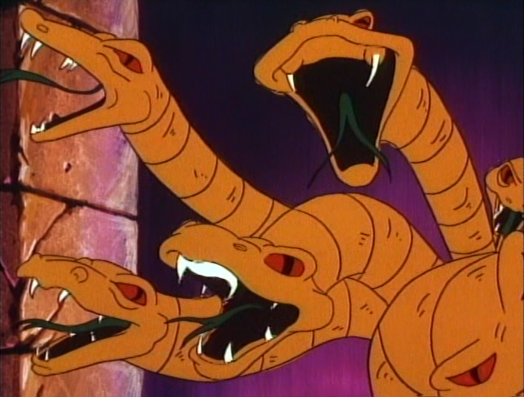
Returning foes are fine and all, but being introduced to new monsters is where this series shines, and “Underworld Connections” delivers. The first new enemies that Link and Zelda encounter are the Ropes. The original Legend of Zelda‘s game manual describes the Rope as “A poisonous snake that has made the labyrinths its home,” and since we’re now seeing the Underworld as more labyrinthine than ever, there couldn’t be a greater time to introduce the creatures. The manual also states that the Rope “senses other creatures quickly and suddenly comes after them once it has found them out.” This is accurate in the cartoon, as they are introduced by bursting through a door rapidly and violently as soon as Link approaches. They are able to entrap Link quickly by speedily slithering around him, making them a prominent threat as they attack in a large group.
The Aquamentus, a recurring boss from the original Legend of Zelda, lurks out of an underwater cave to attack Link.
Next, as Link is swimming in the Black Falls, an Aquamentus is introduced. This is a recurring boss in the original Legend of Zelda game, described in the manual as “a type of dragon that some call a unicorn.” The cartoon version of the beast definitely accentuates the unicorn traits compared to the one seen in the game’s official artwork, with a longer tail, hooves instead of toes, and a horn which more closely resembles that of a unicorn. As Link retrieves a shard of the Triforce of Wisdom, the Aquamentus lurks out of an underwater cave and attacks him, taking him to the surface and soaring in the air. Link rides on top of it as it flies, struggling against its frantic movements.
Another returning enemy, the Gibdo, also appears in the fiery area of the Underworld. It has a lesser role this time compared to its previous appearance in “Kiss ‘N Tell,” but what it lacks in dialogue and magical prowess in this encounter, it makes up for in physical strength. It charges directly at our heroes from out of the darkness, attempting to grab Zelda before flinging Link off its back.
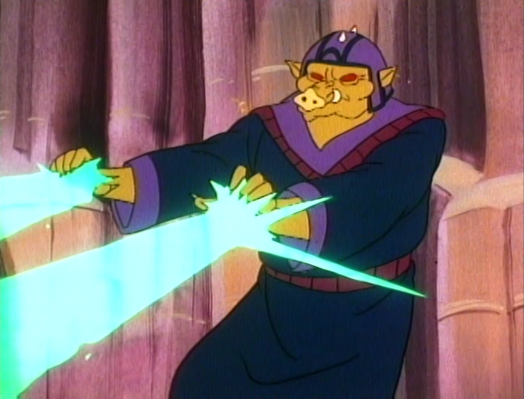
Ganon is once again eager to defeat Link and Zelda with his magic, shooting lasers and manipulating the Underworld’s ferocious flames at will.
Finally, Ganon appears as the duo retrieve the final piece of the Triforce. He played the waiting game while Link and Zelda did the work for him, ambushing the heroes to swipe the wholly reformed Triforce of Wisdom. The villain’s instinctive greed ends up being his undoing, however, as when Link offers him the Triforce piece, he instantly lays out his hands in anticipation. Still scorching hot from lying on hot stone, the fragment burns Ganon’s hands. As usual, Ganon is never taken seriously for very long, with his evil presence quickly diminished by his stupidity and goofy actions. Personally, I wouldn’t have it any other way.
A strong connection
Link’s a happy boy, and so he should be: This episode is the TV series’ greatest success.
Following a solid 12 minutes of classic Zelda adventure, the dialogue does take a slight tumble toward the end. When Link threatens to zap Ganon one more time to send him back to the Evil Jar, the villain retorts with, “That’s a zap you won’t make, Link!” Not only is this a lame comeback, but it’s actually the second time Ganon has used this line in the show. Zelda follows this by labeling Ganon as an “evil wizard” like it’s an insult. She has used funny nicknames like “Porky” and “Hogface” in previous encounters, but, unfortunately, it seems that our princess is all out of pig puns this time. As Link makes his dramatic exit by using his shield to surf across the fire, he decides to state the obvious by yelling, “Yahoo! Flame surfing!” For a series chock-full of terrible-yet-enjoyable puns and one-liners, it seems like the writing team was eager to wrap things up when finishing this episode.
This nitpick isn’t nearly enough to dampen such a fantastic episode, of course. All of the main characters are on top form here, with Link as frivolous and playful as ever but ready to jump headfirst into danger when called upon. He even sets a new record in “Underworld Connections,” as this episode has more instances of the “Excuse me, princess!” catchphrase than any other. If that doesn’t sell you on this episode, I don’t know what will. Similarly, Ganon displays his hilarious balancing act between being a serious villain and an injudicious buffoon. The episode wouldn’t be complete watching him needlessly teleporting around his lair during his scheming, his Skeletor-like laughter, and confronting Link and Zelda for a showdown to provide the episode’s exciting end sequence.
“Underworld Connections” manages to capture all of the best qualities of The Legend of Zelda TV series.
Princess Zelda is the real star of the show, however, showing that she is more intelligent, witty, and adept in combat than ever before. It’s thanks to her knowledge of the Triforce’s capabilities and Hyrule’s secret passageways that she and Link are able to put a plan together, and once again she proves to be an essential partner for Link throughout their quest. Zelda saves Link from certain doom mere minutes into the episode when he falls from the castle window, defeats the rabid Aquamentus with a bomb as it attacks him, and assists him in the fight with Ganon with a well-aimed boomerang hit. She is also responsible for the funniest scene in the episode: As Link attempts to utter his dreaded catchphrase a fifth time, Zelda cuts him off, raising her hand and letting out a repulsed “Ugh!” before telling him to get moving. There’s something funny about Link being so predictable that even the princess can’t take it anymore.
Bombs and boomerangs aren’t the only items Zelda fans will recognize. Believe it or not, this is only the second time Link has used the Magical Shield in the series, with the item first appearing way back in the first episode, “The Ringer.” Seven episodes later, the shield from the original game is finally back to protect Link from fire once again, as well as magical zaps from the enraged Ganon. It may seem like a small detail, but seeing Link with his sword and shield is yet another loving reference to The Legend of Zelda on NES, bringing to mind the 8-bit version of the hero.
“Underworld Connections” manages to capture all of the best qualities of The Legend of Zelda TV series, while also going further than any other episode to draw inspiration from the legendary game that the cartoon spawned from. There are Triforce shards to find, dangerous labyrinths to explore, a myriad of items and weapons, monsters to fight, and a boss battle at the end. It’s the only time you’ll see the Magic Compass, Ropes, and an Aquamentus, and while I generally have no issues with the cartoon-only characters Spryte and King Harkinian, their absence from this particular story also helps establish this episode as a pure experience for Zelda devotees. It’s my episode of choice when introducing a Zelda fanatic to the TV series, and it’s the one that I implore you to watch if you’ve never given the show a chance.
Reece Heather
Reece is the former leading news editor and columns editor at Zelda Universe, and is the greatest video game journalist in the history of video game journalism. He recently won an award for "World's Most Influential Video Game Critic," but had to decline his certificate as his ego is now too big for him to leave his front door.


 by Reece Heather on November 13, 2019