Having been let down again and again by his minions, Ganon realizes that he needs to take a new approach if he’s going to successfully kidnap Zelda and acquire the Triforce of Wisdom. Since Zelda is too strong, smart, and steadfast to lose to Ganon’s schemes and attacks, it stands to reason that he would decide to make his own copy of the princess to do the job for him.
Field the force, Link
Link picks up a Force Field Ring dropped by a defeated Moblin.
At the very beginning of the episode, a Moblin tries to infiltrate North Castle in order to steal the Triforce of Wisdom. Unfortunately for him, he runs into Link and is easily defeated, as you’d expect. As the minion’s body returns to the Evil Jar, it leaves behind a peculiar item.
Link identifies it as a “Force Field Ring,” and once activated, it creates a barrier around its wearer to provide protection. Later in the episode, deep in the Underworld, Link grabs Zelda and jumps off a ledge to avoid a barrage of projectiles from a group of Octoroks. The ring’s barrier protects them from the impact, allowing for a safe landing.
This item does not exist in any of The Legend of Zelda games and was made from scratch for the cartoon. There are many items that serve a similar purpose, such as A Link to the Past‘s Cane of Byrna, Nayru’s Love from Ocarina of Time, and The Wind Waker’s Magic Armor, but all of these games released long after the TV series aired.
The force field allows Link and Zelda to land safely after falling into the depths of the Underworld.
We have already seen many items from the original Legend of Zelda appear in the show, including the Recorder and the Power Bracelet (albeit renamed to the “Magic Flute” and “Magic Bracelet,” respectively), and while the purpose of the Force Field Ring isn’t pulled from the NES titles, its appearance does at least resemble the Blue Ring from the first game. Whether or not this was a source of inspiration, the Force Field Ring manages to fit well in a series that has already established many magical devices.
Prepare for trouble, and make it double
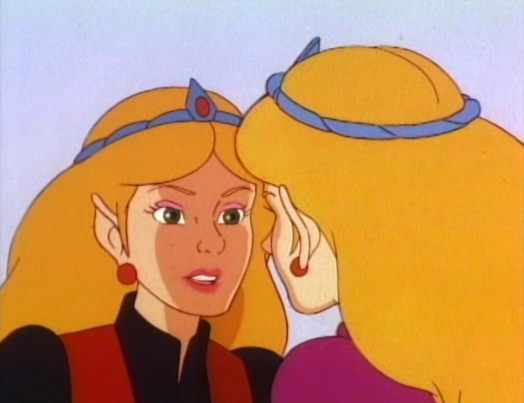
Zelda’s reflection comes to life as an evil manifestation of the princess.
After raging at another failed attempt from his Moblin servant, Ganon decides to take matters into his own hands with a new magic spell, planting a mirror in Zelda’s room. When the princess and Spryte discover it, they question where it came from, but Zelda decides to keep it. Later that night, while the princess is brushing her hair, a peculiar light strikes the mirror, and Zelda’s reflection comes to life in the form of an evil clone.
Zelda’s clone, along with an army of Moblins, step out of the mirror, which acts as a gateway to the Underworld. They manage to kidnap Zelda, but Link, who hears the struggle, arrives in time to defeat the remaining Moblins. The mirror is smashed in the process before Zelda’s clone can exit through it with the Triforce of Wisdom, leading Link to believe that she is the real princess.
The clone decides to take advantage of the situation, manipulating Link in order to make her way back to the Underworld. She announces her “plan” for them to take the Triforce of Wisdom down to the Underworld to fight Ganon. If Link seems naive by accepting this, this is exactly what Link and Zelda did in the previous episode, so it stands to reason why he would trust her.
“You, me, and the Triforce are going to go uh, um, attack Ganon. Right now!”
Zelda’s clone is far harsher and blunter than the real Zelda. As they ride on horseback to the Underworld, Link asks why she made him carry the Triforce, instead of making it float with her magic. She sharply responds, “Because, because I don’t want to, that’s why. Now shut up!” This also may suggest that she is not capable of casting magic at the level of the real princess, or that evildoers can not interact with the Triforce of Wisdom in the same way heroes can.
The doppelganger exploits Link’s biggest weakness.
She is well aware of Link’s weakness: his relentless affection for Zelda. The doppelganger seduces Link constantly to get him to follow her orders, kissing him three times throughout the episode. This is a big deal for Link, as he has tried to get a kiss from the real Zelda constantly until this point. He notes that her kiss seems “cold,” however, giving his first hint that something isn’t quite right.
When Zelda breaks free from Ganon’s imprisonment and reunites with Link, the clone realizes that she has been exposed, and, in a last-ditch effort, runs away with the Triforce. She seems to know her way around the winding, seemingly endless passageways of the Underworld, but Link and Zelda manage to remain in pursuit. Zelda lunges at her clone, causing them to both fall into dirty water. Drenched in mud, Link can no longer tell them apart from the colors of their outfits, but, in his infinite wisdom, arranges a “kissing contest.” While the clone kisses him without hesitation, the real Zelda slaps him, instantly allowing Link to tell them apart.
There are limitations to this imitation
Zelda’s clone has no reflection, leading Link to realize that she is not the real Zelda.
While the clone’s personality is interesting, the character had much more potential left unexplored throughout the episode.
One of the biggest issues is that Link figures out that she is an impostor almost immediately. Link agrees to accompany her to the Underworld, but in the very next scene, he notices that the clone has no shadow. It’s a cool scene, presenting the clone as a soulless entity, but it would have been far more effective had there been more time to build suspicion leading up to it.
There could have been an opportunity for the clone to use her false identity to fool Link into doing something consequential. It would also have been fun to see her interact with other characters, such as Spyrte, King Harkinian, or the Triforce of Wisdom, confusing them with her unusual behavior.
“Doppelganger” is the first episode in the series which doesn’t introduce a new enemy from the Zelda games.
Unfortunately, these characters contribute little to nothing in this episode. Spryte only has two lines in the entire script, and the Triforce remains silent throughout. This is especially odd when Link is carrying it to the Underworld per the clone’s orders, as it doesn’t give him as much as a cryptic clue that something’s wrong.
“Doppelganger” is also the first episode in the series which doesn’t introduce a new enemy from the Zelda games. It’s understandable that the writers would allow the evil clone to take center stage, but this is a personal disappointment for me, as my favorite aspect of the TV series is the large variety of monsters. Considering how half of this episode was spent traveling through the Underworld, there were plenty of opportunities to throw a new threat in Link and Zelda’s path, instead of just gangs of Moblins and Stalfos once again.
Throwing shade at Link
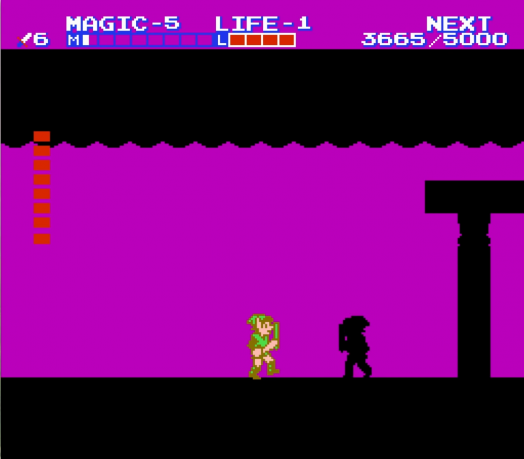
In The Adventure of Link, Link must fight himself in the game’s final test.
The TV series isn’t shy about including references to Zelda II: The Adventure of Link, with enemies such as the Moby, the Lowder, and Deelers appearing in previous episodes. Based on this, I’m baffled that they never introduced Link’s Shadow.
In Zelda II, Link’s Shadow is Link’s dark doppelganger, protecting the Triforce of Courage in the Great Palace. He is the final boss of Zelda II, and by far Link’s most difficult challenge.
Since the writers arrived at a premise involving an evil clone, it seems so strange that they let such a perfect opportunity slip by. They could still have kept Zelda’s clone in the episode, of course, as a partner for Link’s Shadow and an expansion of the concept.
In the actual episode, Zelda’s clone can order Moblins around. Initially, this makes her seem like she is a notable threat and an authority figure among Ganon’s minions, but she never engages in any actual combat. In fact, after she is exposed, Zelda takes her down with a single zap from the Crissword, resulting in a rather anticlimactic ending.
Official artwork of Link’s Shadow, courtesy of Zelda Wiki.
In Zelda II, however, Link’s Shadow is able to go toe-to-toe with the real Link. I would have loved to have seen a proper fight between the heroes and their evil duplicates. Since the previous episode established Zelda’s magical abilities, there could have been a spell-casting face-off between the princesses, while the Links engage in a symmetrical sword fight.
Imperfect impostor
Zelda’s clone asks Link if he likes her “new look.”
I feel that there is a lot of untapped potential in the concept of “Doppelganger,” but I also realize I may be asking too much from a cartoon with a 15-minute runtime (though a two-parter could have shaken up the series in an interesting way). In any case, there are still some aspects of this episode worthy of appreciation.
Cynthia Preston, the voice of Zelda, also voices Zelda’s evil counterpart in this episode. She does a fantastic job of putting a darker spin on the character, giving a convincing performance of an angry, malicious, and deceptive version of the princess.
The Underworld appears incredibly vast and labyrinthine in this episode with endless stairs, twisting paths, and a confusing amount of doors everywhere. It makes for a very enjoyable chase sequence when Zelda’s clone runs away with the Triforce.
This episode could have been so much more, but, judging it on what it does offer, it’s still an entertaining ride.
At the very beginning of the episode, before the Moblins attack, Link is whistling the Super Mario Bros. theme while training. It’s a fun little Easter egg and made me wish there were more Nintendo references like this littered across the series.
We also get another hint of Zelda’s feelings for Link at the very end. When our heroes are done defeating the doppelganger and escaping Ganon’s wrath, Zelda marches home angrily with Link walking awkwardly behind her. In an attempt to break the tension, Link cracks a joke about her trying on a black outfit. This just makes her even madder, implying that she is jealous of her clone kissing Link.
This episode could have been so much more, but, judging it on what it does offer, it’s still an entertaining ride.
Reece Heather
Reece is the former leading news editor and columns editor at Zelda Universe, and is the greatest video game journalist in the history of video game journalism. He recently won an award for "World's Most Influential Video Game Critic," but had to decline his certificate as his ego is now too big for him to leave his front door.


 by Reece Heather on September 22, 2019