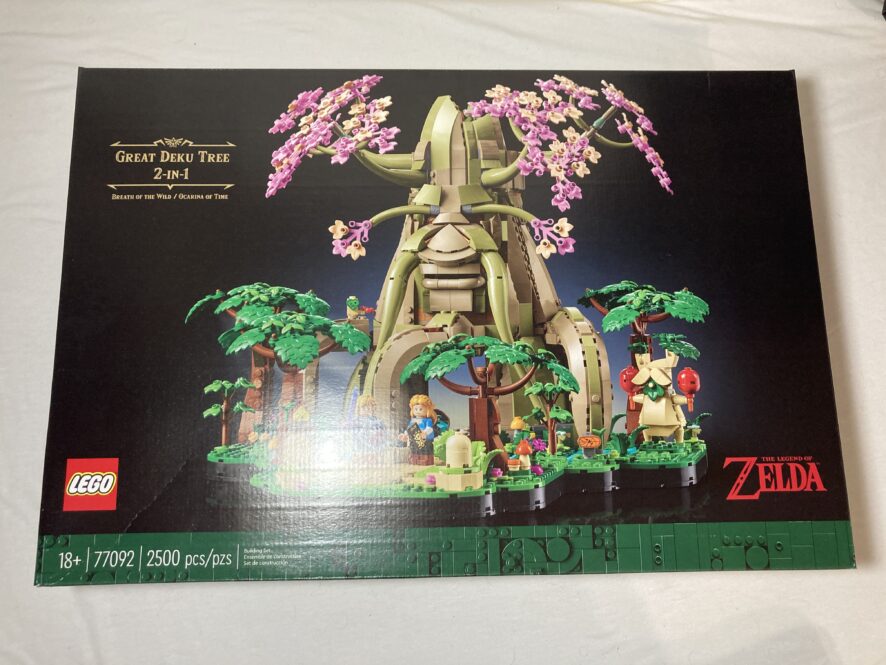
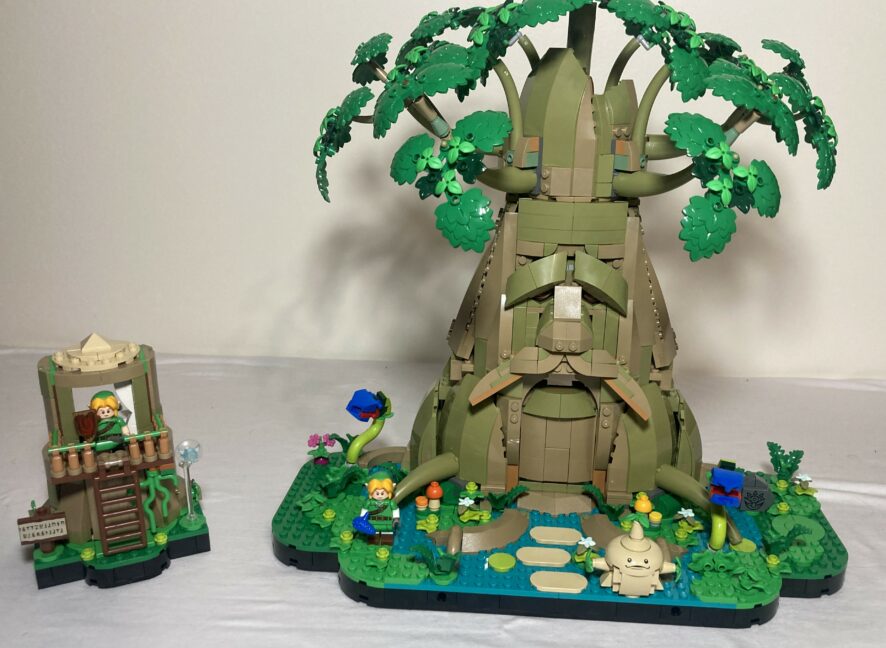
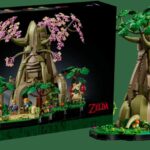
The Great Deku Tree 2-in-1, set 77092, released worldwide on September 1 for $299.99 USD. As the name makes obvious, this set is a “two for the price of one” deal. (Well, kind of. We’ll get to that.) Builders can choose to either build the version of the Deku Tree from Breath of the Wildor the original version from Ocarina of Time.
This is a Legend ofZelda set, but it’s also part of LEGO’s Icons line. This means it’s a high-end set intended primarily for adult collectors, and the design, exclusive parts, parts count, and price all reflect that. The set sounds like a dream for Zelda fans, but before investing time and money, there are important factors to review and consider.
The box and what’s inside
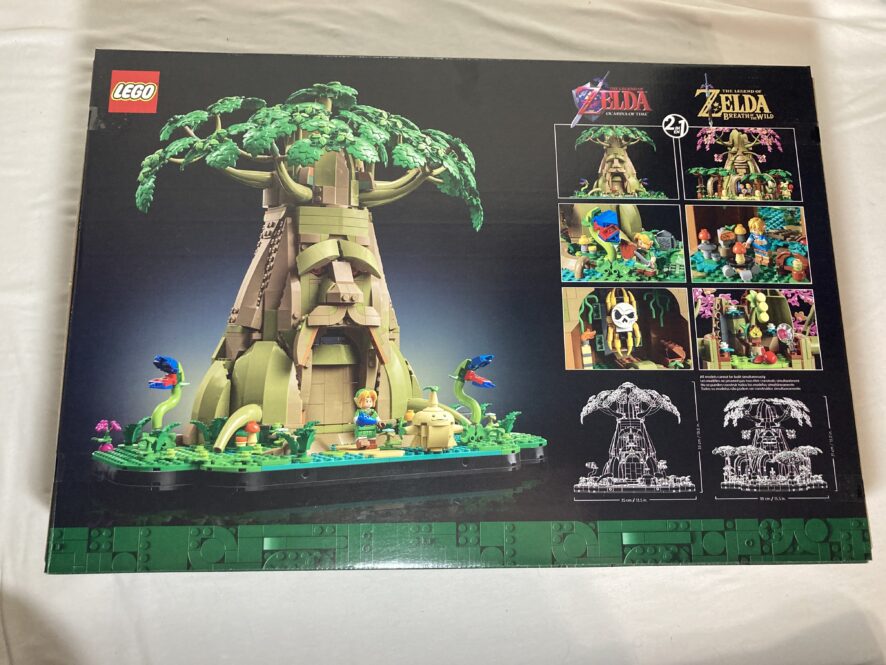
Naturally, this LEGO set includes all of the parts and instructions needed to complete the build, and they all come in a decorated and eye-catching box. The box has the usual black background aesthetics used for most Icons sets, but it also sports high-quality images of both versions of the build, the included minifigures, and a few close-up shots of each tree’s hidden features.
For many people, the LEGO boxes themselves are collector’s items, and this one is no exception. In fact, I’m one of those people, which is why I actually had to message LEGO for a replacement set when the first one they sent me arrived smashed. But I guess that’s a rant for another time.
Once you’re inside the LEGO box, you find LEGO pieces, to no surprise at all. The set’s 2,500 parts come in 24 bags and are marked for each step in the building process. I strongly recommend laying the bags out in order so you can find the ones you need quickly. It’s also worth noting that this set’s pieces still come in plastic bags instead of the long-awaited paper bags.
Instructions
Along with the parts comes the instructions, which is a hefty book with over 400 pages. And these are Icons instructions, so there’s more to find within its pages than the steps. The first few pages are dedicated to exploring the overview and history of the Zelda series, the specifics of Ocarina of Time and Breath of the Wild, and profiles of the four minifig characters. From reading these opening pages, you can find a clear understanding of how much detail and respect for the games was put into this set.
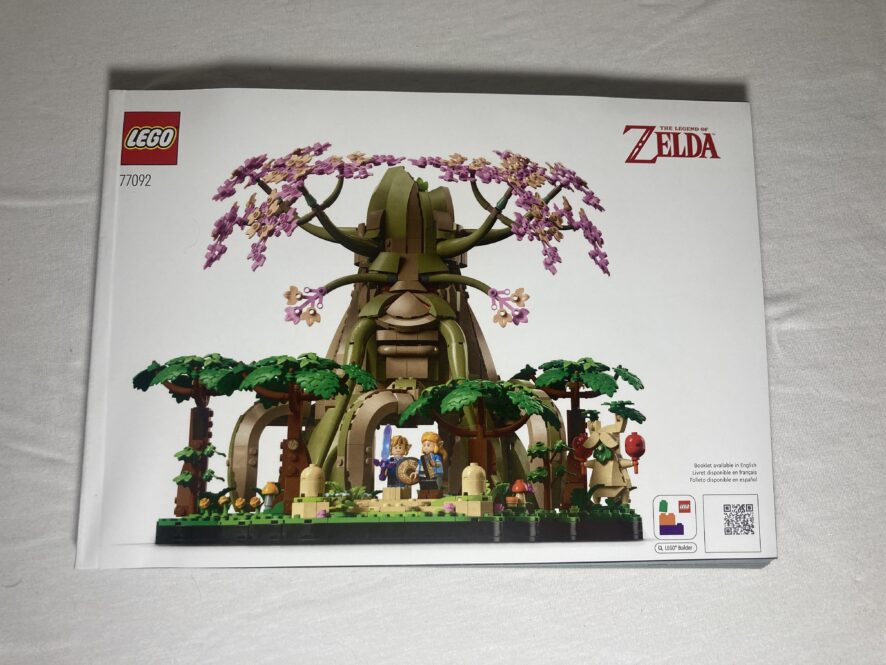
The front of the instructions feature the Breath of the Wild version of the Deku Tree.
And the Zelda trivia doesn’t stop there. As you go through the instructions, you’ll find paragraphs explaining the easter eggs used throughout the build. For example, on page 29, you’ll find a short bio for the fairy Navi as you place her in Link’s Kokiri home. They include these fun facts for even the smallest of inclusions, like the Silent Princess, Razorshroom, and other plants from Breath of the Wild.
With this being a 2-in-1 set, the instructions are a bit complex. You first build Link’s Kokiri home, and then the pedestal from Breath of the Wild where the Master Sword rests. You start on the main build of the tree after that.
Once you reach a certain point with the build, the instructions prompt you to choose which version of the tree you want to complete. You’ll skip to page 158 to build the Breath of the Wild verison, or you’ll skip to page 297 for the Ocarina of Time version.
Overall, the instructions themselves are very good and easy to understand, as you should expect from any LEGO set. The only exceptions I noticed came when building the leaves and flowers that go on top of the tree. Those being so closely clustered together made it tricky to see exactly where each leaf, flower, and branch connected.
The Small Builds
As I mentioned earlier, the first things you build are Young Link’s house and the Master Sword’s resting place. This is nice, because it means their parts aren’t meant for either version of the tree, so you can build them and keep them intact.
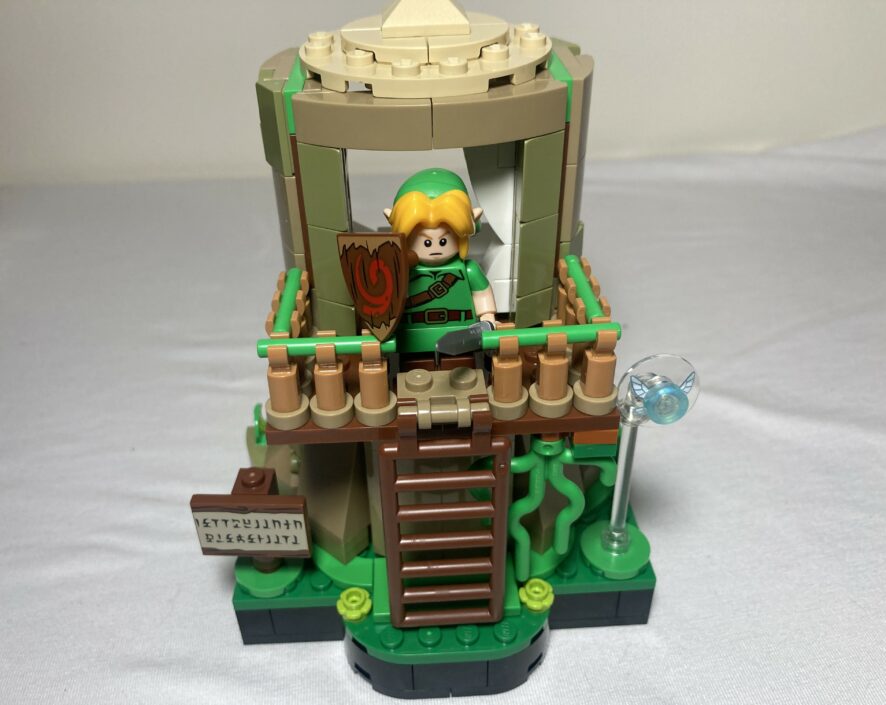
Young Link’s house
Link’s house is a small and simple build, but it captures the essence of the house perfectly. It has the interior, complete with the bed Navi finds Link sleeping in at the start of Ocarina of Time. The sign out front is the same as the one from the game, spelling out “Link’s House” in Hylian text. The back of the house has a secret compartment for storing a crate. In this crate, you can store all sorts of items from Link’s adventure.
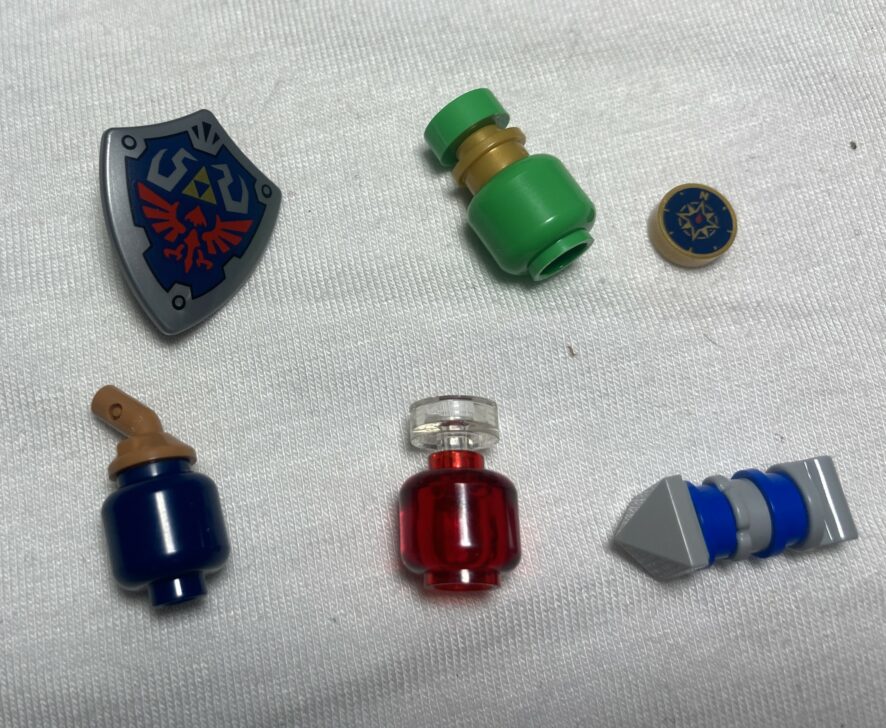
Here’s a full list of everything you find:
Magic Jar
Red Potion
Bomb
Compass
Hookshot
Hylian Shield
Each item is an optional accessory for the Link minifigs, allowing for customization and an element of play with the set. After all, a Zelda set wouldn’t be complete without all of the items Link inexplicably has on him at all times.
Last, there’s a new 2×2 trans-clear dish with a print of Navi on it. It’s a small piece, but it’s perfect for representing Link’s loyal, though often annoying, companion.
In all, Link’s house is a great side build to set next to the tree. Honestly, it would be a perfect set on its own, and LEGO should consider selling it individually next year to give people another way to obtain it.
The Master Sword’s resting place
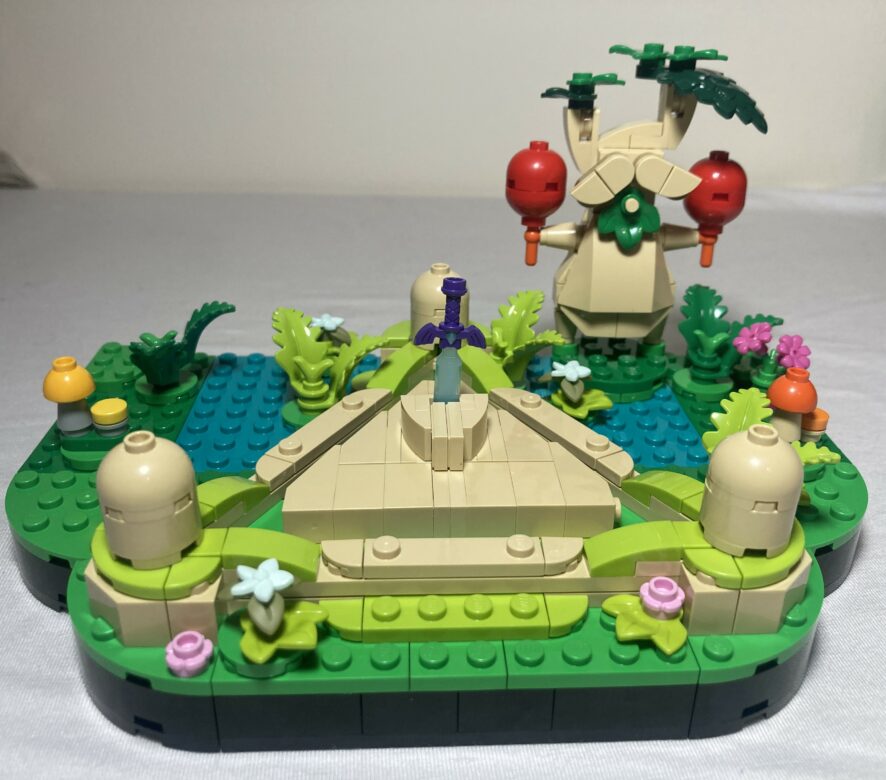
The stage and pedestal build is next, and while it wouldn’t be as fun as an individual set, it’s still a great inclusion as a standalone side build. You could look at it as a prologue of sorts to the main build, as it’s meant to connect to the Breath of the Wild version of the tree and uses the same aesthetic details and color patterns.
The various shades of green paired with the tan parts for the platform evoke the forest scene we remember from the game, and the plant builds give it a bit of life. The Master Sword can even rest in a slot you build into the center of the platform.
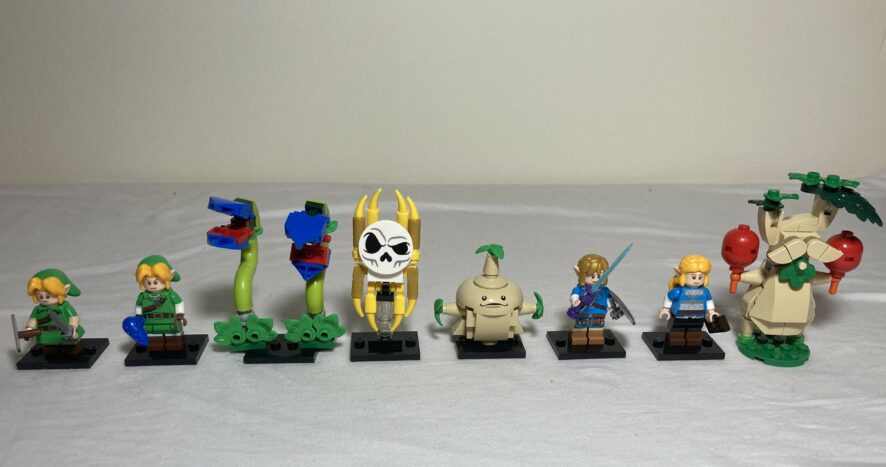
The whole platform is great, but the best part is probably the brick-built Hetsu. This design has great parts usage that produces a very accurate depiction of the character, and the stand you build him on allows you to place him on different sections of the final build. Plus, his maracas have loose 1×1 round plates in them, so you can shake him to make him play his music. And, of course, those round plates are gold to match the golden color of the Korok Seeds. That’s dedication to detail.
The Ocarina of Time Deku Tree
Overall, the build experience for the Ocarina of Time version of the tree is a pleasant one, with the vast majority of the steps being clear and easy to follow. The only issues I dealt with were reaching into the back of the tree with your adult-sized hands and the repetitive nature of building the tree’s branches and foliage. But those are modest low points in an overall fun build.
That all said, there is one catch that occurs with both sets of instructions. At certain points, the instructions prompt you to open multiple bags at once to continue the build. Both builds share all of the parts, but they don’t use them at the exact same steps. The only way around this was to skip to certain bag numbers.
For example, you start the Ocarina of Time build by opening bags 10, 14, and 23 together. This isn’t horrible, but it does make it somewhat frustrating when you have to deal with the contents of all three bags simultaneously. And while you can keep the parts separated from each other, the instructions won’t tell you which bag you’ll be pulling each part from. This can lead to situations where you need multiple copies of a specific part, but you need to pull them from multiple bags. Your best bet is to sort the contents of all three bags by size or color and take your time building. Fortunately, the combining of bags only happens a couple of times throughout the entire process.
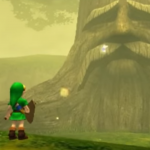
Once the Deku Tree is built, there’s a lot to see and do with the design. The facial features for the tree look amazing and are the first things you’ll recognize as belonging to the Deku Tree from Ocarina of Time. The wide nose, thick eyebrows, and Mario-caliber mustache tell you this is Link’s beloved surrogate father. And the face is expressive too, reflecting the stoic-yet-gentle look the Deku Tree has in the game.
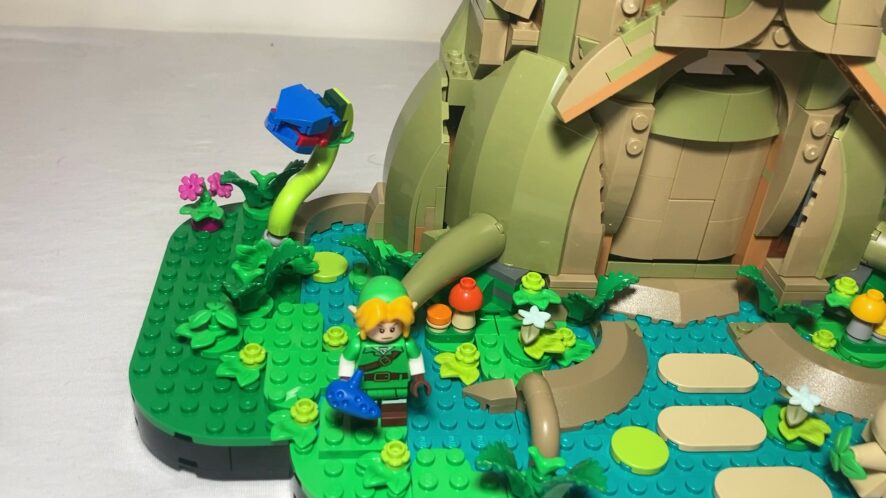
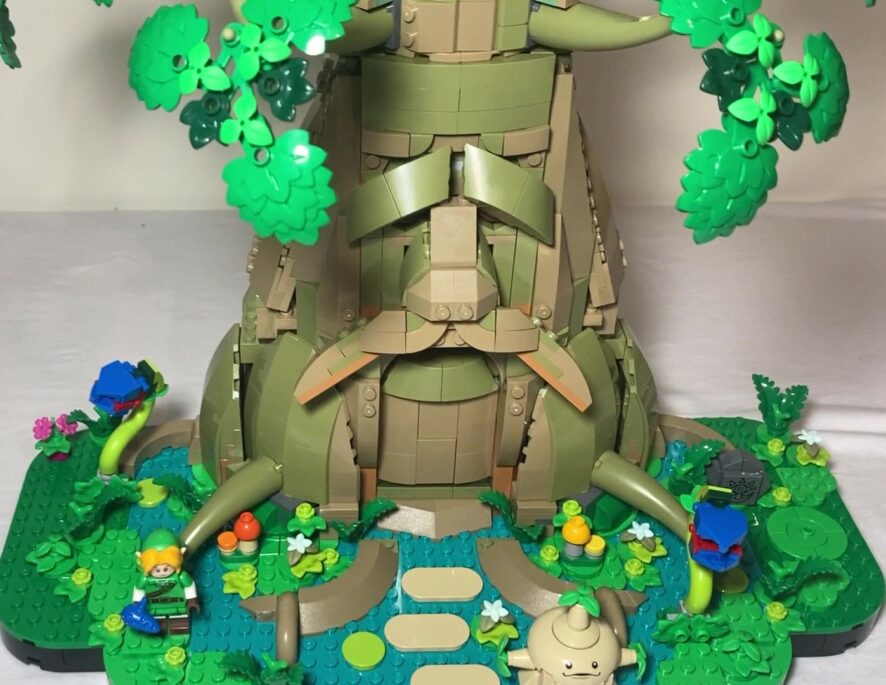
On the ground surrounding the tree, you have two Deku Babas with poseable jaws, the Deku Sprout that Link meets after clearing the Forest Temple, and a Gossip Stone. Each is positioned around the front of the tree, which allows them to bring a lot of life and energy to the scene.
The sides of the tree have references too, though these are hidden. Each side at the base of the tree has a hidden panel. If you pull these open, you’ll find two stone plaques. One holds the Fairy Bow and sports references to the Fire, Ice, and Light Arrows. The other references the notes used to play “Saria’s Song” on the ocarina.
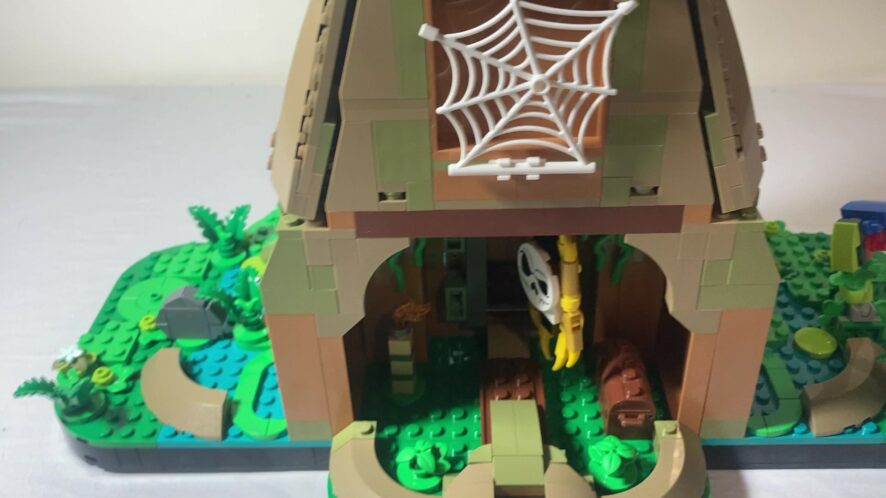
The back of the tree has fewer details, but it is where you find the great callbacks to the game’s first dungeon, which, as all Ocarina of Time fans fondly remember, is found within the Deku Tree. There’s a lit torch (a reference to the dungeon’s puzzle that requires the player to light multiple torches), a chest with the Fairy Slingshot inside, and a minifig-scale Skulltula dangling from the ceiling. It’s not a large section, but I love that they made the effort to highlight this essential aspect of the Great Deku Tree.
References and details aside, this is a LEGO set, so that means there should be at least a couple of play features, and this version of the tree has a few. The first and most impressive one is that you can open the Deku Tree’s mouth the same way he does in the game to grant Link access to the dungeon. You build a sliding mechanic into the back of the tree that lets you raise and lower the mouth. It was a memorable moment from the game, so it’s great to see it come to life in this set.
And the mouth leads directly to the set’s second play feature. Just past the entrance into the dungeon is the hiding spot for the Skulltula, which dangles from a string piece, which is in turn attached to a rotating gear piece. By moving a piece on the back of the tree, you can make the gear spin and drop the Skulltula to imitate how they ambush Link in the game. The play features are modest, but they’re novel and embody the game’s emphasis on story and gameplay moments.
Unfortunate shortcomings
As great as the build is, I did have a number of issues with its design. After I was done building the tree, it was clear this iteration was the “B” model of the set, with the Breath of the Wild version being the “A” model. Much of the exterior, both the tree and the floor, use the design styles and details from the later game. The most noticeable is probably the dark turquoise plates used to represent a watery ground, which wasn’t present in Ocarina of Time. The water is meant for the Breath of the Wild build, and we are simply meant to ignore it for this one.
And while this might sound nitpicky, I do wish the designers would have done more tochange the flora surrounding the tree. They add a few extra leaf pieces and the Deku Babas, but the Silent Princesses, mushrooms, and Hearty Radishes look out of place for a build that is supposed to be from Ocarina of Time. The Deku Tree sitting on top of a layout that doesn’t belong to him makes the whole thing look repurposed rather than unique from the ground up.
The appearance of plants from Breath of the Wild in a Ocarina of Time setting is somewhat offputting.
The biggest problems I had, however, were with the tree itself. Aside from the face and the leaves being green, this tree still looks mostly like the Breath of the Wild version. What’s hardest for me to ignore are the dimensions. The roots are not nearly big enough. In the game and official artwork, his roots extend as far as his canopy and take up most of the space around him. I understand that this set couldn’t exactly match what we see from the game, but the small approximations it did give us look awkward.
Going up the tree, the more sloping, conical shape of the trunk matches the Breath of the Wild version instead of emulating the thicker, evenly proportioned trunk from Ocarina of Time. The grade wouldn’t have been as noticeable if the roots had extended more.
And at the top, leaves simply aren’t covering the elderly tree’s dome in a convincing way. Now, for most LEGO sets, we know we can’t expect full coverage. The cost and build experience would suffer dramatically if they went overboard with it. There are enough leaves here, but their positions aren’t great.
The best way to describe the canopy is to say the Deku Tree looks like a balding man who got a bad haircut and can no longer do a convincing comb-over.
The the wide-open spot in the front is the biggest issue.
Sadly, and going back to the idea of this being the “B” model, the awkward placement of the leaves is due to the design starting with the Breath of the Wild Deku Tree. The branches stem from the same places on that version, but they work for that design. Here, they needed to make the branch placement from the Breath of the Wild tree work while also adding in a few smaller branches to do their best to fill it out.
This Ocarina of Time Great Deku Tree is a blast to build, and any Zelda fan would love all of the details packed into it. It’s just unfortunate that for a deluxe set like this, this design requires a number of compromises to make it work.
The Breath of the Wild Deku Tree
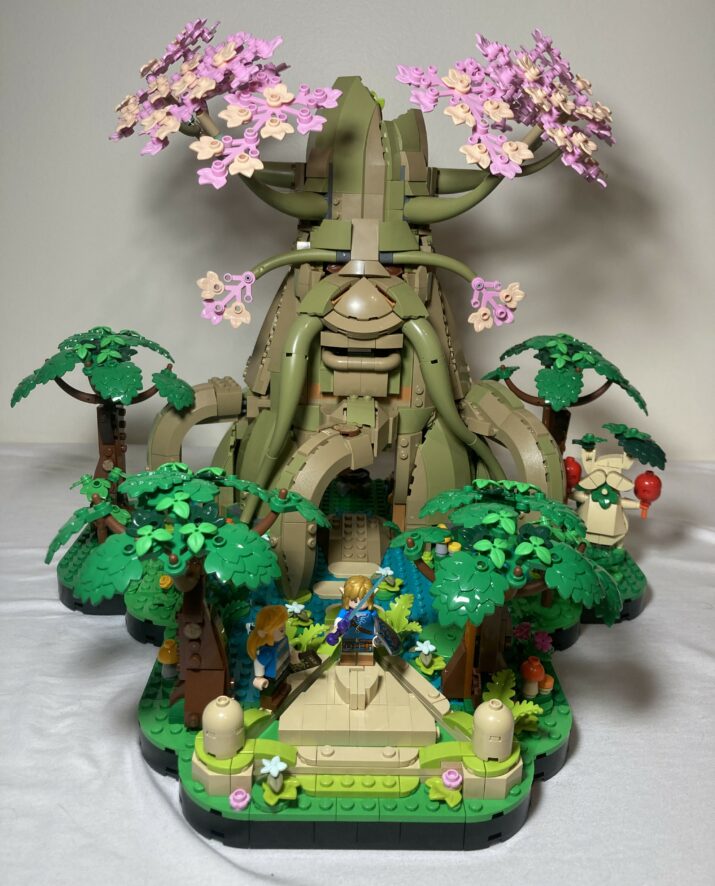
Yes, for the builds, I saved the best for last. The Great Deku Tree from Breath of the Wild is undeniably the star of the set and makes the most of the parts included.
For the building process, it’s mostly the same as the Ocarina of Time one, though there is more use of Technic pieces to create the moving play features. It’s not too terrible, but if you’re like me and prefer not to touch Technic sets, the steps when you’re using those parts will definitely make the entire process feel drawn out. Creation of the leaves is equally tedious at the leaves for the other build, but that’s to be expected. Just pretend that you have max Stamina Wheels and have at it.
The Technic parts are all worth it, because they’re what make the Deku Tree’s mouth and eyebrows poseable. It’s a clever and amusing mechanic that allows you to replicate his expressive nature from the game.
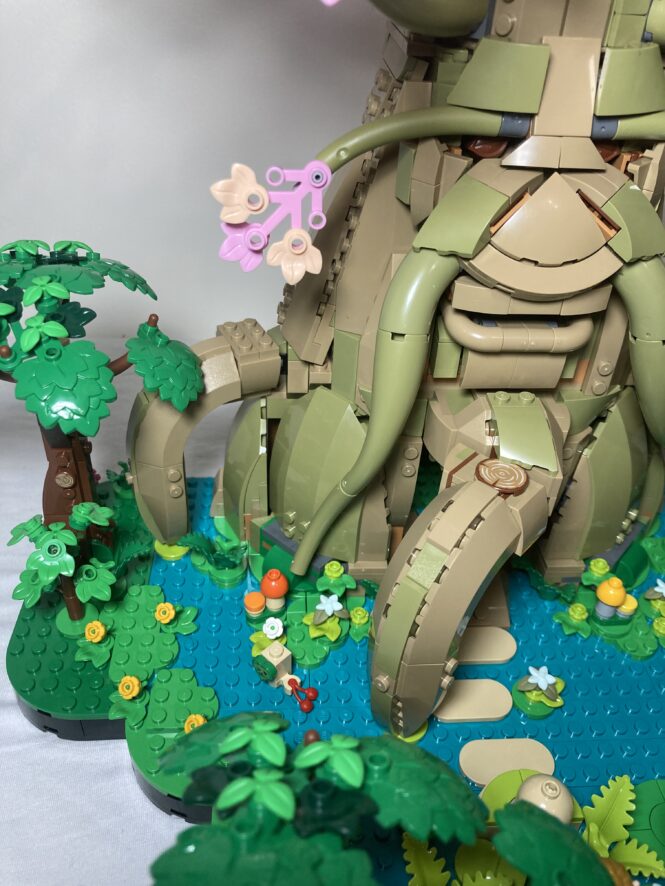
From start to finish, the build is authentic to the wise old tree that guards over the Koroks and the Master Sword. The shaping of the trunk and roots, surrounding floral details, color schemes, facial structure, and interior all work together to create what is essentially a LEGO-fied monument to the character and the game he comes from.
Starting at the bottom, the base that both trees share was explicitly designed for this one, and it connects perfectly with the Master Sword platform build. Simply slide the Technic axles into the ports on the front of the tree base to bring the whole look together. This turns an already sizable diorama into a sprawling layout.
With everything in place, you can start to appreciate the full scene. You’ll see various items, such as mushrooms, bird eggs, Silent Princess flowers, and acorns on the ground and in the smaller trees that surround the Great Deku Tree. You’ll also spot a friendly Korok, which is cleverly built using only a couple of parts and printed tile for the face. Finding Koroks is a staple of Breath of the Wild, so it’s no surprise they’re hiding in this set too.
“Yahaha! You found me!”
As with the other build, you can open the side panels at the bottom of the tree to find hidden references. This time, one side houses two podiums that hold copies of the spherical and cubed Remote Bombs, and the other side hides a Sheikah Slate Terminal. You can leave the terminal empty or you can set the Sheikah Slate accessory that the Zelda minifig carries on it.
The exterior of the Great Deku Tree is magnificent, to put it simply. The parts usage and design makes him look almost sculpted, especially in his large, raised roots and face. While I do think the face looks a bit better on the Ocarina of Time tree, this one is still good and instantly recognizable.
At the top, the limbs and leaves are as sparse as the other version, but it works much better here. The pink leaves of this build and the character in the game are inspired by cherry blossoms and match their very light tones. That less dense color scheme makes the sparseness less glaring and allows everything to blend more evenly.
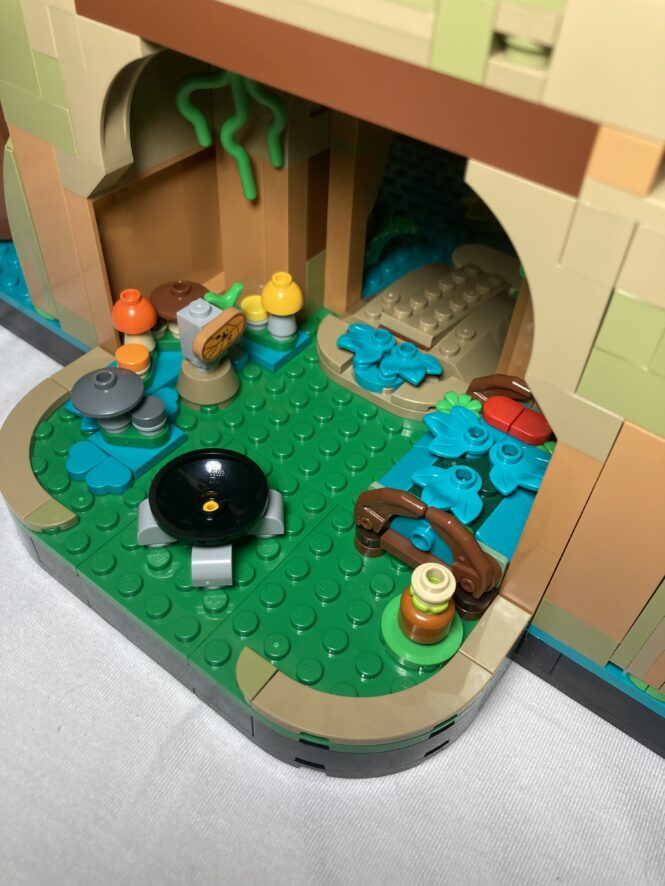
The tree’s interior lacks the action elements of the other build, but has many more details. The bottom floor is a reference to the lower portion of the tree’s interior in the game, featuring a small shop, a fireplace for cooking, and a bed for Link to rest in. You’ll also find another Korok in there, minding the store. It’s a fun and well-thought-out nod to the charming and cozy part of the tree that many Koroks call home.
You’ll find the last detail at the top of the tree. This is the home of Walton, a Korok who tests Link using riddles, as explained in the set’s instructions on page 274:
This Korok, found on top of the Great Deku’s head,offers the riddle, “Small, red, round, sweet.” The answer is found in this build.
If there was a spot on the set where the designer’s could fit a worthwhile detail, they used it for that exact purpose. This is a build you can admire repeatedly and from all angles.
While it’s a shame they had to make concessions with the Ocarina of Time build, I do believe they made the right call by letting one version be the dominant one rather than making both versions compromise in some way. And if there’s going to be a “main” tree, let’s face it, they were always going to pick the one from the best-selling game in the franchise. I don’t believe a Zelda set would have ever been made without Breath of the Wild’s wide appeal, so we need to give the game its due credit.
The Minifigs
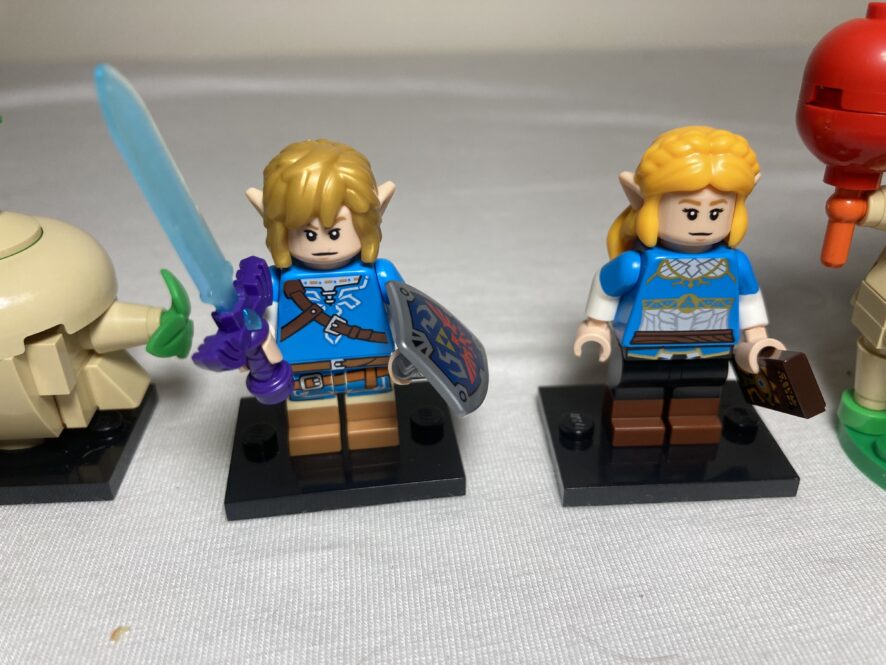
For many people, the most exciting thing about this set is the inclusion of the new and exclusive minifigures, and the excitement is understandable. These minifigs are fantastic and match the quality of the set’s overall design.
Each figure sports what have become the two most-loved attributes by LEGO fans: custom prints and dual-molded parts. Each figure has a dual-molded headpiece and a dual-molded leg assembly. For the Ocarina of Time Links, they share the very nice triple-molded piece that makes their hat, hair, and ears. The Breath of the Wild Link has his more golden-colored hair with ears, and Zelda has a similar part. The legs are colored to match their pants and footwear and also sport custom prints.
The prints on the heads and torsos are detailed and vibrant. This is important, and very appreciated. For years, LEGO has had quality issues with the opacity of their minifig parts, especially when it came to white prints on darker plastics. But for these figures, I’m thrilled to say all of the colors are solid and clean. I’m probably most impressed by Zelda’s torso, which perfectly replicates the ornate design seen in the game.
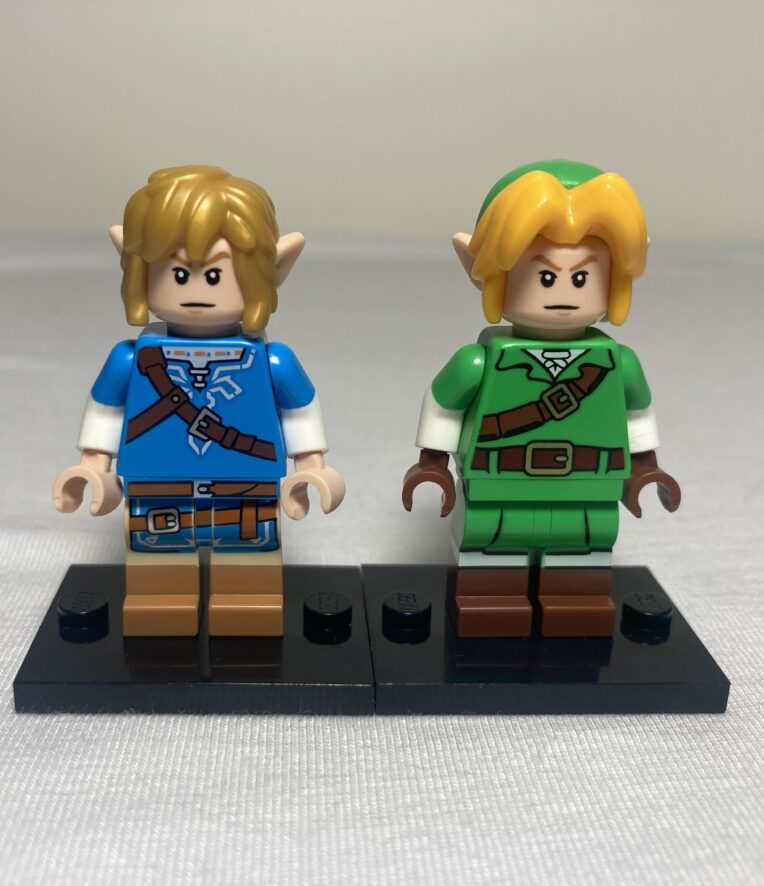
The only thing I can say about the minfigs that could be considered a drawback is that both adult versions of Link share the same design for the face. They might be incarnations of the same character, but they’re different enough to make the argument they should have different designs. I personally don’t mind that much, because having the same face makes it easy to say the Ocarina of Time Link is actually the Breath of the Wild Link wearing the Hero of Time armor set.
They could be twins.
Price and Value
With all that this set is and offers, we have to wonder if it’s truly worth the $300 price tag. Unfortunately, there’s no one-size-fits-all answer to that question. I can only give my advice depending on what type of fan and consumer you might be.
For the LEGO and Zelda Fanatics
Now, for me, yes, this was an absolute must-buy set day one. If there’s anything I love as much as Zelda, it’s LEGO. I’ve wanted a Zelda set for years, and I make my own custom Zelda MoCs (A LEGO fandom term that stands for “my own creation”) all the time. The set is expensive, but for me, the subjective value is of equal weight to the objective value.
If you love Zelda and LEGO as much as I do, I can’t recommend this set enough, even at the regular price. A lot of people have remarked about the price, saying it’s more than a set this size should be. And I agree it’s more than you’d normally see for a set like this, but not by as much as people think. After factoring in all of the pieces, the design work, the new and exclusive parts, and licensing fees, I don’t think the price is far off. To me, the ideal price would be $279.99 USD. So, if you’re passionate about Zelda, you would love to have a set like this, and you have the means to make the purchase, the extra $20 isn’t much of a hurdle.
The main issue for Zelda fans would be if they were only interested in the Ocarina of Time version of the tree and feel dissuaded by notes I shared about that build. If that sounds like you, you might want to reconsider buying the set at full price. That version of the tree isn’t a letdown or anything, but if you’re very particular or picky, it might bother you that your Deku Tree plays second fiddle to the Breath of the Wild Deku Tree.
For the Zelda Fanatics
If you’re a Zelda fan but aren’t much into LEGO, you won’t get as much enjoyment out of this set for its standard price. This isn’t something you buy simply because it’s Zelda. While this set is currently a LEGO exclusive, meaning it’s only available either from their website or physical LEGO stores, that might change in the future, and sales do happen.
In terms of fun and quality, Zelda fans can’t do much better than a set like this. But if you don’t think you’re going to absolutely love it, then wait for a sale or pass on it.
For the LEGO Fanatics
If you’re a LEGO fan who doesn’t play Zelda games and is simply looking for a fun build, this set probably isn’t for you, especially at the original price. I don’t believe the set is drastically overpriced, but I do know that it’s expensive. If you’re looking for a fantasy-style build, there are plenty of other sets you can buy that will give you more variety than references to video games you don’t play.
Verdict
If this set was a video game, it would be Breath of the Wild, and I would rate it similarly. It’s well made, revolutionary, and has a lot to love about it. But, for some longtime fans, it might not be what they’re looking for.
Zac Pricener
Zac Pricener has been an avid Zelda fan for twenty years. The series has been a source of creative inspiration for him and fueled his desire to become a writer. That desire to write in turn led him to now serve as the Features Manager, Assistant Columns Manager, and Assistant News Manger for Zelda Universe.


 by Zac Pricener on September 16, 2024