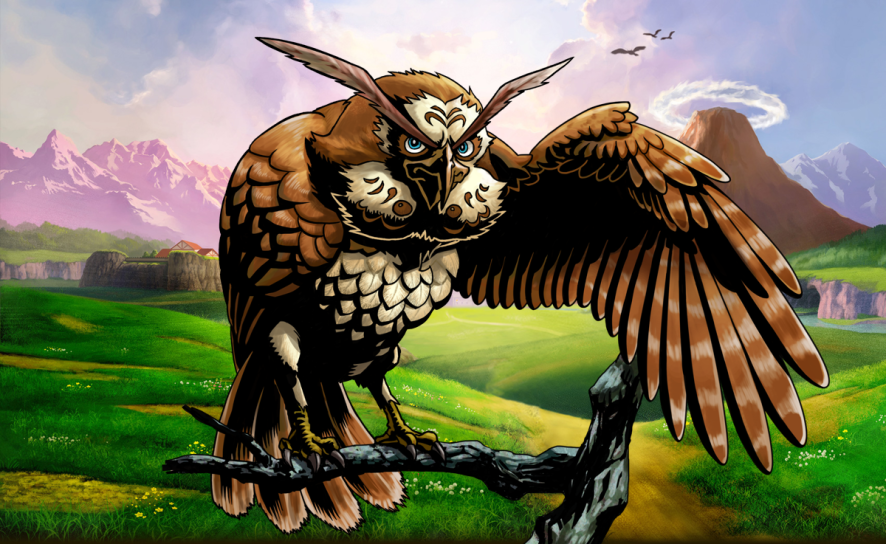
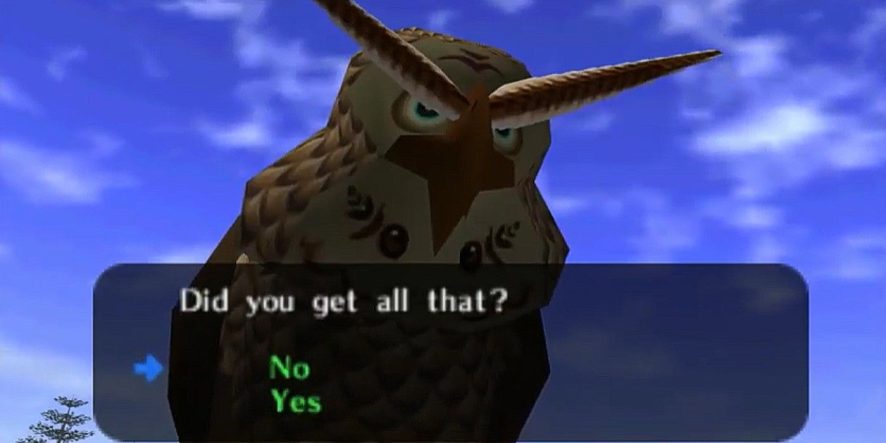
It always fascinates me the ways in which game designers approach tutorials and information delivery. It’s almost always very awkward, grinding gameplay to a halt to show a few lines of text that detail menu navigation and the functionality of the A-button, among other mechanics. This is handled rather charmfully in Ocarina of Time, in a way that sutures the game’s fiction and mechanics: Kaepora Gaebora, the didactic owl who follows Link throughout his childhood adventures, simultaneously directs the young hero on his quest, and walks the player through opening the map interface.
But Gaebora is not restricted to the realm of solemn authority; he inverts his head mid-sentence, hoots cheerfully (sometimes smugly), and repeats himself if Link/the player isn’t paying attention. Like the owl himself, “Kaepora Gaebora’s Theme” balances a stately and playful tone, capturing both his wisdom and whimsy.
And then there’s whimsy. This is, of course, the musical theme for a rather absurd character: a gargantuan, talking, encouraging bird of prey. Much of the whimsical quality of Gaebora’s theme comes from its lilting rhythms. In the first half, the rhythms almost stumble into each successive beat, giving it a sort of lopsided charm. The second half of the theme—in a major key—pronounces the theme’s playful tone even more, evoking the lively Baroque-era bourée with its emphasis on dactyls (long-short-short rhythms) that bounce along.
Let’s start with wisdom first. One of the clearest features of “Kaepora Gaebora’s Theme” is the rigidity of its form. Each pair of measures composes a call-and-response phrase, every two pairs form a complete musical section, and each section is repeated once almost like Gaebora’s own repetitive speech. This regularity recalls the strict style of dance music from the Renaissance and Baroque periods with very clear patterns that guide dance steps. There is also something to be said about the call-and-response structure of the theme; for a character whose role is to instruct, the question-and-answer pattern in the music matches his didactic style neatly. Additionally, tying Gaebora—a manifestation of the ancient sage Rauru—to an old musical style, the music helps to assert his authority and ancient wisdom. All of this is especially evident in the first half of the theme, whose minor melody is carried by the bassoon.
Koji Kondo’s choice of instrumentation encapsulates all of this at the same time. The two instruments that carry the melodies of the theme’s first and second halves are both double reeds: bassoon and oboe, respectively. For centuries, double reed instruments have carried bucolic and rustic connotations, evoking the shepherd’s pipe and the pastoral landscape; the oboe in particular has been described as having an inherently pastoral character since at least the Baroque period. At the same time, since Haydn famously exploited it to insert fart jokes in his symphonies, the bassoon has been a vehicle for musical humor in everything from art music to film and TV scoring (this is especially clear in British television, where the bassoon’s pastoral and comic associations go hand-in-hand). In choosing these two instruments, Kondo writes Gaebora’s wisdom and whimsy into the theme’s timbre.
“Kaepora Gaebora’s Theme” is among the most characteristic pieces in the entire Zelda franchise. It perfectly captures Gaebora’s personality and role within Ocarina of Time, tying together ancient authority and playfulness.