Just like many before and after me, Ocarina of Time is one of the most influential Zelda games I have ever played. Regardless of what will come after it, I can never deny just how much it shaped how I see and experience a Zelda game. It’s almost as if it’s a sort of standard that all future titles will be undoubtedly compared to, whether I want to or not.
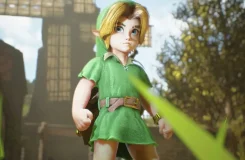
Despite the gripping story, the unforgettable soundtrack, and the revolutionary for its time gameplay, there will always be one element which influences me the most from this game. That element is Young Link.
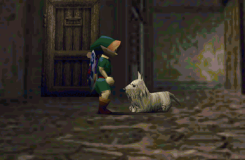
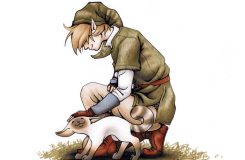
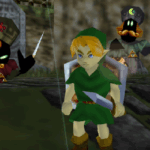
As Ocarina of Time came out in 1998 in the United States, I was seven years old around the time I played it. Ocarina of Time was the second Nintendo 64 game I had played up to that point; the first one being Super Mario 64. The Nintendo 64 was subsequently my first foray into the world of 3D gaming so everything was very fresh and new. Seeing Young Link for the first time, however, was almost like seeing a strange reflection of myself; a young child who was around my age.
I grew up being a very lonely child with no friends around my age. I dealt with being picked on and bullied for being a nerd, and with it, I became an outcast against my will. Young Link is an outcast as well, rejected amongst the Kokiri. At first it seems to be implied that he is one just because he doesn’t have a fairy companion like the others. Of course, we learn later that he’s also an outcast because he’s a Hylian and not a Kokiri, but I felt yet another connection to this character because of it.

Young Link is given a mission from the Great Deku Tree and is sent on his quest which will be far greater than he knows, but before he can leave the forest he is stopped by Mido, who accuses him of killing the Great Deku Tree. Mido has never liked Link, especially because of his friendship with Saria, but seeing that bullying happen in the game was almost too real for me as a child. I felt so strongly for Young Link because of what I’d been going through, and it only steeled my resolve to help him on his quest so that he could find something greater. More than anything, I wanted to be like his friend, helping him out in his time of need.
One aspect of Young Link that to this day stands out to me is how he is, in my opinion, the ultimate representation of courage. At such a young age, he’s flung into a very dangerous quest fraught with dangers and perils at every turn, fighting terrifying creatures and braving the lands and their hazards. Never once does he ever falter nor complain about his quest, however. He knows that it must be done and so he carries on, strong of will and strength in his heart on a quest that would probably break just about anyone. All this starts at just the age of nine.
This is an obvious motif from the game as most of us know Link is the representation of courage from the Triforce; it’s quite literally on his hand in fact. But even still, it stuck with me. I yearned in my life to be more like him where I could face all of my trials and tribulations with such strength. I am admittedly a major coward and this was, unsurprisingly, even more so the case when I was younger. Seeing Young Link experience all that he does and to do so without even the slightest word of defiance was very inspiring.
During his journey, Young Link learns many lessons and gains many friends. Darunia teaches him, if somewhat forcefully, the importance of camaraderie as is evidence by his decision to call him brother, as he helped the Goron’s get their food supply back. He saves Ruto from the stomach of their guardian deity Lord Jabu-Jabu and learns, again rather forcefully, an idea of love. It may be a very childish notion of love, which makes sense given Ruto and Young Link’s ages, but it is still an idea nonetheless.

Even though he meets all of these characters and friends, Young Link’s journey is arguably one of tragedy. When he finally obtains all the Spiritual Stones for his quest and pulls the Master Sword, he finds that he is too young to wield it, and is sealed in the Temple of Time until he comes of age to use it. This allows Ganondorf free reign to do whatever he pleases with seemingly no opposition, and Link is forced into a future where the bad guy wins. His friends are nowhere to be found, the world is in ruins, monsters roam the land, and Link is shoved into yet another quest, this one far more perilous and even hopeless than the previous.
However, Link yet again shows his courage and accepts the task knowing that it is, of course, what he must do. I also never really considered this as well, but in Young Link becoming an adult and being forced into the journey that he embarks on, he loses his childhood. Suddenly he’s an adult now and living in a dangerous world, making those choices while on the inside he’s still just a young kid. Even in Majora’s Mask, Young Link seems to have matured a lot by then; the journey alters who he is and his childhood is almost forcefully taken from him.
For a character who never speaks, there’s so much to talk about with Young Link. He’s a character who I go back and think of regularly because of the number of layers Nintendo managed to put into him despite him having no voice outside of grunts and groans. Not only that, but to me, Young Link was an inspiration to me as a child and even as an adult with his sense of duty and courage. Ocarina of Time and Young Link are both equally influential to me, and I wouldn’t be who I am today without either of them. For that, I will always be eternally grateful to both this game and the story of Link that it contains within.