Just about every popular video game series has a board game these days. Don’t believe me? Just check out Kickstarter, gamefound, or BoardGameGeek and type in one of your favorite series. Chances are, you’ll find it there. But for every Bloodborne, The Elder Scrolls, and Super Mario Bros. board games you’ll find, you’d be at an absolute loss to discover many based on The Legend of Zelda. And no, the bevy of usaopoly (Monopoly, Clue, Yahtzee) variants do not count. In fact, if you look for a board game based on the gameplay of the series, you’re really only left with this iteration published by Milton Bradley in 1988.
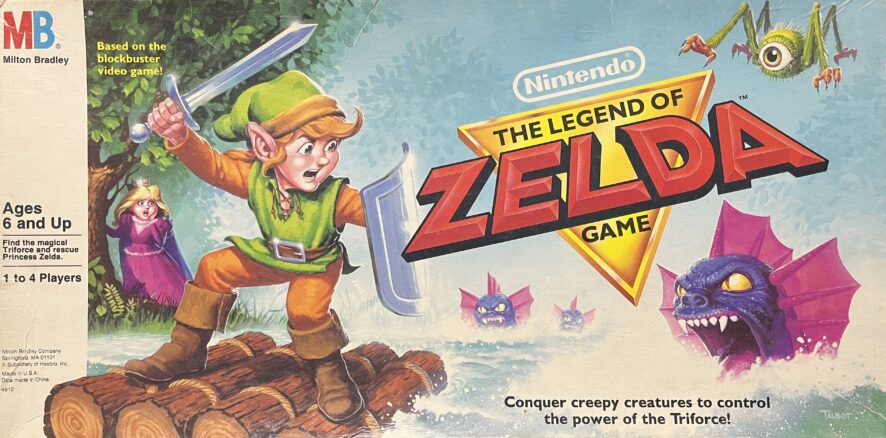
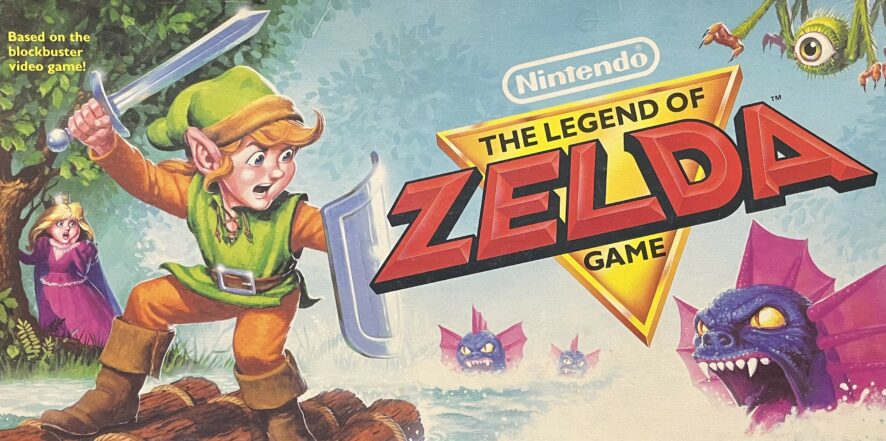
At first glance, the artwork on the box is surprisingly stunning. From what I can assume is an original painting from a house artist signed ‘Talbot’, we have Link armed with sword and shield, battling Zolas at sea (more on that in a minute). Aboard his trusty raft, he balances precariously while Princess Zelda watches on, aghast from the shoreline. Considering this work is based on the original The Legend of Zelda game, some design variations here are to be expected. Did they get the basics right? Sure, they did. Link is clad in green and appears elfish in look and stature (granted a little more Hobbit like, if you ask me), while carrying a generic sword and shield. The Zolas and Tektite are pretty on-brand for the game, as well. The only character that might seem a bit too generic is Zelda herself, as she seems to be your stereotypical design of a fairytale princess in distress.
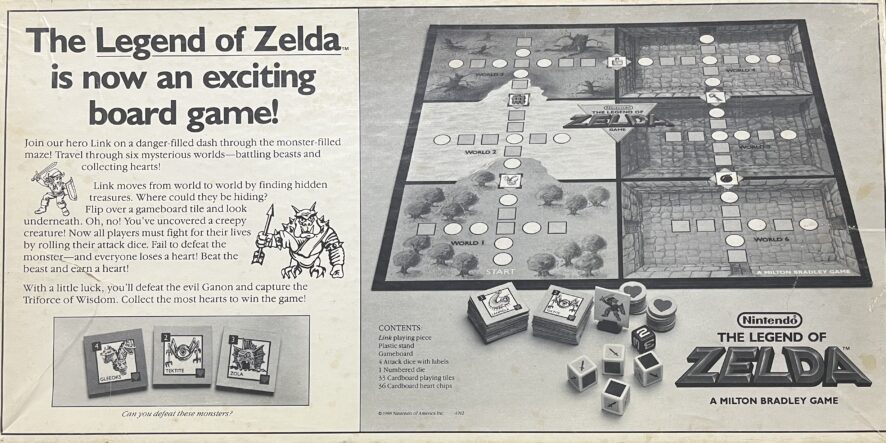
Moving to the back of the box, we find ourselves within the premise of the game. Link has to battle through six ‘mysterious’ worlds collecting hearts in an attempt to rescue Princess Zelda and win the Triforce of Wisdom. Honestly, it’s a pretty fair assessment of the original Zelda. Outside of the ‘collecting hearts to win’ bit, the idea of exploration and battling monsters is very accurate.
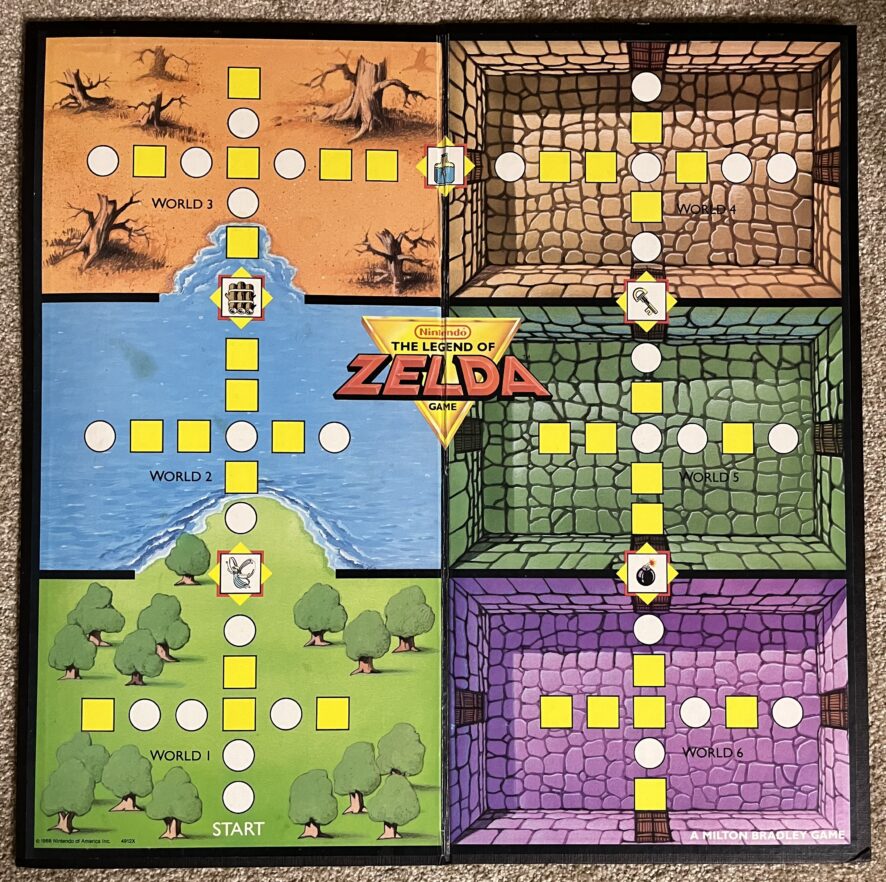
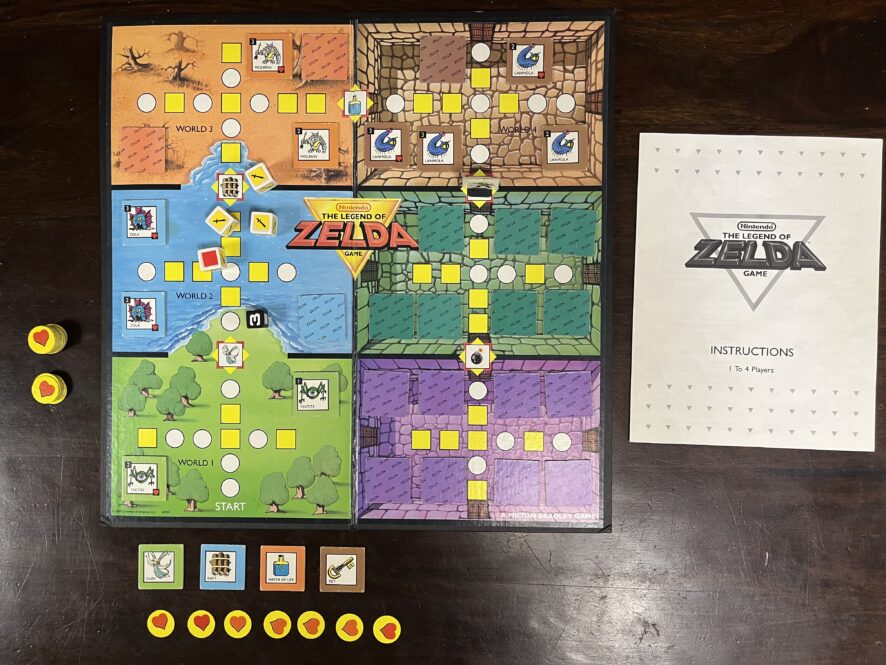
Now let’s take a look at what comes in the box itself. Starting with the game board, we start off similarly to the video game in a verdant forest called World 1. World 2 is based on a lake or sea theme, while World 3 portrays the dead woods/lost woods found in western Hyrule of the first game. Worlds 4-6 are different colored dungeons that mimic the nine dungeons hidden throughout the wilderness of Hyrule. Each world has white circle and yellow square spaces that are separated by a ‘magic’ entry space.
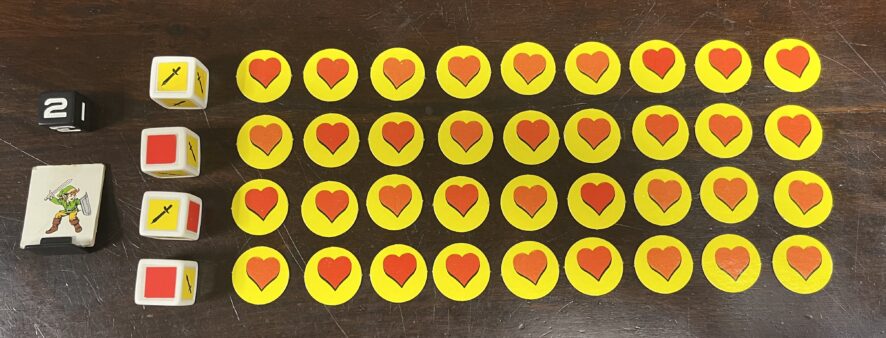
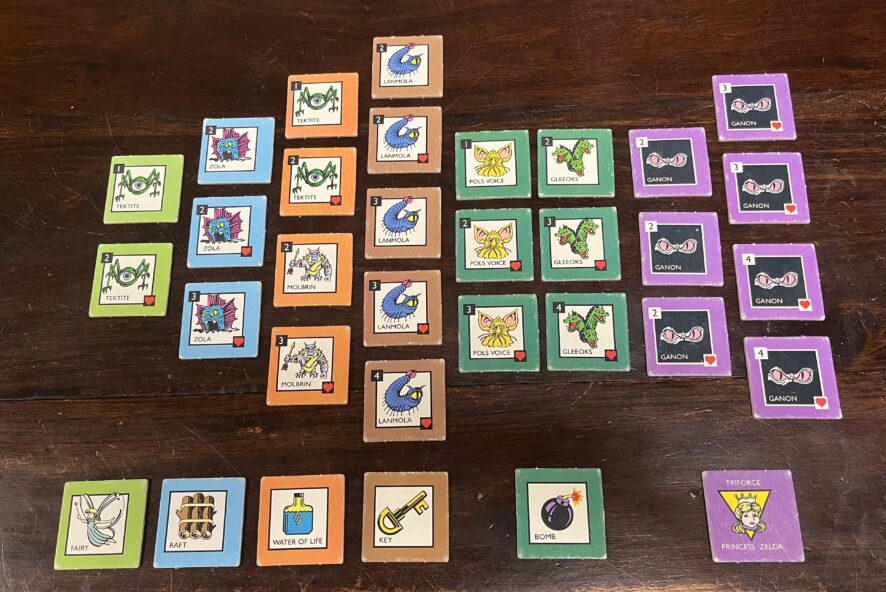
Next, we have the 36 ‘heart chips’ that double as your life and points to win the game or, if playing alone, to set a high score for others to beat. Of course, there is the Link playing piece, which is simple folded cardboard with a molded plastic stand (I personally would use this guy, as I preferred a left-handed Link). The game includes four attack dice (some assembly required), 1 numbered die, and finally 33 playing tiles which include all of the following:
- 27 Monster Tiles
- 4 Tektite (two variations)
- 3 Zola
- 2 Molbrin (their spelling, not mine)
- 5 Lanmola
- 3 Pols Voice
- 3 Gleeoks
- 7 Ganon
- 6 Magic Tiles
- Fairy, Raft, Water of Life, Key, Bomb, and Triforce/Princess Zelda
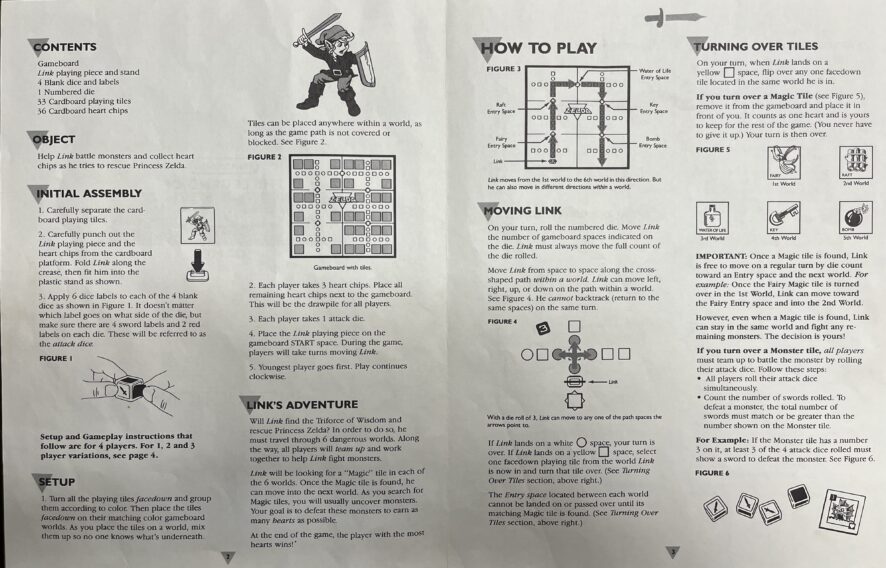
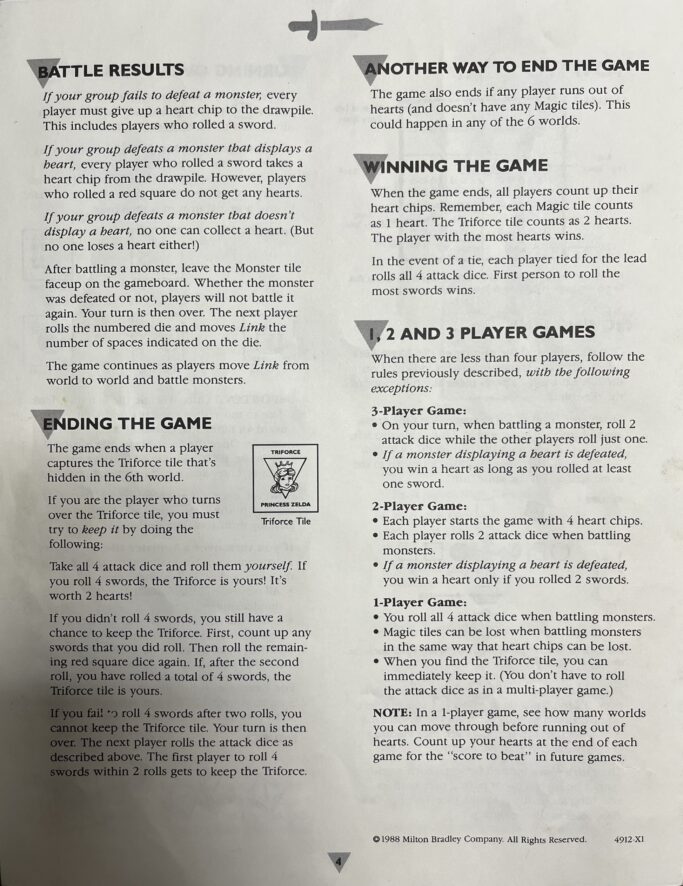
If you’re playing ‘multiplayer’, everyone will start with three heart ‘chips’ and take turns rolling the numbered die to move Link around. Each of the colored tiles for each corresponding world are shuffled and placed down in each area. Similar to The Adventure of Link, you only battle a monster when you land on a yellow square space, simulating the randomized encounters from that game. From there, each player rolls one of the attack dice in the hope that you roll enough swords to be greater than or equal to the number on the monster tile (dice rolls vary with the number of players). If your group is successful and the monster tile also had a heart icon, then every player that rolled a sword receives another heart chip. Likewise, if you fail the roll, then everyone loses a heart chip.
Gameplay will continue like this until someone uncovers the magic tile and the group is able to advance past the magic entry space into the next world. The player that reveals the magic tile keeps the tile and it is worth one heart. From there, the group chooses to move to the next world or attempt to fight any remaining monsters if there are more tiles still un-played.
The end game plays out with all players battling Ganon in World 6. Just as in previous worlds, everyone takes a turn moving through the dungeon until someone turns over the Triforce/Princess Zelda tile. However, unlike the other magic tiles, the player must then roll the dice to see if they are permitted to keep it. If they roll four swords on their first try, they keep it, and the tile is worth two hearts. If not, they can try again by rolling the remaining red square dice to see if they succeed. If they fail again, the next player has two turns to roll the dice and attempt to get four swords, and play continues until that happens.
Once finished, everybody counts up their heart chips and any magic tiles they have accumulated. Whoever has the most at the end, wins the game.
Okay, now that we’re through all of that, let’s break down some of the inconsistencies between this board game and the video game. Let’s remember this is based on the first game in the series and even Nintendo of America was pretty inconsistent in licensing agreements and their own marketing materials. Let’s give it a go, shall we?
- Link is right-handed and should be left-handed in this iteration.
- Unlike the other magic tiles, the Fairy tile is the only one that does not represent an item you can acquire in your inventory in the video game (Counting the Zelda tile as the Triforce here).
- Molbrin should be spelled Moblin (Credit where credit is due, though, as they have them brandishing an arrow and that’s what they appear to be throwing in the original game).
- Zola is actually not a mistake on the part of the board game, as this is what they were initially called in the video game manual due to a mistranslation. Modern gamers are probably more familiar with their current designation, River Zora.
I’d say not bad for early licensed video game merchandise from the late 80s.
I couldn’t really find an original price on this board game, but given the time period it probably ranged between $15-$20 in 1988. Current eBay prices (sold listings) are anywhere from $100-$300. This is one of those pieces that I would watch a YouTube review/play session about to get the gist and then move on. It’s definitely not worth the price of admission, unless you’re a die-hard merch enthusiast with plenty of savings.
Wrapping up, I will say I have pretty fond memories from playing this as a kid. We couldn’t afford an NES at the time so this was my fill in, but I honestly can’t remember who bought it for me. I usually only played the single player rules since my sister (who is four years older than me) wasn’t interested as she was focused on new hits from New Kids On The Block and her daily regiment of Aqua Net.