When writing your bullet-list for what makes a great Legend of Zelda dungeon, there’s a few obvious requirements: clever puzzles, story relevance, awesome aesthetics, and perhaps the maze-like experience of doubling back to unlock new areas. It probably should weave in some key thematic tones. A solid boss fight, surely. Honestly, what better way to introduce the Ancient Cistern?
The Ancient Cistern is an extremely popular dungeon from Skyward Sword, remembered most for the iconic thematic contrast between its individual levels. Visually and thematically, it’s a seriously good reward for what (at this point in the game) may feel like retracing old steps. After acquiring the Goddess Sword, Link is tasked with tempering the blade using the three Sacred Flames, each of which is guarded by a Dragon watching over the surface world. Hence, Link must travel back through the surface world and uncover more of its secrets.
This being the game that explains Hyrule’s beginnings, the conventions of the Three Golden Goddesses (Din, Nayru, and Farore) continuously pop up throughout the story. Named after the three goddesses, the main regions of the game are the Faron Woods, Eldin Volcano, and the Lanayru Desert. It’s revealed in the game’s second half that protecting these lands are three Dragons, bearing the same names as the regions themselves. The Dragon Faron is the one Link meets first – and, yikes, she isn’t doing too hot, due to some… plot shenigans. We all know that when the story needs a little push, Ghirahim, acting agent of Demise, will arrive to start a fight.
Luckily, Link is able to heal Faron’s wounds by retrieving a vial of Sacred Water from the Skyview Temple. In return, Faron reveals the location of Farore’s Flame, the first of the three Sacred Flames needed to craft what will eventually become the Master Sword. After she halts the flow of the Lake Floria waterfall, Link can enter the Ancient Cistern, a truly remarkable Skyward Sword dungeon.

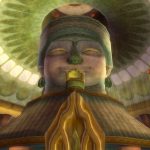
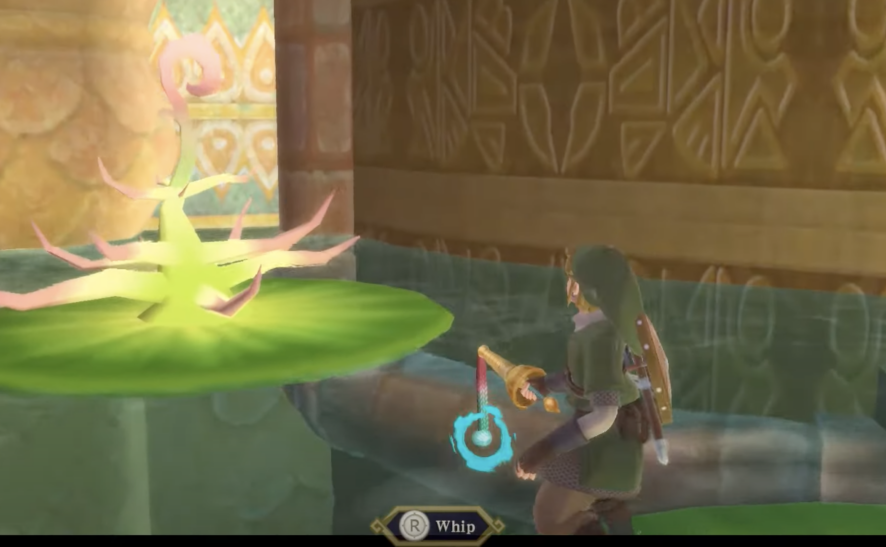
Entering the Ancient Cistern feels like unwrapping a sparkling treasure box. Amidst the lush Faron Woods, the Ancient Cistern feels like a lost temple of paradise. The primary area of the dungeon contains the collapsed torso of a giant statue reminiscent of the Buddha, surrounded by fresh water that flows from the open mouths of fish-head gargoyles. Alongside some smaller flowers, giant lily pads are spread across the pool’s surface. Whorls of climbable ivy creep up the cracked stone walls, allowing access to gates that lead to interwoven chambers beyond the cistern’s center. The player’s eye is drawn to the room’s high ceiling, where Furnixes flap around, on watch for any foreign entities… like Link, for example.
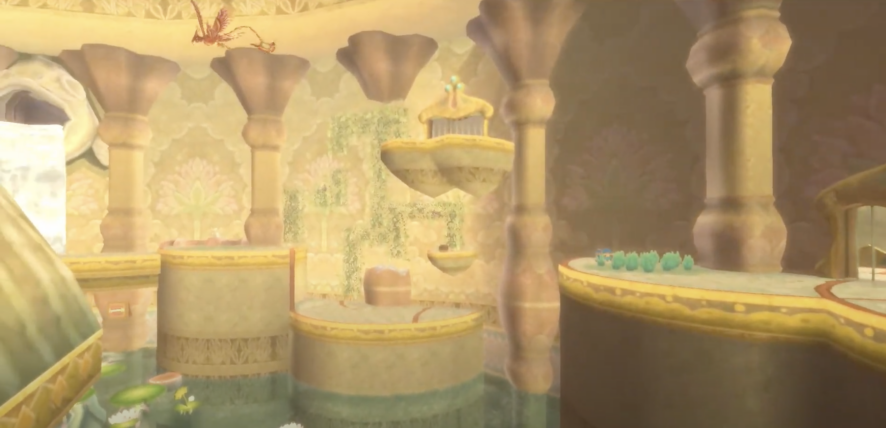
In addition to the Furnixes, other monsters lurk throughout the abandoned inner workings of the Ancient Cistern, including various Bokoblins and Babas. Looming Skulltulas and Walltulas add tension to every twist and turn. The Stalmaster miniboss of this dungeon is a pretty formidable threat, with its battle requiring skilled use of the game’s motion controls. Considering the encounter is one that Link accidentally falls into (wrong water spout – it happens to the best of us), the reward is pretty good: the Whip!

As the main item introduced in this dungeon, the Whip’s functionality is incorporated in various ways throughout the Ancient Cistern. The puzzles that Link comes across include elements that involve pulling, swinging, grabbing, etc., all of which are meant to be accomplished with the Whip. These abilities certainly make it one of the more versatile reward Items from Skyward Sword, and it’s just plain fun. It also compliments the design of the cistern itself. The aforementioned lily pads have barbed roots on either their bottoms or tops, and Link can use the Whip to flip them over, making it easier to cross sections of water. He can also use the Whip to twist pipes, spout handles, and switches, as well as waterwheels and gate locks. The consistent alteration of the the cistern’s functions contributes to its overall challenge.


Of course, the other key aspect of the Ancient Cistern is its evil underside. After activating a giant whirlpool, Link can dive in, getting swept to the dungeon’s lower levels. These areas seem to be the waste recess of the cistern, below the enormous statue at its center. It’s made up of contorted caverns, pools of liquid malice, and rotating columns that Link can jump between. There’s also a lot of skeletons down here, and they’ve probably been down here for a while. Their bones have become one with the floor, and in some places there’s a chilling squish and crunch sound effect as Link steps over them. What even was this place?
It’s a jarring contrast to the heavenly atmosphere of the dungeon’s entrance. Beyond the aesthetic difference, navigation across the lower levels is more focused on correctly timing jumps and swings, as opposed to the cause-and-effect water puzzles from above. The Puzzle Key for this dungeon is the Blessed Idol, the chest for which is located in the middle of a well of broken skeletons right underneath the golden statue. The Idol, like the cistern’s statue, also resembles a traditional Buddha figure.
After the player obtains the Blessed Idol, Link must fight a hoard of Cursed Bokoblins as the statue begins to lower its bottom half, crushing him if he doesn’t squeeze out in time. Cursed Bokoblins are a new variation, first seen in this dungeon. They, also, must have been down here too long. They’re the same cartoonish purple as the goopy malice that flows through the underbelly of the Ancient Cistern. Their attack gives Link the Curse status effect, disabling his access to both his sword and Items for a few minutes.
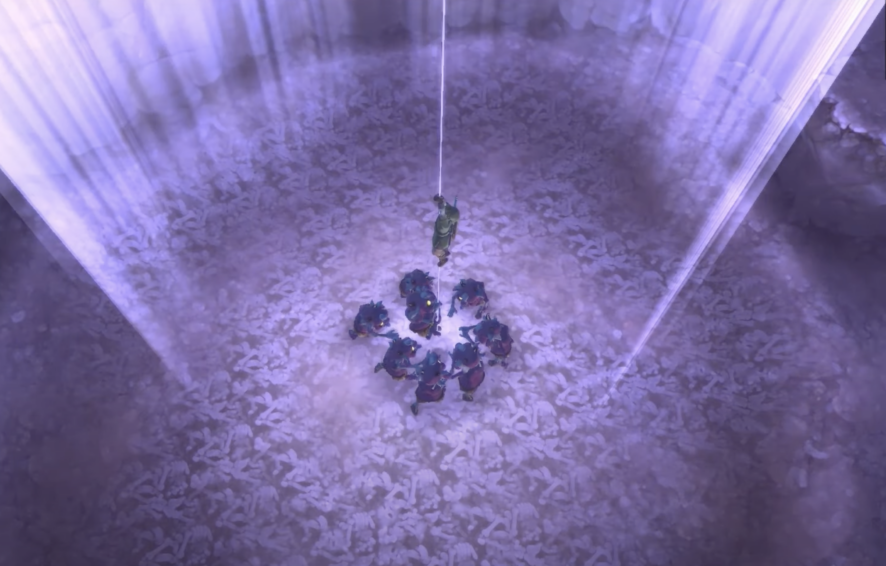
In a separate segment, Link forced to climb a rope to ascend to the upper levels of the cistern, only to be closely followed by a unruly group of Cursed Bokoblins whom he has to shake off to make it up the rope. This is likely a reference to the Buddhist short story “The Spider’s Thread”, which involves a criminal climbing up a spider’s thread to escape hell.
Eventually, the player reaches the third level of the Ancient Cistern and encounters the dungeon’s boss, Koloktos. This, truly, is a boss battle of insane proportions. It’s established by Fi that the “Ancient Automation” used to be responsible for eliminating intruders. Like the Blessed Idol and the cistern’s statue, Koloktos also resembles the Bhudda. Under the evil influence of Ghirahim’s magic, Koloktos stretches beyond its physical limits. Koloktos is now able to twist its arms and legs to gain height and reach. It’s an intense fight, and one can’t help but feel that Link must have personally slighted Koloktos, considering how hard and fast this thing swings. In order to take it down, the player must target the red orb at its core for multiple rounds. Kolokos, aware of this weak spot, uses two of its many arms to protect its core when Link gets too close. The player can pry the arms away using the Whip. The use of the Whip alongside the constant sprinting needed to avoid Koloktos’ blows also adds a dynamic sense of movement to the fight.

Having defeated the main guardian of not just the cistern, but of Farore’s Flame, Link accesses the Flame and absorbs it into the Goddess Sword with the help of Fi. It’s the first of the Sacred Flames that we collect, and it feels like an amazing accomplishment. There’s an epic sequence of the Flame bursting to life as Fi stands to collect it herself in order to transfer it to the Goddess Sword. It’s the Flame of Courage, and it arguably sets a basis for the remainder of Link’s growth as a Hero for the rest of the story.

Allegedly built before the establishment of Hyrule, every surface world dungeon in Skyward Sword feels beyond ancient, especially to players who’ve delved into games that take place farther ahead in the future. The enormity of the Buddha-like statue at the center of the Ancient Cistern feels reminiscent of a time when the gods existed more closely alongside the people of the surface, before they became immaterial. In games such as Breath of the Wild, which seems to take place on the near-opposite end of the timeline, the gods feel like distant, abstract concepts. The remnants of the surface world come from a time before Demise’s cyclical curse; before the Legend of Zelda stories we’re all used to.
The Ancient Cistern is a dungeon rich with detail, style, and plot relevance. Skyward Sword revolves around constant travel between the dangerous surface world and the familiar, peaceful sky. Before his destiny came knocking, the sky was all Link knew, lulling him into a false sense of security. It’s startling when Zelda is ripped away from that world and into the depths below the clouds – suddenly, the reality of their world’s ancient evils hit the player right in the face. This world is much bigger and far more dangerous than we thought, with a history we can only begin to grasp. The dungeon’s non-linearity reflects Link’s journey as he weaves between land and sky in a constant search for Zelda. The Ancient Cistern’s statue is a landmark to return to as you make your way through the dungeon, similar to how the Goddess Statue in Skyloft remains a reminder of home, wisdom, and safety every time you return. While the world below is dark, there is always a way to return to the light above.