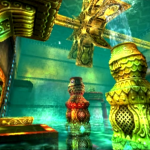
The Ancient Cistern is a truly magnificent dungeon. It is stunning to behold, the interior painted by an array of resplendent colors over elaborate stonework, blooming foliage, and pristine water. Imagery of lily pads, lotuses, and the Buddha-like central statue evoke a distinctly Asiatic character. The stark contrast between the vibrant upper levels and the eerie basement of the dungeon is thought to be influenced by the famous short story, The Spider’s Thread, by author Ryūnosuke Akutagawa.
Its gameplay features a near-perfect balance between exploration, puzzle-solving, and precision-based navigation of tricky hazards. An early fight against the Stalmaster is a rousing duel. The Ancient Cistern excels all the way to the very end, where it finishes with a boss battle that is one of The Legend of Zelda’s very best — the Ancient Automaton, Koloktos.
Fans were introduced to Koloktos well before Skyward Sword actually released. Although we did not know its name at the time, we got our first glimpses of the memorable boss in March 2011 from a trailer that debuted at that year’s Game Developers Conference. Fleeting shots of Link doing battle with Koloktos only showed off the first phase of the encounter, though, leaving some surprises for fans before they would play the game later in the year.
Much like the visual and thematic contrast between the different levels of the Ancient Cistern, Koloktos can be seen as a foil to the huge statue in the central chamber. Where the Buddha-like monument appears friendly and inviting, while serving as a means for Link to navigate the dungeon, Koloktos is a daunting foe — a moving armory whose sole purpose is to keep you from reaching Farore’s Flame once it is powered by Ghirahim’s cursed energy.
Initially, Koloktos is fixed to the floor, as if it is seated. Perhaps this stance was inspired by the meditative position that many multi-arm Buddhist deities assume when they are depicted in art. While Koloktos uses most of its arms to attack Link, either slamming them toward him or hurling giant axes through the air, it uses two to defend the vulnerable core in its chest. A subtle, but fascinating detail is that Koloktos does not clutch at its core desperately. Rather, it places its open palms over the weak spot gracefully, in a gesture that resembles a prayer-like position.

Midway through the battle, Koloktos decides to increase its offense in a big way. The Ancient Automaton lifts itself from the floor, pulling its lower body free until it stands as a towering titan of xanthous metal. In placing all of its hands to the ground and pushing its entire body free, there is a brief moment where Koloktos is seen in a somewhat creepy stance that resembles a spider. It makes one wonder what an additional phase to the battle might have been like with Koloktos crawling about the chamber like something out of a Ju-On movie.
Once Koloktos brandishes a bevy of giant blades, the thrilling music (previously heard while contesting with Moldarach) raises the tempo and volume. Those series of trumpets make for easily one of the most exhilarating tracks ever scored for The Legend of Zelda combat. The second phase of the battle with Koloktos is memorable in large part because it has so many moving parts, both literally and figuratively. As Link, the player is rarely allowed to stand still for more than a few seconds at a time. Koloktos’ long reach makes each and every slash deadly, particularly because it is always striking with three arms at once. On other occasions, it’s summoning Cursed Bokoblins for Link to dispatch while he avoids the enormous swords. When Koloktos puts all six of its arms to use at the same time, marching forward and whirling its blades in what looks like a walking woodchipper — that can obliterate stone pillars, no less — the player better get out of the way.
Motion control’s prevalence in Skyward Sword will forever be a polarizing subject among The Legend of Zelda fans, but if there is any one instance where gamers can come together and agree that motion control created immersion to the degree that Nintendo clearly hoped for with that Wii adventure, it has to be the Koloktos battle.

The Whip and 1:1 swordplay are masterfully implemented in this encounter, channeling intense, savage gestures between Link and the player. By ripping away Kolotos’ arms, you progressively break down its armament before you can move in safely and strike with the same weapons it uses to assail Link. Chopping Koloktos’ legs from under it and battering its core with a sword nearly twice Link’s height delivers a sense of raw strength that no other point in Skyward Sword equals, the windup and subsequent connection on each swing more satisfying than the last.
It all fits right in with the Ancient Cistern’s remarkable achievement in balancing symmetry with contrast — your first steps into the dungeon are breathtaking because of its idyllic beauty, while your last steps are also breathtaking, but because of a rousing battle that is an all-time great in The Legend of Zelda’s long history.