When I was a youngster, one of my favorite things to do was to pick up and read video game magazines. While I liked reading the articles and strategies for games I owned and didn’t own, I spent most of my time staring at zoomed-out, fully-fledged maps. I loved analyzing them and finding all the secrets within. I regularly traced my finger over where the player would start and played the game in my head, while I went in the direction the game designers intended the player to go. In my head, it was like I peeled back the layers of the game and it was like exploring a whole new dimension.
This love of maps stemmed from when I played Zelda II: The Adventure of Link. As it was a game beloved by my family, it was only natural that I’d pick it up at some point. Sure enough, a lot of my free time gravitated towards Zelda II and it became a game that has been etched into my mind since my earliest years. So, to celebrate what I consider a classic title and the game that started a love of maps, I’d like to talk about a segment of the overworld map, specifically the northwest part of Hyrule.

We’ll start from where the game begins with the palace tile in the southern part of the map surrounded by water. If you’ve played Zelda II to any capacity then you know this area very well. You know it even more if you’ve played it for long enough to get a “game over” screen, which makes you restart at this location. As you move east, you’ll notice other tiles dot the landscape, such as grass and trees. In any other game, these might just be for cosmetic purposes, but in Zelda II, it determines what creatures Link faces when he runs into them.
If you want to pick a fight, the game will behoove you to stay on the grasslands or the forest tiles. If you run into a monster while on the roads, you’ll be taken to a blank 2D screen where you won’t fight anything. This is why, if you look at the map, you’ll notice that two of the towns can be accessed without requiring Link to engage with any enemies. This allows you to at least get the Shield spell from the rightmost town Rauru before you encounter anything, which is good to use while you get adjusted to the game’s combat. And if that town name sounds familiar, that’s because it should.
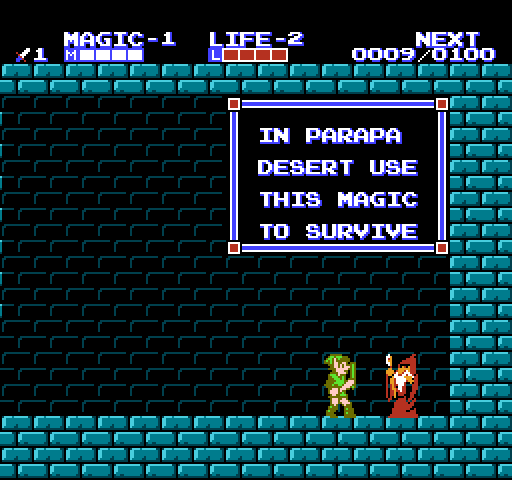
Sticking to the east side on the map, you’ll notice a cave covered behind some trees. Upon entering this cave, you’ll find it to be pitch dark. However, you’ll have to brave the darkness eventually as it’s the only way to get to the first Palace in the Parapa desert, aptly named the Parapa Palace. Clearing the palace grants Link the Candle, which allows him to see inside the dark caverns.
If you head southeast while in this desert area, you’ll see a strip of road, which halfway through leads to a special 2D segment. Getting through this area then leads Link to what is most likely his first Heart Container, permanently increasing his maximum Life (which, in a game this difficult, is most certainly a welcome boon).
Back to the main area, you might notice on the northern side a standalone forest tile. Walking into this tile also leads into a special area where you can fight creatures, but more importantly, find your first Treasure Bag. Collecting this gives Link 50 experience points which, if he hasn’t gained one yet, will instantly give him a level. Quite a handy bonus indeed!

Continuing on our quest westward, there are two more caves to explore. The southern one contains a Magic Container which will increase Link’s maximum Magic, though the cavern is fraught with platforming perils and cantankerous creatures, so it’s best to wait until you acquire the Candle from the first palace before heading there. The northern cave contains the Trophy, which Link will need to recover so he can acquire the magic Jump spell in the town of Ruto.
Speaking of Ruto, it’s located in the mountainous region in the far northwest. As previously mentioned, you’ll find the Jump spell here and with that, you can finally make your way through the cave to the south, and continue your journey onward.

I have to admit, it was really fun writing this and reliving the beginning of the adventure in Zelda II. Doing this gave me a greater appreciation of the map than I had prior. A lot of this area is about teaching the player all of its mechanics by showing rather than telling. The Treasure Bag is in an obvious spot right along the road, so you’re most likely going to find it soon. Rauru and Ruto are along the roads, so you can get to both of them from the very start without ever fighting a monster. It’s all very well designed, and it shows that Nintendo has been doing that smart design philosophy since the very beginning.
Perhaps the only real misstep here is that you’re required to go into a dark cave to get to the Parapa Palace, and you’d be forgiven after seeing how dark it is that you’d need to turn back. Otherwise, this is a wonderful map, and it was great to dissect it into little bits and really examine it. Plus, it was a huge nostalgia trip for me, and I’m always thankful to have those, especially in a game that is very important to me. More importantly, I hope it helped you to look at a black sheep title with a bit of a different perspective, and I hope you enjoyed this tour of northwestern Hyrule in a game many turn their nose upwards towards.