“Over 100 hours of gameplay!” — It’s common to hear this sort of marketing speak thrown around a lot. It’s seen as a bad thing for a game to be too short, as games are expensive and people naturally want value for money. Some people even have their own personal “dollar to hours” ratio for what they see as worthwhile purchases. With this perspective in mind, it is only natural that many developers and publishers want to make games that will have enough content to satisfy consumers. One genre that proved to be the ideal format for meeting these needs was the open world game.
With the rise of open world games however came a constant race for companies to make bigger and bigger titles. Many of these titles are giant time sinks, made to keep you playing for months, or even years in the case of live service games. So the question has become this: Can a game be too big? Personally, I think that in order to find the answer we need to break down what makes a game truly big, and look for the possible ways to make a game big while still keeping the content fun.
THE RISE OF UBISOFT: FROM SANDBOX TO CHECKLISTS
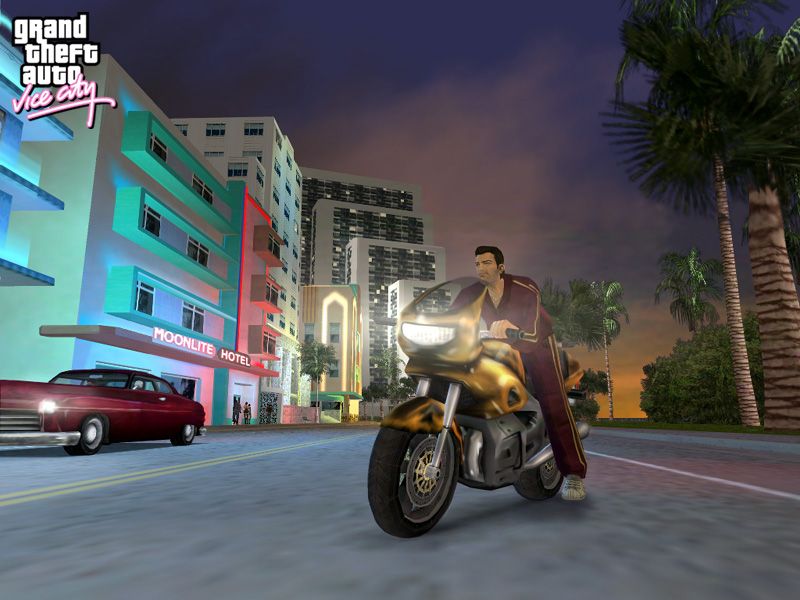
When open world games began to show up, there was another word used to describe them: Sandboxes. This came from the idea that the game gave you a whole bunch of “toys” to play with, and simply let you run wild with them. Grand Theft Auto was certainly one of the leading examples, giving you a big city to explore and play around in while also filling it with side missions and secrets to find. At any time you wished you could steal a car, grab weapons, and go nuts. It was a freeing experience, and one that gave you the choice of what to prioritize. Did you want to complete main missions? Side quests? Hunt for secrets or just wreak havoc? The choice was yours.
This city was your playground.
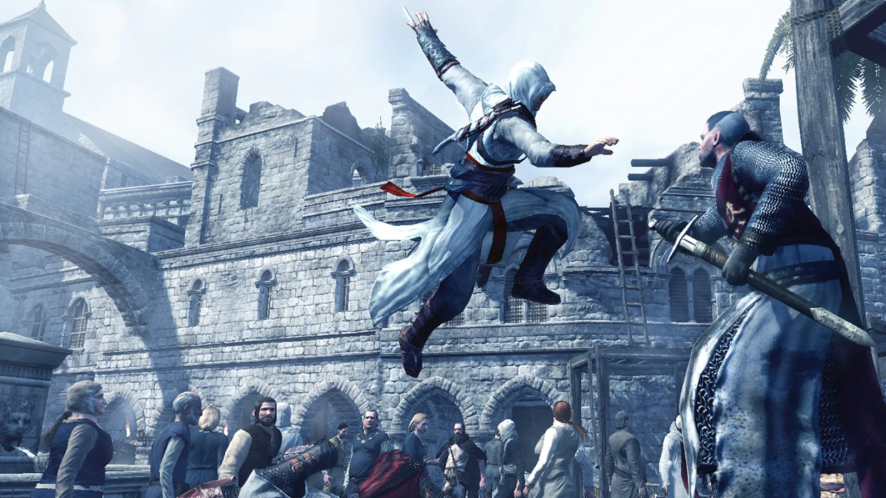
However, it was Ubisoft that really changed what an open world game meant when they released certain key titles. The first was the Assassin’s Creed series, and the second was Far Cry 3. These games were less focused on having a big open world for you to rampage in. Instead, they gave you a checklist of objectives and missions to do, towers to climb that would reveal the map and every activity in the area, strongholds to capture and so on. This was fun at first because while the towers, strongholds and side missions were fairly similar, they were each satisfying to do and completing all of these areas felt manageable and rewarding.
Simpler times, back when Assassin’s Creed was about Assassins.
However, as the demand for larger games came around, not to mention the open world genre filling with imitators at the same time Ubisoft began pumping out more games almost every year, some people like myself started to burn out. Players no longer enjoyed these later titles the same as they felt more like bland toast.
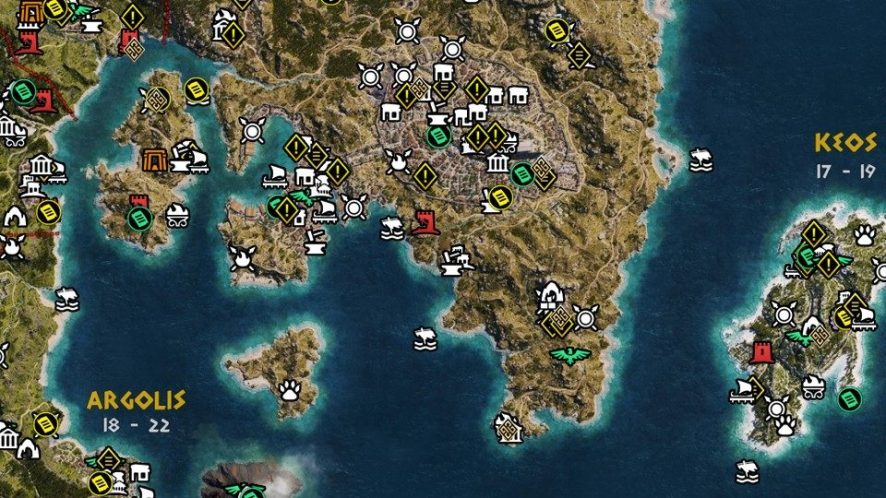
Not only did the formula go stale, but the sheer scope of these world tasks ballooned to an overwhelming size. Looking at a map and seeing hundreds of icons for repetitive missions became demoralizing, and completing the map now felt more like taking the garbage out than an adventure that was actually fun to engage in. The commitment became too much.
How to give a player anxiety in a second.
It’s not only the scale of these games that can cause issues, but how these games achieve that scale. They often have lots of activities repeated dozens of times, and this can result in boring side activities after doing so many of the same type. For example, capturing a enemy camp is exciting at the start, but when you get to your 15th one, you’re probably a bit sick of it and running on autopilot. This is another case where the larger the scale of an open world game gets, the worse the issue can become. The difference between seeing 10 racing challenges compared to 20-30 is a lot in a player’s mind.
Fortunately, the open world genre didn’t end there. A new title came out and made some big changes to the open world formula that would send waves through the game industry. Of course I’m talking about Horizon — just kidding, it’s Breath of the Wild.
BREATH OF THE WILD: THE RETURN OF ORGANIC EXPLORATION
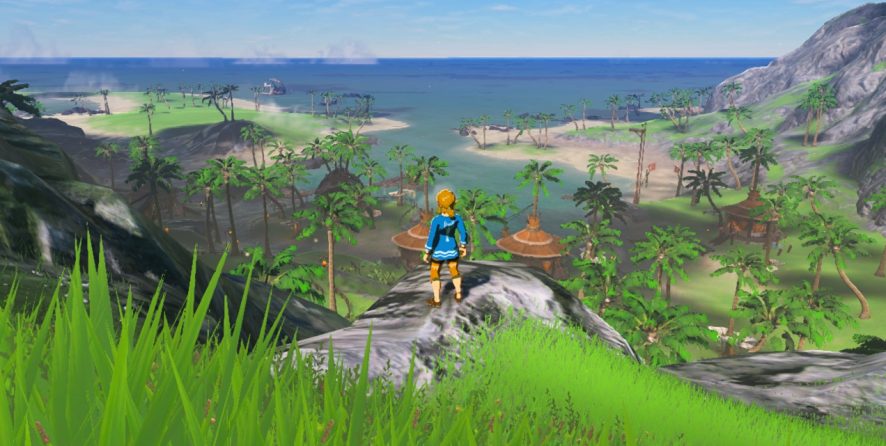
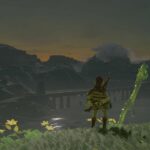
Look at this. No icons or markers in sight, just a guy living in the moment.
On the surface it could seem like just another franchise shifting to the open world format, but there are several core design decisions that helped make Breath of the Wild stand out, with one key philosophy guiding them. It wasn’t about adding something new, but reviving something from our past: Organic exploration.
What do I mean by “organic exploration?” Put simply, organic exploration relies on the player observing their surroundings and looking for identifiable landmarks to help guide them. Rather than having giant floating path markers telling you which way to go, organic exploration says, “use your eyes and your ears. Listen to the world around you, look for secrets, talk to the people of the world.” It asks the player to choose for themselves where to go, what to do and which task they should focus on. And after years of open world games guiding you by the nose with markers, highlighted pathways, and compasses, this concept felt truly freeing.
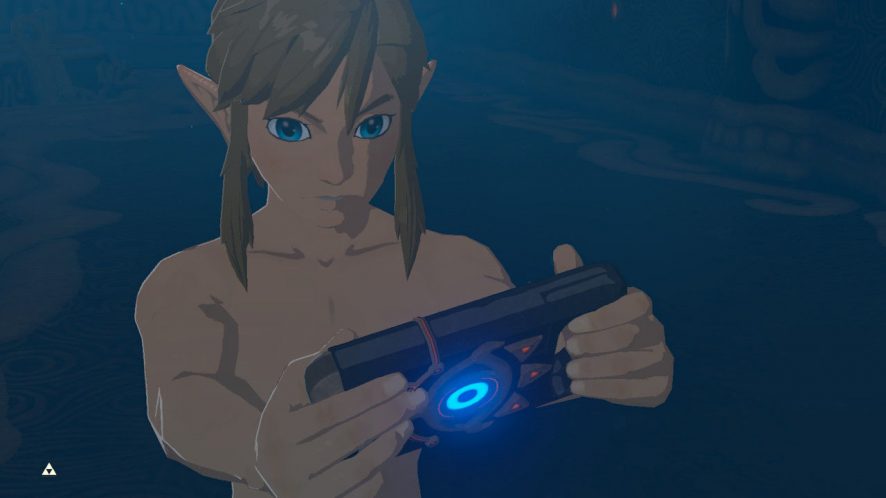
Ok, there may be a smartphone, but he’ll still be using it to see the world around him.
Breath of the Wild encourages you to use the Sheikah Slate as a telescope to look at the world around you, and mark interesting locations yourself. Even the Sheikah Towers only reveal the landscape of the area on the map, leaving you to look for hidden caves, shrines, or potential secrets all by yourself.
You want to get the lay of the land? Get up high where you can see more of it. You want to do a side quest? Listen to the directions that an NPC gives you. While main quests will give you a mark on the map, and side quests will give you some direction, they only will lead you to the general area you need to be, so you still need to keep aware of the world around you. This focus makes exploring far more interesting. No longer are you just mindlessly following a highlighted path or markers, but you are actually exploring. There’s a million secrets that could be between you and your destination, and you’re encouraged to keep an eye out for them rather than being on autopilot.
BOTW’s map doesn’t show much, but that may be a good thing!
Now, this isn’t something new to gaming. Many old PC RPGs would ask you to do this, as did the first few Legend of Zelda games. But aside from games like FromSoftware’s Dark Souls series, most modern open world games or RPGs have begun to hold our hands more and more as focus testing has told big AAA developers that players hate to get lost. But the solution here was not to remove the ability to get lost, but to make getting lost exciting.
Breath of the Wild understands this, and puts bread crumbs all over the place in the form of Ancient Sheikah Shrines, Korok Seeds, chests and monsters. This allows the player to get caught in a thought loop of “ooh, something’s over there!” over and over without feeling too crowded or overwhelmed. Now with so much content stuffed inside, the game could risk feeling too big much like modern Assassin’s Creed games.
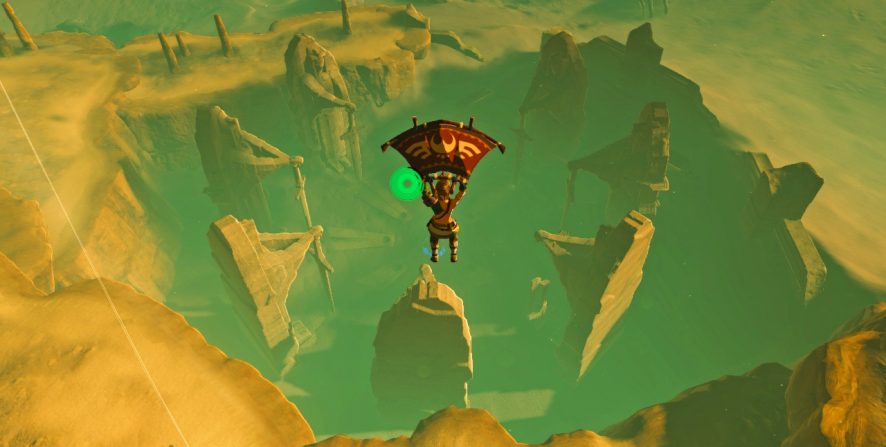
What could be down here? Let’s find out!
However, Breath of the Wild does another smart thing and doesn’t go out of its way to tell you how many shrines or Korok Seeds are out there. There’s no Crash Bandicoot-style counter constantly reminding you that you are missing 700 Korok Seeds, or an Assassin’s Creed-style splashing of markers everywhere to blot out the map. Breath of the Wild just says “Hey, these things exist, look out for them,” and lets you go after as much or as little as you want. This eases the tension for most people, and therefore it matters little if the game is huge, as they don’t feel pressure to do it all.
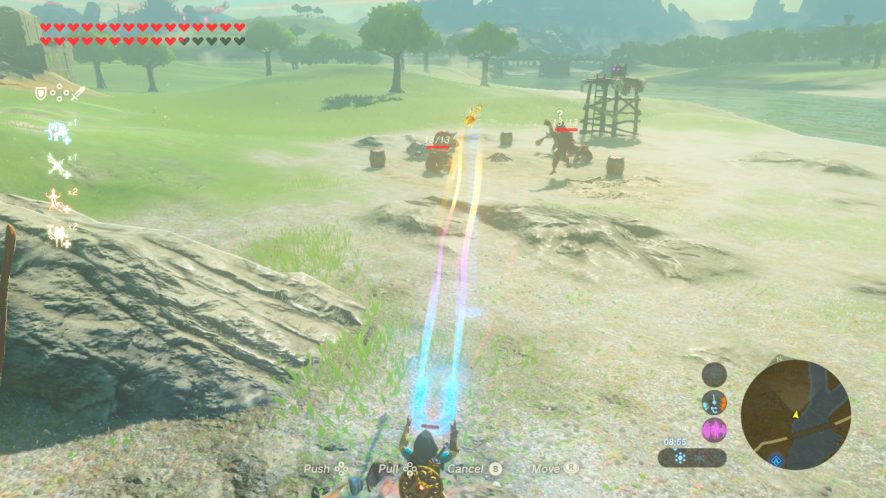
Wanna steal someone’s weapon? You can do that!
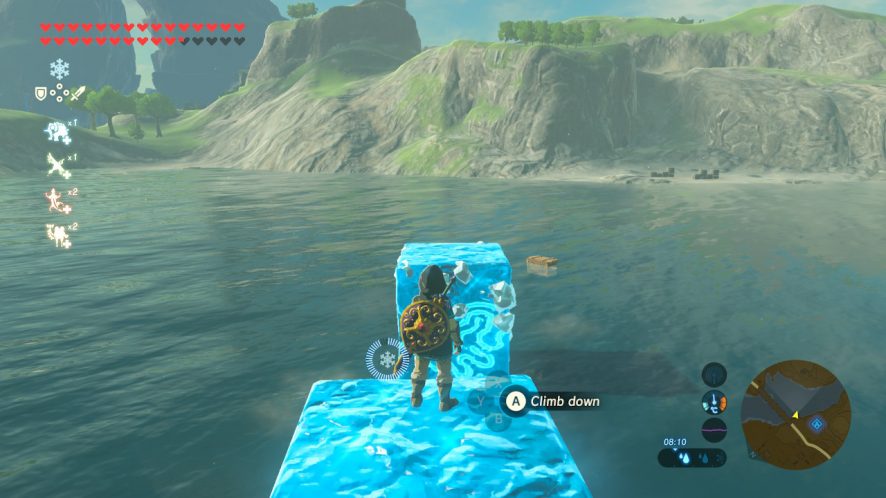
Another big contributor to the sense of freedom this game gives you is your toolset. Rather than give you a static set of abilities, combos, and weapons, Breath of the Wild gives you a core set of abilities that can interact with the world in a natural and organic way. The Sheikah Slate gives you a set of Runes that can affect the world around you: Bombs to blow up stuff, Magnesis which allows you to pick up and move any metal object, Stasis which allows you to freeze time for an object or enemy then build up momentum by hitting it, and lastly Cryonis which allows you to make ice pillars on any water surface. These can be used anywhere and allow for creative use of the environment, which also extends to your other weapons and tools.
For example, any wooden weapon or object can be set alight and used to burn things around it. Electrical weapons or arrows will spread electricity through water or metal if they are in contact with it. But this is only scratching the surface. Create a fire and then use it as an updraft to send you into the sky on your glider! Cut a tree down across a river, then use Cryonis to stop it from moving downstream so you can walk on it as a bridge. There’s an interactivity and freedom here unlike any other open world game before.
Cryonis makes for an effective way to stop and take a breath in the water.
Even Breath of the Wild’s main plot gives the player a lot of freedom. Early on as you finish the tutorial area known as The Great Plateau, you are given a clear main objective: Defeat Calamity Ganon, who is waiting in Hyrule Castle. You are also pointed in the direction of the four Divine Beasts which could assist you in weakening him, and you are taught about how to get stronger through the use of shrines and finding better weapons and armor. However, it’s all left up to you. You could set out to get stronger first or you could just walk straight to the castle and end the game sooner if you’re skilled enough. That freedom is what makes Breath of the Wild feel as big as you want it to be, because at any point you can just say, “Alright, let’s end this.”
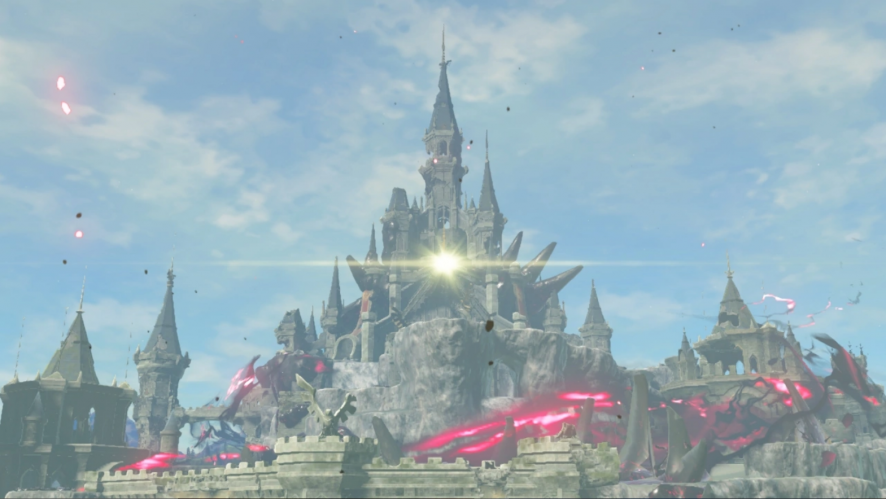
Oh right, should probably do something about that.
All of this freedom provided by these mechanics help make exploring such a large map far more exciting and fresh than traditional open world games, and thus distracts the player from getting worried about the sheer scale of the game. You’re less overwhelmed as you aren’t given too much information, and you are allowed to explore and discover things at your own pace. The interactive nature of the world allows more creativity and makes the journey go from “okay, I need to travel 1,000 miles to get to my next objective” to “okay, I need to cross this river, I could go downstream and look for a shallow crossing or I could try and create my own way across”. This is what makes Breath of the Wild truly special.
THE IMPACT OF BREATH OF THE WILD AND ELDEN RING
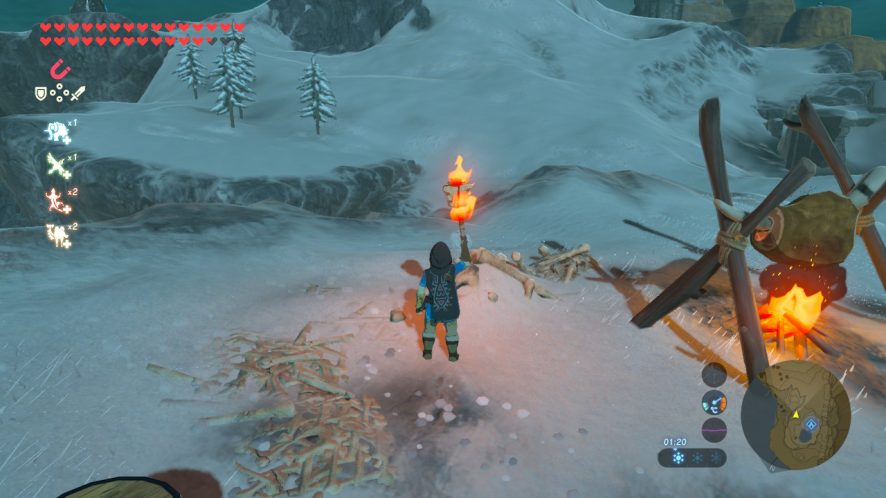
Light a wooden stick or club to help get through a cold area.
While this did make some big waves, not all of the following games that took inspiration from Breath of the Wild took this lesson to heart. Ubisoft’s own attempt at Zelda’s reimagining, Immortals Fenix Rising, may have taken some surface-level inspiration but it still has the same hand-holding as their normal open worlds, just in a different way. Genshin Impact also took a fair bit of inspiration and has some of that organic exploration in mind, but it also ends up in a middle ground with a fair bit of guidance for main questlines including glowing trails and markers for most quests. However, another big title was looming, and to say it made a splash is an understatement. If Breath of the Wild was an earthquake, then this next title was a severe aftershock almost as impactful. I am of course referring to Elden Ring.
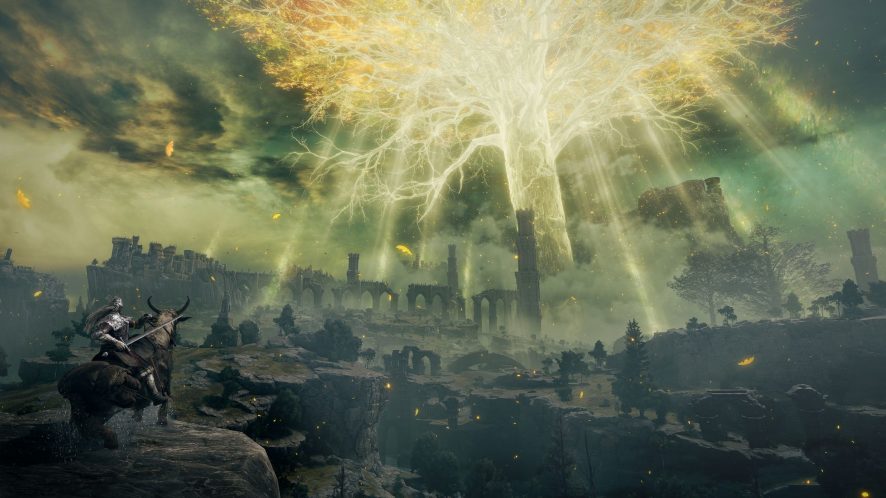
Down, down come the leaves, do you believe the words of the gilded and gold?
FromSoftware always had a passion for organic exploration with their RPGs for the last decade or so. While not being fully open world games, Dark Souls, Bloodborne, and Sekiro: Shadows Die Twice, all have large interconnected areas almost like a Metroidvania. Lacking guidance, the player is guided by the environment and cryptic instructions from NPCs that may not be trustworthy. So it makes a lot of sense that they continued this design trend with the smash hit Elden Ring, which shared a similar design focus on organic exploration as Breath of the Wild. With both of these games, there was a desire to see as much as you could but no pressure or expectation that you’d find everything.
In Elden Ring, exploration is treated as a way to get stronger, find new weapons, and receive new spells and items to give you an edge in battle. Checkpoints have rays of light, known as the Guidance of Grace to direct you to major areas and bosses, but the player is expected to make their own way to get there. The first major boss is even treated like a difficulty wall that’s meant to teach the player to go away and explore, get stronger, and then come back later. It’s an interesting way of encouraging that behavior, and since the main “path” of Elden Ring merely requires you to beat only some key bosses, it gives you that freedom to engage with the parts of the game you want at any time.
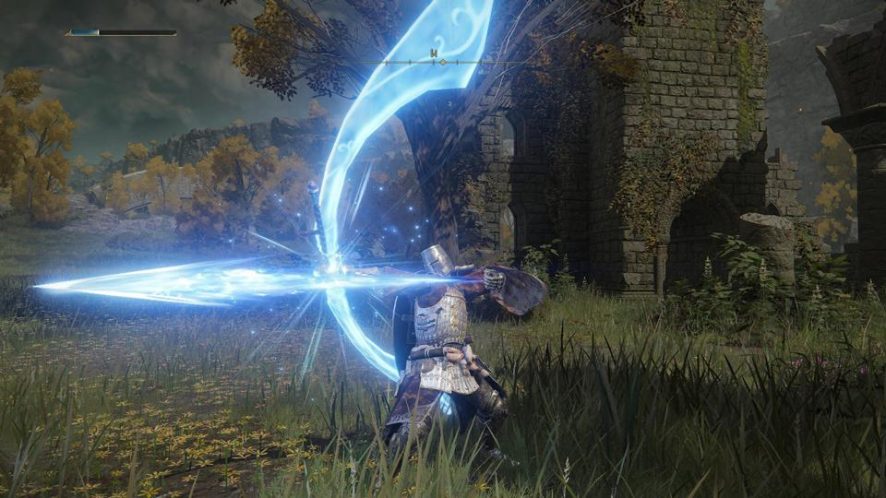
Let’s see them dodge this!
Both Breath of the Wild and Elden Ring emphasize this ideal — that the player is trusted to take initiative, pick a landmark or a direction, and just start wandering. And most players will do so because these games constantly reinforce that if they explore, they will be rewarded. Freedom of choice is what makes these games feel big without feeling overwhelming. If you compared the content of these games to a Ubisoft-style open world, you’d find them not that different in terms of scope. Yet the way these are presented is the key difference that changes everything.
The difference between playing to complete vs playing to experience (Genshin Interactive Map vs the Genshin in-game map)
At the end of the day, the sense of freedom really is the key factor that makes a game “feel” big without getting too overwhelming. Breath of the Wild and Elden Ring both present a huge world with so much to see and do, yet they don’t expect you to do everything. They don’t display a counter nagging you to complete “1/25 towers climbed” or “5/75 feathers found,” so it doesn’t feel like you’re playing just to fill those requirements. Instead, goals like Ancient Sheikah Shrines and Korok Seeds feel more like neat surprises that you might want to pursue, but you’re never expected to find them all, and there’s no grand reward held behind you doing so.
In a traditional open world game, you might climb a tower and get a bunch of icons that make you think, “Oh, there’s five strongholds, four racing missions, 10 feathers to find, a bunch of shops, and 15 side missions in this area. Well, better get started I guess.” It’s uninteresting, and feels like work to be completed, even if individual missions are fun. The mere fact that it’s broadcasted to you how many there are makes you feel like you’re checking off a to-do box.
The way they highlight the key information you need for the quest is also a nice bonus.
But in Breath of the Wild and Elden Ring, you’re only playing to experience as much as you like. You look at an area and naturally think, “What’s this? Ooh, what’s over there? I bet there’s a secret at the bottom of this ridge or behind the waterfall!” It brings back the childhood wonder of not knowing what could be out there, imagining all manner of surprises hiding around the corner. That discovery and sense of wonder is something truly special, and I think having that greatly enhances the exploration and content present in open world games. On their own, a shrine or a mission isn’t much different from one in a Ubisoft-type game, but it’s the presentation and freedom that prevents it from feeling too big in the first place.
In conclusion, I think a game can feel too big, but one way to reduce that feeling is, strangely enough, to give the player less information. This overwhelming feeling will only come across if the content that makes it big is presented as a box on a checklist or a bunch of icons on a map. It’s possible for a game to be truly massive like Elden Ring or Breath of the Wild, but if you give the player freedom to discover and choose what content they want to do, it all of a sudden becomes much more enjoyable and manageable. Player freedom is the key, and this is best achieved by giving them the ability and choice to explore organically on their own.
LocktheChest
LocktheChest is 27, lives in Australia and is very passionate about video games, musicals, DND and other nerdy stuff.


 by LocktheChest on November 2, 2022