I have been playing video games my whole life. Since I could pick up a controller with my grubby little toddler hands, the medium has never been far from my grasp. From my first adventures in gaming where I would watch my older cousin play the original Kingdom Hearts on the PlayStation 2, to getting my very own console for my fourth birthday and playing Jurassic Park: Operation Genesis well into my childhood nights (yes, I did let my dinosaurs run loose and eat my park-goers, thank you very much!). In all my years playing games across countless genres, publishers, and developers, there have been few times in my life where playing a game has made me gasp, drop my jaw, make my breath catch in my chest, and let a “wow” spill forth from my lips. Climbing the western edge of the Gerudo Highlands for the first time in Breath of the Wild was one of those times for me.
I was following my red map pin towards a Sheikah Tower that I needed to unlock. Kind of. I was sort of aimless, wandering the rolling hills of Hyrule, doing that thing I do best when I play massive open-world games like Breath of the Wild. That thing being wandering aimlessly towards the loose direction of my initial objective.
I love to lose myself in games. To explore every corner of the map, to drink in the scenery, admire how the score compliments the situations I encounter, and I especially read every bit of lore I can find. Well, at least I try to (looking at you, BioWare!). As games get bigger and more grand, and with the apparent renaissance of the open world genre across the industry, I am very grateful for lore journals and notebooks becoming a standard practice. Yes, I will read all the lore. But, like, later. Promise.
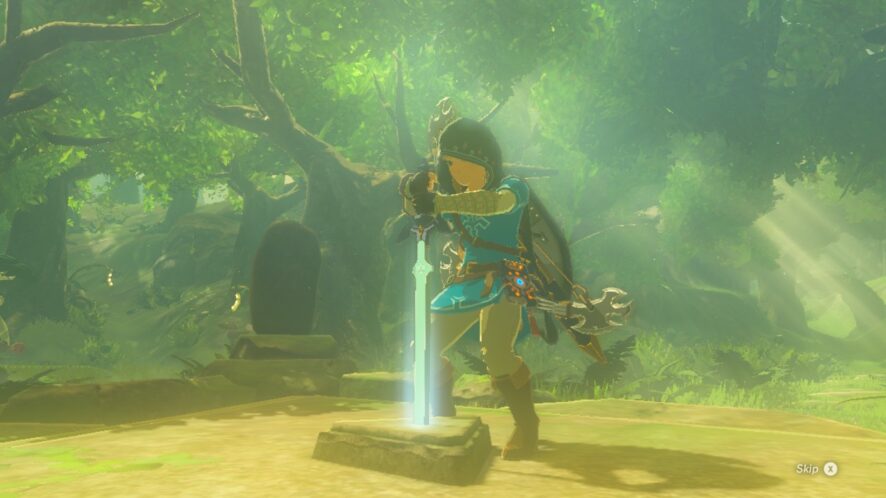
It was on one of these wanderings that I crested a hill in the Highlands, not even sprinting, but slowly and with care, entranced with the world that the talented artists and engineers built for me to wander in. I remember stepping over the hill with my game camera pointed behind Link. I turned the camera around to a gorgeous view of Lake Hylia at sunset. It was a stunning sight, one I decided I would stop and admire for a few seconds.
For me, this admiration of the sunset was an act of reverence for the game’s creators. Many real people with real love for the Legend of Zelda series spent many hours of real lives making sure that the wind blew through the grass on the Highlands at just the right speed, and that the crickets chirped at the right pitch and volume. Someone had to ensure the sunset was the right shade of orange, and I intended to be there to appreciate its hues.
I noticed something then, out of the corner of my eye. How long had it been there? My reaction was to turn the camera quickly. Was it an enemy that I hadn’t encountered yet? Some new form of Guardian? Hylia forbid, not another Keese swarm!
My eyes adjusted as the motion blur from the camera pan settled. What I saw wasn’t a new enemy, Guardian, Keese, or otherwise. It was… a dragon? Oh my gosh, that’s a dragon! And a dragon it was indeed. Snaking its way out from beneath Lake Hylia, was the yellow-green visage of Farosh. Or at least, that’s what my camera was telling me; I couldn’t have opened it up faster.
My first experience with a Zelda game was in 2013, playing The Wind Waker HD on the Wii U. The charming console themed around the beloved GameCube title was pre-loaded with a copy of Hyrule Historia, Nintendo’s attempt at weaving a cohesive narrative from the notoriously narratively incohesive franchise. Like I said, I am nothing if not a lore nerd. At that point, I had been a bit-more-than-casual Zelda fan and had taken some forays into the “Zelda timeline” YouTube black holes, where I spent a bit (read: many dozens of hours) of time.

It was because of my previous encounter with the series through The Wind Waker HD that I was able to connect that the dragon represented much more than just a crazy and unexpected in-game encounter. It was a thing of majesty, and I was there to witness it. In a way, I felt that I was meant to be there at that moment. Though I had already logged many hundreds of hours into Breath of the Wild, the trophies of countless evil minions of Calamity Ganon littering my inventory and bulging from Link’s pockets, in that moment I felt truly small in the land of Hyrule. In the waning twilight of the Gerudo Highlands, as Farosh’s lighting rained down from his scales, the Hero of Time felt quite timeless indeed.
It’s moments like these in games that I find myself reflecting on what gaming is to me as a medium. I could have experienced a serpentine dragon-god rising from the bottom of a lake in a fantasy novel, sure no problem. Heck, I probably have already, who knows these days with all these dragon shows and their houses and such. But it wasn’t in a novel. My meeting with Farosh wasn’t planned or scripted. Someone hadn’t written it, published the scene, edited that moment with flowery language until it fit their perspective of what the author thought a mighty creature being revealed might look like. It was my wanderings, a beautifully blank canvas left to uncover built with the love and attention of the people that made Breath of the Wild a reality, that allowed me to cross paths with the dragon. Watching Farosh ascend to light up above Lake Hylia was something I will never forget. I will admit, I was nervous that when I started Tears of the Kingdom that my breath would be more measured, that my footfalls would be quicker, that I would press the sprint button more and the camera button less. Thankfully, I can say that is not the case, and I cannot wait to pick my jaw up off the floor once more.
I wonder: if I encounter Farosh again on my wanderings through Upheaval-torn Hyrule, will he remember me? Only one way to find out!