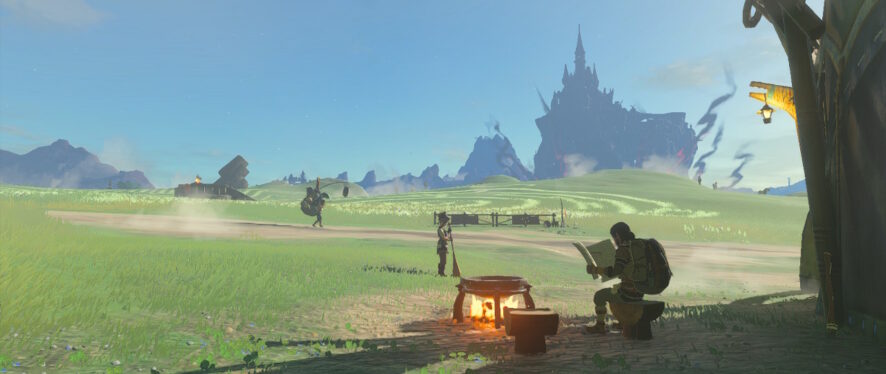
Praise for the world that Breath of the Wild introduced comes in all shapes and sizes, from long-standing players who anticipated the game ever since its first teaser to those who were first introduced to Zelda by the 2017 title. A remarkable feature that persists both in of Breath of the Wild and later in Tears of the Kingdom is the strange peace that is present even in a post-Calamity, post-Upheaval version of Hyrule. By all accounts, the Kingdom should be in ruin — and it is, in many areas — yet its people live lives that have not been entirely shrouded in terror and doom. Villages thrive with fertile soil to grow plenty of food to go around; merchants wander mostly-intact roads with carts full of goods and pockets full of Rupees; stables of horses and wild animals alike thrive; and treasure hunters stage new adventures in the rubble of fallen temples.
Hyrule persists, as do her people. What has emerged from the Calamity and the Upheaval are communities that quietly get on with their lives even amidst tragedy, and great swathes of open fields and skies between. With two games taking place in the same incarnation cycle, the Era of the Wilds has suffered twice its share of attacks. How, then, do Breath of the Wild and Tears of the Kingdom create such tranquil environments for exploration?
Generations Apart
In most Zelda titles, we watch the catalyst event happen right in front of us and must deal with the fallout immediately. Breath of the Wild, however, begins one hundred years after the Calamity took place. Hyrule has, to an extent, healed itself, even in the absence of its Princess and her Swordsman. The chaos of those first few weeks, months, or even years has long since passed.
Link emerges from the Shrine of Resurrection.
By joining the story a hundred years after the Calamity, we, the player, are sheltered from the events that must have taken place in its wake. What kind of disarray must the panic and fear have fueled? Did anybody take the opportunity to perpetuate more violence and cruelty, and if so, what happened to them? How did having Hyrule’s knights, its protectors by tradition, utterly decimated affect the world that once relied upon them?
Link’s memories are lost. The vast majority of Hylians alive in Breath of the Wild would have been entirely new generation to those who lived through the Calamity. To them, to us, all that is known is a post-Calamity world. We only know the peace of the Era of the Wilds because we have forgotten or been shielded from the cost of achieving it, even if that cost was simply time.
That said, there are longer-lived peoples in Hyrule who both experienced the Calamity first-hand and are still alive to remember it a century on. Members of the Sheikah and Zora greet Link as an old friend, many having fought directly alongside him against Calamity Ganon. One hundred years on, though, and they seem to exist in relative peace, even if they were not born into a post-Calamity Hyrule like many of its current citizens. Again, time has somewhat healed — or buried — those wounds.
Second Wave
Naturally, the events of Tears of the Kingdom ensure that even those who were born after the Calamity live through a Ganon-orchestrated, destructive event. The Upheaval differs in that Hyrule does not get a hundred years to heal before we, the player, rejoin the story. In fact, the game opens with the Upheaval itself, throwing us directly into the danger it presents.
It’s unspecified how much time passes between the Upheaval and Link waking up on the Great Sky Island. Long enough, at least, that concern has spread across Hyrule about he and Zelda going missing, Lookout Landing has been erected, and the Zonai Survey Team have mobilized. Long enough, too, then, that initial panic could have died down.
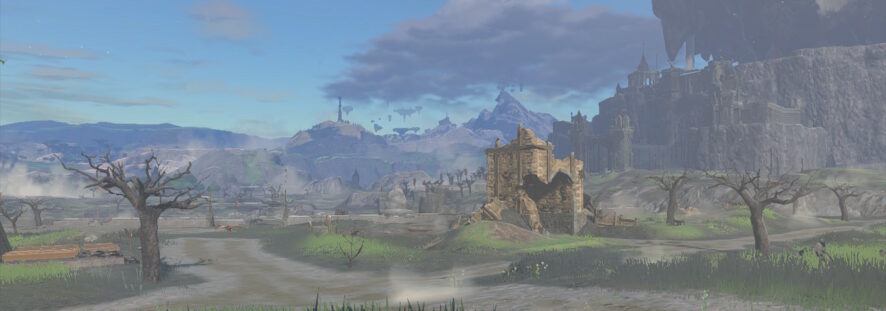
Despite the state of Hyrule Castle after the Upheaval, Hyrule’s people continue with their lives.
In any case, when Link returns to the surface, the people of Hyrule are still going about their business. They’ve even found excitement in some of the new developments, such as visiting the Ring Ruins in Kakariko Village and spelunking in the newly-opened-up caves. Again, we see communities pushing forwards with their lives, not being discouraged from building, exploring, living.
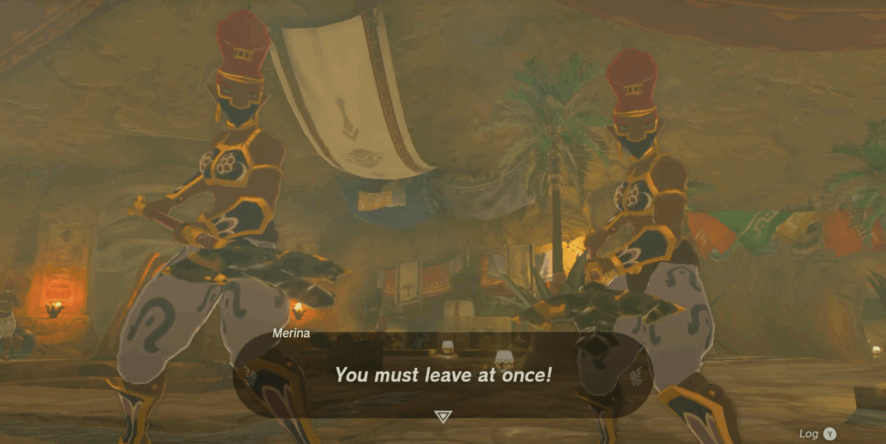
The Regional Phenomena questline(s) are where lives are rather more disrupted, with natural disasters and new monsters threatening four major settlements. Though all are struggling and all are in need of help, none of them are snuffed out before Link can reach them. The Gerudo especially are a picture of endurance, moving their people to the bunker beneath their town where they can still maintain their way of life in relative safety. Perhaps it is down to the 7-foot, spear-wielding guards, but a sliver of peace is found even in the Gerudo Shelter.
Two guards protect the peace in the Gerudo Shelter.
Tears of the Kingdom adds the Depths and the Sky Islands to the map, too. Arguments could be made for the Depths having a strange peacefulness, but the Sky Islands do have the edge in that regard. High above the surface of Hyrule, absent of most types of enemies, and backed by the Era of the Wilds’ trademark minimalistic score, you are left with the remains of an old, near-forgotten Zonai civilization. The cloud barrier might not remove all the problems below, but it does an incredibly effective job at helping you forget them for a while.
Bandits and Monsters
In many stories where such great disruption occurs, once-harmless citizens will take advantage of the disorder, becoming bandits and thieves. In Breath of the Wild and Tears of the Kingdom, the Hylian people are (mostly) unthreatening, nor does Link have much to fear from the Zora, Rito, Gorons, or Gerudo (aside from one very particular Gerudo). Again, we don’t know about the immediate aftermath of the Calamity or Upheaval, but when we’re exploring as Link, the enemies are not insidious — they are obvious.
The Yiga Clan are the closest Hyrule comes to bandits. Descended from the militant Sheikah, they’re an odd group characterized by their slapstick brutality, detailed more in The Yiga Clan: Hunger for Bananas, Thirst for Blood. Their tricks and disguises can disrupt the peace, certainly, but only for a short while before Link can go on his way. What’s more, once you as the player are well-acquainted with the game, you can spot their deceit a mile off, to the point where there are quite a number of videos online of players setting up cartoonish traps and weapons beside disguised Yiga, perfectly timed to one-shot them once their attack is triggered. On reflection of that particular gameplay style, perhaps it is Link who is the biggest threat to Hyrule’s peace.
So where do the monsters fit into this? Surprisingly, even many of the monsters seem quite peaceful if you sit and observe them from just far enough away that they don’t spot you. Bokoblins sit around a fire roasting meat while Lynels pace back and forth on quiet, open plains. Hinoxes spend their time dozing, it seems, when not on the attack. They don’t really hunt or stalk, and if they weren’t so vicious when you cross their paths, you could almost compare it to coexisting with the animals of the wild.
Guardians and Gloom Hands
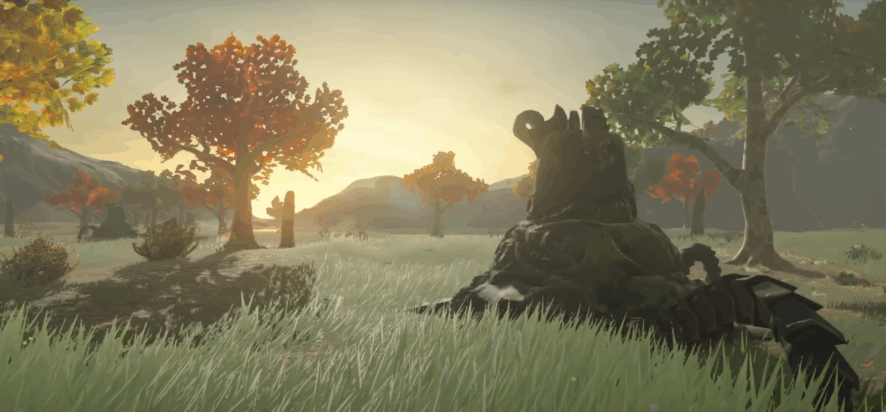
The Guardians’ reputation as being earth-shatteringly panic-inducing is well-earned. They trawl back and forth, their mechanical nature ensuring they have absolutely no human (or Hylian) qualities to them. They do not sleep or eat, and they can’t be distracted, lured, or disarmed the same way other monsters can. With Malice corrupting them, they exist solely to destroy — to kill.
Though you live in a post-apocalyptic world, they are a piece of that historic event that has not been pacified nor eradicated, and that still stalks the overworld searching for targets indiscriminately. Their theme alone is the fastest way to fracture the tranquility of a ride across Hyrule Field.
In Tears of the Kingdom, Gloom Hands pick up the mantle left by the Guardians. If you’re not familiar with their spawn points, they seemingly burst out of nowhere, shifting the tone (and your priorities) just as fast as their predecessors. They’re a threat on both the surface and in the Depths, but the Sky Islands are out of their reach. The latter, again, stands to be the most serene area on either map.
The Kingdom of Hyrule in the Era of the Wilds is by no means a safe one, yet this post-apocalyptic world achieves quietude not only in its most remote spots, but also where the Calamity and Upheaval’s survivors gather in villages and communities. Their persistence, their striving to live well no matter what threats come to their doors, keeps their world from being devoured by evil even in the century before Link rose from the Shrine of Resurrection.
The peace of the Era of the Wilds is not freely given, but fought for. Even in the years before Ganon’s final defeat, those pockets of tranquility that can be found across the Kingdom are testament to Hyrule’s refusal to fall to wicked, brute strength, despite the scars that are left in the battle.
The ruins of Castle Town are quiet as they are slowly reclaimed by nature.
Games are often a form of escapism, the Kingdom of Hyrule no exception. The peacefulness of the Era of the Wilds are not just part of the games’ story, but also a gift to us, visitors to the land when we play as Link. No matter where you are in the tale of Breath of the Wild or Tears of the Kingdom, there is space aplenty to live for a while away from the problems of your world, to breathe and, if necessary, to heal.
Caitlin Stratford
ZU feature writer and aspiring fantasy author. Hobbies include reciting obscure Zelda trivia to people who are politely feigning interest.


 by Caitlin Stratford on June 18, 2025