By this point in its long history, The Legend of Zelda series has developed an intricate mythology, and it appropriately stands alongside other epic fantasies and heroic adventure stories. But nothing exists in a vacuum, and, when the Zelda series first kicked off, it was necessary for the series to draw on other sources for its building blocks.
Of course, when The Legend of Zelda came to be, video game fantasies were fairly rudimentary. Nintendo’s flagship adventure series predated fellow console fantasy pioneers like Dragon Quest and Final Fantasy if only by mere months. The developers could only look back at games with simple visual palettes (or without significant visual components at all) as predecessors, such as Adventure, Tower of Druaga, Rogue, and various text-based fantasy adventures.
It’s possible to see the various traces of other works embedded in the firmament of the zelda series.
This left literature as a major source of fantasy inspiration, but the Zelda team has never emphasized literary sources when discussing its structure and bestiary. Zelda creator Shigeru Miyamoto has more often discussed his love of wandering the countryside as a boy when explaining the wide-open adventure feel of the initial entry in the series. The most notable admitted influence on the series from another media came from Miyamoto’s confession that Link’s initial look of green tunic and cap was a knowing nod to another famed fantasy hero: J. M. Barrie’s Peter Pan. But, with a little bit of analysis, it’s possible to see the various traces of other works embedded in the firmament of the Zelda series.
The beginning of a legend
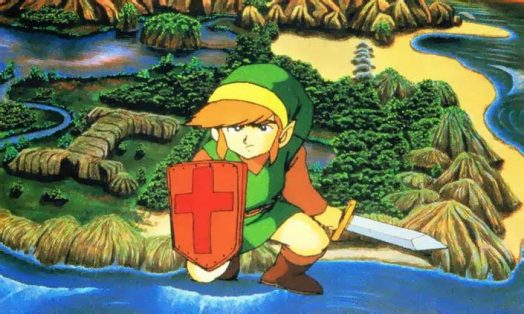
One glance at the original game tells us quite a bit about the thinking behind it. Link’s sword, shield, and overall look immediately set the stage as a Western-style fantasy, distinct from Japan’s own fantasy tradition of yokai spirits and wandering ronin. No, Link is more of the knight errant, a figure closer in spirit to Arthur or J. R. R. Tolkien’s Aragorn from The Lord of the Rings.
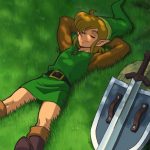
This is complicated by Link’s youth (though this is only apparent in the instruction booklet’s art as well as Miyamoto’s initial vision of the character), placing Link closer to the young heroes of traditional European folk tales and fairy stories, such as Jack of beanstalk and giant-killing fame.
Other details are readily apparent. The cross on Link’s shield is a rare bit of religious iconography from a company that eschewed such things from other developers, at least in U.S. releases, being one of Nintendo’s “Do as I say, not as I do” moves in its early, most puritanical era. The cross, also seen in the graveyard as the markers for the dearly departed (a detail echoed in Zelda II but soon after abandoned as the series’ own religious mythology developed), echoes the look of medieval crusaders, or perhaps the emblem of the dragon-slaying Red Cross Knight from Edmund Spencer’s epic poem The Faerie Queen.
Such an echo may not be entirely specific, of course. The 1980s were saturated with fantasy imagery in specialist circles, due in large part to the popularity of pen-and-paper role-playing games, most notably Dungeons and Dragons, which was highly influential on both sides of the Pacific. Wizardry and other early computer games drew heavily from the Dungeons & Dragons formula, which in turn influenced role-playing games on the NES, particularly with the advent of Dragon Quest.
A different kind of monster manual
But The Legend of Zelda was not an role-playing game, nor was it keen to wear its influences on its sleeve like other games did. While Dragon Quest took the Dungeons & Dragons and Wizardry formula and made it more Japanese (primarily through the art of Akira Toriyama), and the later released Final Fantasy seemed at times to steal straight from the Dungeons & Dragons bestiary entirely, Zelda renamed almost everything in its monster catalog to make them its own.
Thus, you got Moblins instead of orcs and goblins and Zoras instead of generic fish men. Even the most basic monsters got renamed: One might think a bat is a bat, but not when it is a Keese. Slimes became Zols, mummies became Gibdos, and centaurs got a furry recreation as the dreaded Lynels.
One might think a bat is a bat, but not when it is a keese.
In the earliest games, when there was only so much space for a limited number of monsters, this customization of the beasts did a lot to help make them unique and easily identifiable. Instead of fighting nameless soldiers, your hero was battling Darknuts. The name may have been a bit silly or little more than gibberish, but it was distinct, taking away the anonymity of the foes and making them specific to the world in which they lived. Compared to the countless goblins, kobolds, and other cannon fodder in an average Dungeons & Dragons campaign, where all of the creatures are indistinguishable from the folklore versions they are based on, the monsters of Hyrule had, despite their eight-bit simplicity, personality.
This went a long way to forging a unique identity for the Zelda bestiary, as did naming the boss monsters with distinct names such as Gleeok, which seems to be the name of a dragon rather than a different word for dragon, and the similarly-styled Aquamentus. This didn’t always seem to be the case, however. Dodongos are definitely an entire species of dinosaur-like beasts, as later established in future Zelda titles, while Gohma reappears again and again in the series as different creatures of various shapes and sizes.
The repetition of such names also helped make the Hyrule bestiary memorable. Even as some monsters came and went — the sparse appearances of Lynels for almost 30 years, for instance, or the minimal presence of the once-plentiful Moblins in Ocarina of Time — the repetition of a core number of monsters and bosses gave the series and its ecosystems of creatures a vibrant history. And when new monsters were needed, there were always other fantasy tropes to borrow from. A quick swipe of a green cyclops suddenly gave Hyrule the monstrous Hinox.
Taking from the best
The series would continue to pilfer material from various sources even as the games became more complex and self-referential. This is not uncommon, as most major fantasy series borrow heavily from earlier stories. The Lord of the Rings was heavily indebted to Norse legends and Icelandic sagas. The Chronicles of Narnia borrowed willy-nilly from a variety of literary traditions, Greek myths and Jacobean revenge tragedies being some of the most notable. The Chronicles of Prydain are heavily Welsh in character, specifically taking elements from the Mabinogion.
Most of the major fantasy series borrow heavily from earlier stories.
For the Zelda games, the borrowing really started with the 16-bit era. A Link to the Past went a long way to setting the Zelda mythology into a firm shape through a lot of literary repurposing. What is the Master Sword but a Nintendo-approved counterpart to Excalibur, Durandal, and Tolkien’s Andúril? That Link acquires the Sword of Evil’s Bane by pulling it from an Arthurian-style pedestal only seals the comparison.
Then there is the unusual design of the Hylian people and their fluctuating status. A Link to the Past established the Hylians as the early people of Hyrule, somehow distinct from the seemingly human inhabitants of the current land, but it also demonstrated that Hylian blood still appeared in some people, such as Link and Zelda, by way of their pointy ears. This seems to set up Hylians as equivalents to elves from standard Western fantasy series.
Later games, however, seems to suggest that all the human-looking inhabitants of Hyrule are Hylians, and the pointed ears became standard across all characters. The fluctuating status of the Hylian race, complicated by the byzantine timeline of the series, makes it hard to pin down what the earliest intentions were for the species’ history, but the fantasy elf is certainly their forebear, whatever their status. Although the series often describes the Hylians as being humans, visually, at least, they are much more similar to the type of elf seen in The Lord of the Rings, as well as countless other mass-market paperback fantasy epics.
The elf, in the visual form of Hylians, is the only traditional fantasy race to appear in Zelda games in any significant form. The blacksmiths in A Link to the Past are referred to as dwarven in the end credits, but this is the only reference to dwarves in the series. Starting with Ocarina of Time, Zelda games would begin to develop their own set of fantasy races, such as the Goron, Zora, and Kokiri (later Koroks). And while each species is inspired by earlier creations — rock monsters, fish men, and forest spirits all appear in various folk stories, after all — they hardly correspond with the major playable races that Dungeons & Dragons established, which were naturally influenced by and borrowed from Tolkien’s makeup of the Fellowship of the Ring. There are no hobbits, or copyright-free halflings, in Zelda games.
Since this is intended to be more of a survey than an exhaustive study, I won’t go into detail on every game. Some are obvious: The flooded Hyrule in Wind Waker borrows from various flood stories across the world, from the Bible to the Epic ofGilgamesh, while the various parallel worlds of many games — the Golden Realm/Dark World, the Twilight Realm, and Lorule, for example — can be traced to fantasy stories by authors such as Roger Zelazny and Michael Moorcock, both having popularized the very word “multiverse.” Others, like the warped reflection of Hyrule that is Termina, reflect older forms of portal fantasies, like Lewis Carroll’s Wonderland, where familiar customs and faces show up in different ways. And there is the fact that, ultimately, the series has never moved far past the basic “hero saves princess” structure it borrowed from fairy tales and Disney movies from the very beginning.
It’s clear that Zelda games, while increasingly reliant on their own mythology over the course of nearly two dozen games, started like every other fantasy series: stealing the best parts from other stories and dressing it up in new shapes. It’s a long-standing tradition, one in which modern fantasy games often look to Zelda for inspiration in order to continue the trend.
Stephen Milligan
Stephen Milligan first played a Legend of Zelda game when he was 11 and he's never quite gotten over it ever since. Now he writes essays about it in a continual but futile gesture to exorcise the Triforce from his soul. You can find him online on Twitter at @StephenThief, where he never posts, so there's not much point in following him, sorry.


 by Stephen Milligan on November 16, 2019
 Such an echo may not be entirely specific, of course. The 1980s were saturated with fantasy imagery in specialist circles, due in large part to the popularity of pen-and-paper role-playing games, most notably Dungeons and Dragons, which was highly influential on both sides of the Pacific. Wizardry and other early computer games drew heavily from the Dungeons & Dragons formula, which in turn influenced role-playing games on the NES, particularly with the advent of Dragon Quest.
 The elf, in the visual form of Hylians, is the only traditional fantasy race to appear in Zelda games in any significant form. The blacksmiths in A Link to the Past are referred to as dwarven in the end credits, but this is the only reference to dwarves in the series. Starting with Ocarina of Time, Zelda games would begin to develop their own set of fantasy races, such as the Goron, Zora, and Kokiri (later Koroks). And while each species is inspired by earlier creations — rock monsters, fish men, and forest spirits all appear in various folk stories, after all — they hardly correspond with the major playable races that Dungeons & Dragons established, which were naturally influenced by and borrowed from Tolkien’s makeup of the Fellowship of the Ring. There are no hobbits, or copyright-free halflings, in Zelda games.