The Legend of Zelda was a much smaller franchise when Zelda Universe launched in February of 2001. Oracle of Seasons and Oracle of Ages — only the seventh and eighth canon games in the series — had just gotten their Japanese releases. The Wind Wakerwas still months away from making its debut at Spaceworld 2001 and shocking the fanbase with its cel-shaded art direction. The Legend of Zelda manga by Akira Himekawa wouldn’t receive an official English publication through Viz Media for another seven and a half years. Spinoff games likeHyrule Warriorsor Cadence of Hyrulewouldn’t see the light of day for more than a decade.
There may have been much less of the series to enjoy back then than there is now, but that didn’t mean that The Legend of Zelda fans were any less passionate for Link’s adventures through Hyrule and other fantastical lands — it just meant that our coverage here at Zelda Universe was a little different during the website’s early years.
To say that we were in the dark on updates for the series most days out of the year would be an understatement. We were in a pitch-black abyss much of the time. The internet had not quite become a ubiquitous part of everyone’s daily life yet, and personal computers were a luxury for many people. There was no social media for Nintendo to maintain a constant connection to the public or for fans to spread theories and inside info to the masses — no Facebook, no Twitter, no YouTube, no Instagram for a 24/7 stream of news. If you wanted to chat it up with fellow Zelda fans, your best bet was to visit any of the largest fansites’ bustling forums across the web.
For many, the first time you heard the latest updates may very well have been when the newest issue of Nintendo Power made it to your mailbox (and oh, how we miss that beloved magazine). Unless you were there in person at a live event like E3, you were very unlikely to be at the epicenter of breaking news. We were all tethered to our desktop computers, with internet browsing on mobile devices being a long way off. Such is the reason why I was blissfully unaware of Twilight Princess’ epic debut at E3 2004 while I was on a middle school class trip in Washington D.C. I returned home several days after the fact to find Zelda Universe (and allZelda fansites) still going completely bonkers over the reveal. It was the 2004 equivalent of opening a group chat for the first time in a week and being inundated with messages.
Commentary from the creators of the series was rare, usually only being found in the occasional interview for a well-known monthly publication. Enlightening literature like Hyrule Historia, The Legend of Zelda Encyclopedia, or Creating a Champion were not yet being produced by Nintendo to provide fans with deep insight into the lore of the series and the creative process behind the world-building. If any comprehensive books like those did exist, they were only being released in Japan. The most common print publications that fans outside of Japan were reading were likely players’ guides (another staple of gaming’s past that has largely been subsumed by the digital age). As previously mentioned, Akira Himekawa’s Legend of Zelda manga didn’t start receiving translations by publisher Viz Media until 2008.
Fans had no choice but to attempt to fill in the saga’s many gaps themselves. If any single subject dominated editorial content for the Zelda fanbase in the early 2000s, it was undoubtedly the matter of timeline theories. We knew that some games were directly connected, such as Ocarina of Time and Majora’s Mask, or the original Legend of Zelda and TheAdventure of Link, but how they all connected to one another was a web that had scant hope of being untangled without Nintendo’s canon explanations. Still, that didn’t stop Zelda fans from spending years wracking their minds over the possible chronological order of the games, especially in regard to how the meddlesome timeline splits played out. If you talked to two different timeline theorists, you were likely to get two wildly different yet fiercely adamant takes on the topic. It was as hotly contested as any scientific field.
The debate over timeline theories was easily the most popular topic of conversation in Zelda Universe’s early days.
The ambiguous nature of a lot of the series’ world-building back then also prompted many deep dives into the possible mythology and narrative themes of the games. As Nintendo remained mum on many of the inspirations for The Legend of Zelda, fans readily examined the in-game worlds and offered their own answers. Between the mid-2000s and the early 2010s, Zelda Universe had two different editorial teams that were dedicated to such bold, hard-hitting pieces — the Behind the Rupees team (which I proudly joined as one of the earliest members in late 2005) and The Missing Link team. If you frequented our website during those years, you might remember the writings of longtime Zelda Universe members such as Max “lord-of-shadow” Nichols, Pipking, Hombre de Mundo, Crab Helmet, Holly, and Dan “Hylian Dan” Merrill. Dan was especially well known for his thought-provoking essays “The Message of Majora’s Mask” and “Immortal Childhood”. All these years later, we still find those pieces getting views when we check our web traffic.
Fan speculation may not be nearly as heavy as it used to be, but all of the plentiful developer commentary that’s now readily available has opened a new door for our writers here at Zelda Universe. The rise in behind-the-scenes details allows us to write the Zelda’s Study columns, identifying elements of series that are based on real-world influences, as well as little-known facts about the production of the games. There was a time when we would have only been able to theorize about how much of the Sheikah technology in Breath of the Wild was designed to resemble pottery from the ancient Jomon era of Japan, or what kinds of fish were used as references by the art department when creating the Zora. Informational material such as the Creating a Champion book and “The making of The Legend of Zelda: Breath of Wild” video featurette from Nintendo have gone a long way toward shedding light on the murkier parts of the series that we love.
But even when Nintendo doesn’t come forward with the answers, many of us are able to make connections far easier nowadays than we would have when writing during Zelda Universe’s infancy. Simply put, we’ve grown up. As the years have passed, we’ve gained more life experience, progressed in our formal education, and consumed more art that we can relate to The Legend of Zelda. I feel as though I speak for far more than just myself that, as a preteen, I wouldn’t have been able to fully appreciate such features that examined the literary fore-bearers of the series, or how Majora’s Mask is defined by the portal fantasy genre (shout out to Stephen Milligan for writing those excellent pieces). Many fans wouldn’t have even had the chance to read them. At the further risk of making anyone feel old, I must point out that we have members of the site staff who hadn’t been born yet when Zelda Universe launched in 2001.
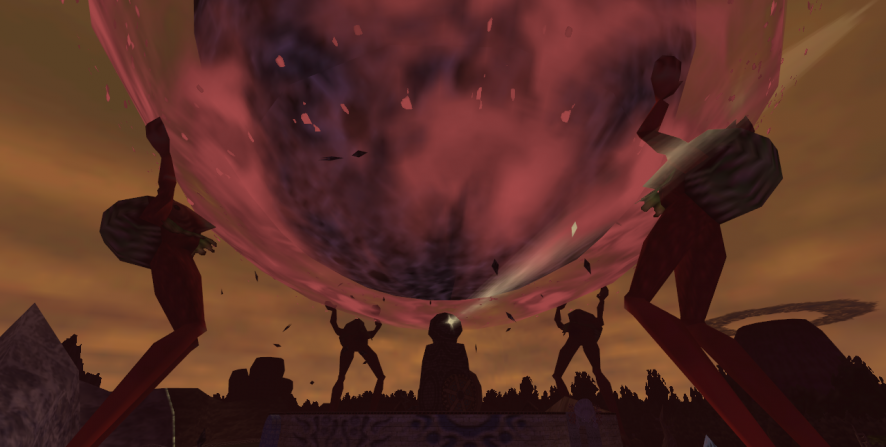
Majora’s Mask is loaded with heavy themes that writers have examined at length over the years.
I had my first article published on Zelda Universe when I was just 15 years old. That was exactly half my life ago. What I knew then about spiritual beliefs around the world while writing a piece about the religious elements in The Legend of Zelda was far less than what I know about different spiritual beliefs at age 30. I have consumed far more fictional entertainment to this point in my life than I had by my college years when I was analyzing the tonal diversity between Zelda games and comparing it to other fictional properties.
It’s fun to look back at my older work not just to see how my knowledge differed back then, but also how my opinions, and in some cases, the opinions of the Zelda fanbase at large differed. I was admittedly part of the crowd that was outraged upon learning that The Wind Waker was going to be a colorful, cartoony adventure with cel-shaded graphics. Few reveals have polarized a video game fandom the same as that debut did. It was perhaps the first news story that rocked the online Legend of Zelda community. The mixed feelings on The Wind Waker’sart direction played a role in the staggering excitement that came from the reveal of Twilight Princess in 2004, which brought back Link as a young adult in a game with more realistic, detailed visuals. The hype for Breath of the Wild was immense, yes, but I’m still not sure it topped the anticipation that led up to Twilight Princess’release.
Eighteen years later, it feels absurd to say that The Wind Waker was ever controversial. The vibrant cel-shaded graphics that once revolted so many fans are now beloved for creating one of the most charming art directions in any video game. There’s a good reason why Nintendo saw fit to give The Wind Waker a gorgeous HD update for the Wii U. Fans readily welcomed the remaster and now continue to clamor for a Switch port. The Wind Waker withstood an inauspicious start to eventually win over countless gamers and become one of the most acclaimed entries in The Legend of Zelda. I definitely reversed course and now consider it a favorite of mine.
That polarizing debut is a distant memory for our beloved The Wind Waker.
Then there’s Majora’s Mask, once an overlooked follow-up that released at the tail end of the Nintendo 64’s life cycle and spent years living in the shadow of its groundbreaking predecessor, Ocarina of Time. There may not have been much talk about Majora’s Mask in the early 2000s, but fans more than made up for lost time as the years went by. Hylian Dan’s “The Message of Majora’s Mask” was only the tip of the iceberg when it came to academic analyses that Zelda Universe later published, with the game’s provocative themes going on to be lauded and appreciated by far more than those who did during its quiet debut.
Looking at just how much the perception of games like The Wind Waker and Majora’s Mask have changed in the last two decades makes me very curious as to what trends await The Legend of Zelda fandom. Maybe I’ll even have the chance to write about them someday.
Hey, what’s another 20 years following a series that I love at a website I’ll always call home?
Jeffrey Pawlak
Jeffrey Pawlak is the Features Director for Zelda Universe, and has been a member of the website's community for more than 20 years. He is also a high fantasy author and an aspiring comic book artist.


 by Jeffrey Pawlak on February 27, 2021