Xenoblade Chronicles: Definitive Edition is the HD remake of Xenoblade Chronicles, a strategy-based role-playing game for the Wii that balances deep combat options, imaginative and beautiful environments, endearing characters, and an engrossing story to create what many people consider to be an example of the absolute best the genre has to offer. Mixing elements from modern action RPGs and the classic format of turn-based combat, Xenoblade Chronicles requires the player to use tactics, upgrades, and teamwork to achieve victory. It is a clever and complex adventure that manages to offer both visual action and intricate strategy.
For this review, we wanted to hear more than one perspective on the game, so we had two members of our staff tackle the adventure. Zac Pricener, who has never played before, will provide the main body of the review, while Cody Davies, who played the original, will chime in and mention any notable changes from the original version.
Full disclosure
Nintendo of America graciously gave Zelda Universe a review code for Xenoblade Chronicles: Definitive Edition.
Zac Pricener, the noob: Despite all of the acclaim Xenoblade Chronicles has received over the years, I have never played any version of this game. I’ve never been a huge fan of RPGs, and I somehow missed the news about this game’s release. I only became aware of it during the development of Super Smash Bros. for Wii U and 3DS when fans clamored for Shulk to be added as a playable character. This remake was my chance to give the game its chance. Did Xenoblade Chronicles: Definitive Edition distinguish itself in my eyes from its contemporaries? Time to find out.
Cody Davies, the veteran:I’ve played through Xenoblade Chronicles before, so I’m already quite familiar with the series. That said, it’s been a few years since I last played it. Plus, I have to admit that in some places the original game was kind of ugly. It’s been good to have a chance to play this game again with all its updates.
A tale about the past, present, and future
Our story starts at a logical point: the beginning. Eons before the present day, two massive gods waged a seemingly endless battle within a seemingly endless ocean. The two gods, the Bionis and the Mechonis, were evenly matched titans that dealt crippling blows to each other. Neither gave in, but neither gained the advantage. Eventually, both gods succumbed to their wounds and died, their bodies still locked in combat.
An epic origin story for an equally epic game.
Ages pass, and eventually all manner of biological creatures, including the humans (called Homs), sprung to life on the Bionis’ continent-sized remains. The problem, however, is that the same happens on Mechonis’ body. His prodigy, the vile Mechon, were robotic in nature, and seemed intent on destroying all life on Bionis.
From the start, Xenoblade Chronicles captures your attention with its grandiose mythology and the genesis of the characters you will later play as and grow to understand. There are some similarities to be found to our world, but since this game takes place on the literal corpse of a colossal god, the unbelievable nature of this tale is never forgotten.
The setting and backstory are not easy to overlook, but the characters are easily the high points of this fantasy. I’ve never been a fan of the tropes seen in RPGs, mostly because I’m not a fan when tropes are used heavily and repeatedly. (I’m not a big fan of anime for this reason as well.) And one of the major tropes in RPGs is the use of character clichés. The main character who tends to be overly serious and dramatic about their duties, the damsel-ish sidekick who secretly has feelings for the main character, the thick-headed yet sincere friend, and the mean-spirited authority figure: these personalities are prevalent and far too predictable in RPGs — and they all appear in Xenoblade Chronicles.
There is a special difference between how Xenoblade Chronicles handles these clichés when compared to many other RPGs, however. The special difference is that this game handles the clichés well. Many protagonists of the genre could be replaced with cardboard cutouts of themselves with minimal impact made on the game’s story. Monolith Soft deserves a lot of credit for this game’s hero, Shulk. He is a multi-faceted, down-to-earth character who moves the story and relationships forward with his kind personality and loyalty to his friends. The same goes for Fiora, one of Shulk’s dearest friends and the “she isn’t interested in the main character but clearly is” girl of the game. Even Shulk’s mortal enemy, the evil and strategic Metal Face, comes loaded with its own kind of depth. They breathe life into the narrative in a way that is not exactly different from other RPGs, but the interplay is more enjoyable and organic.
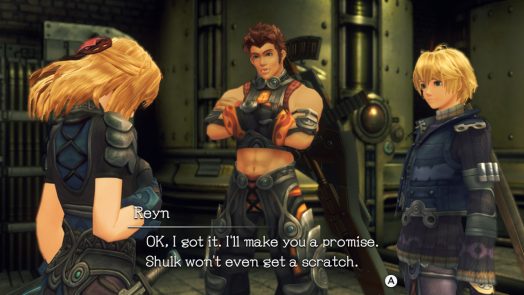
Oh, and Reyn is a character too, I guess. Apparently, a lot of the time, it’s “Reyn time.” And if you are not sure when it’s Reyn time, don’t worry he’ll tell you — again and again and again. That would have to be my biggest issue with the characters. Having loads of personality during story moments is great. Having way, way too much personality during and after the battles is not. If it wears on you a lot to hear the same line of dialogue repeatedly, be prepared to make the sacrifice and turn off the in-game voice audio.
With these compelling characters (plus Reyn) established, the game is ready to take the player into the heart of the story. After a year of peace earned from a decisive battle against the Mechons, the Homs of Colony 9, Shulk and his friend’s home, are suddenly attacked by the returning Mechons, though this time they are accompanied by Metal Face. Shulk attempts to fend them off with the Monado, a powerful and almost supernatural sword that can cut through the Mechons with ease, but to his horror, Shulk learns that the blade is useless against Metal Face. The Mechons eventually retreat, but not before leaving Colony 9 with heavy losses. Shulk and his friends vow to destroy their enemies, and set off in search of the means to do just that.
The story carries many of the same beats seen in other RPGs, so I did find it disappointing that I could predict the sequence of events fairly well, including some of the plot twists. I did, however, thoroughly enjoy how polished the tale’s presentation and delivery were.
Cody (the veteran): As Zac says, if you’ve played through this kind of game before, most of the plot beats aren’t going to be groundbreaking, but in my opinion, that doesn’t stop the story from being both fun and well-paced. Whether something uses familiar tropes is, in my view, an entirely separate discussion from whether it’s good or not — you could ask ten different people to prepare a meal that includes chicken and rice and each one will come out differently. In this case, it has led to a very polished final product.
Speaking of story, don’t skip out on the side-quests! Even after you’re done with a major hub plot-wise, you can continue to go back to it throughout the story and new quests will open up dealing with the interactions between the townsfolk. In particular, if you enjoyed Breath of the Wild‘s Tarrey Town, there’s an in-depth community rebuilding side story that you will enjoy throughout the game. The Heart-to-Heart conversations (which unlock when affinity is high between certain characters) also reward players with further meaningful interaction between your party members.
I also love the level of personality in the game. I’ve heard some people criticize the voice acting, but I honestly don’t really hear it (aside from the aforementioned repeated lines of dialogue during combat). I suspect that for a lot of Americans it’s not often that they hear a varied British voice cast so it jumps out to them as strange, but for me as an Australian, it’s not really particularly different from any number of times I’ve had to listen to a Japanese Samurai speak like they’re from Texas.
Another thing worth noting is that if the story and characters are your main area of interest, one helpful addition is the new Casual Mode, which lets you significantly reduce the percentage of time you spend in combat. There are no penalties attached to the mode — you won’t gain less EXP or get less loot or anything along those lines, but rather it seems to simply increase your damage output while reducing your enemy’s.
The main thing the Definitive Edition brings to the story though is Future Connected, a new epilogue chapter to the game. I won’t talk about the details so as not to spoil anything, but if you’ve already played the original game, don’t feel like you need to complete the entire game again first — the epilogue is available in the main menu from the start. If you haven’t played XenobladeChronicles before, though, you should avoid this chapter until after you’ve finished the game, for obvious reasons.
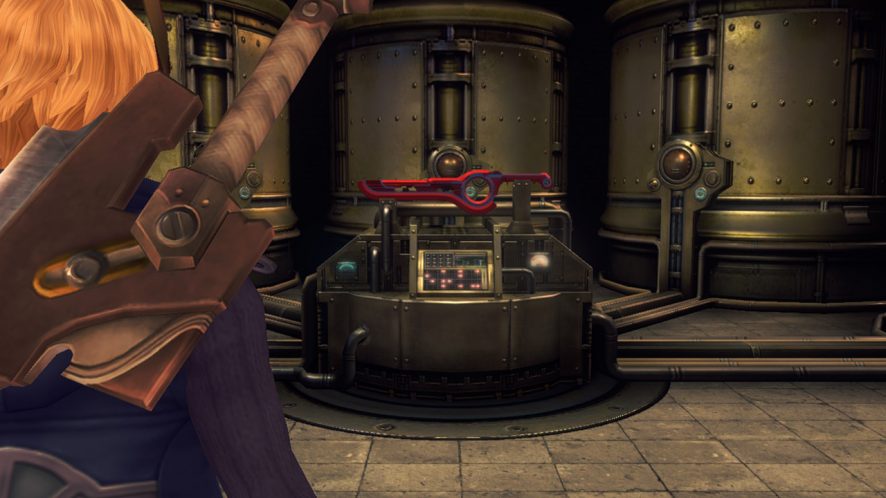
The Homs’ only chance at survival rests in Shulk’s ability to unlock the power of the Monado.
The game’s mechanics have an affinity for the arts
At the core of Xenoblade Chronicles are the themes of family, comradery, and friendship. Very “human” elements, to match the story’s focus on Homs’ struggle to survive against their synthetic foes. These themes are weaved through every part of the game, and shine through in all of the gameplay mechanics, side quests, and collectibles.
The sheer amount of gameplay features present in this game is amazing. Each character fights by using basic stats such as attack strength, and they also use physical and energy-based moves (referred to in this game as ether, a major gameplay and plot component and the supposed building block of all existence), but you also have other, unique tools, such as Ether Gems and Ether Crystals, which can be used to upgrade your weapons and clothing.
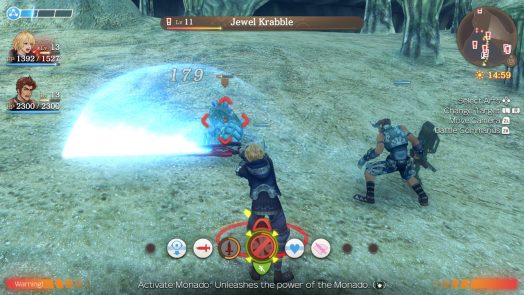
Learning how to successfully use the Arts and perform the Chain Links, along many other mechanics, are critical.
Added to these standard fares for RPG battle systems are the Arts and the Monado Arts. The Arts are the attacks the characters can use, and each character has a unique set of skills that can be used in battle. The Monado Arts, which can only be used by Shulk, are a special subset of his normal list of moves. These Monado-specific Arts allow Shulk to perform powerful attacks and status-altering techniques that have effects on the enemies, his friends, and himself. The Monado is the only weapon that can effectively damage certain enemies (such as the aforementioned Mechons) and defend against specific enemy Arts, so proper use of its abilities is critical throughout the game.
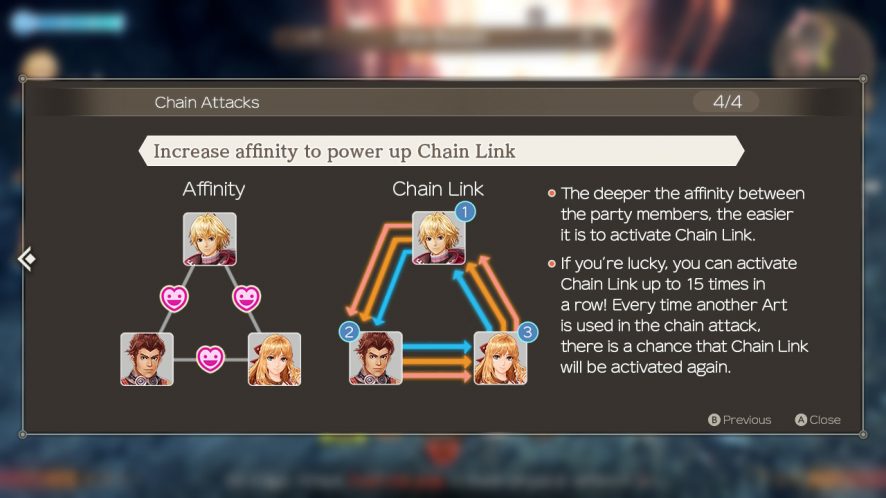
Chain Attacks help take down powerful enemies quickly.
Those classic options and the new upgrades are great to see, but players can also expect to find mechanics created specifically for the Xenoblade Chronicles experience. The most important of these relate to the connections the characters have with each other. In battle, these manifest as options such as Chain Attacks, strategic positioning, and Skill Links. Chain Attacks are combos that Shulk and his friends can unleash to multiply the damage given as each move is successfully performed. The positions of your characters matter because you can move freely around the enemies, meaning that where you and your party members are located in relation to each other and the opponent can have an effect on the battle. Skill Links are affected by affinity, the upgradeable measurement of how strong the bonds are between the characters, which will allow your party members to borrow each other’s skills during a fight.
The characters must combine their efforts and fight as a team.
There’s more to learn than what I’ve mentioned: Character stats, weapon and gear upgrades, stat bonuses, upgrades for each character’s Arts, and much more are important factors to consider when fighting and developing your party. You’ll want to be certain that each tool at your disposal is managed and used to their fullest.
Fans of the Xenoblade series and classic RPGs will be sure to love all the variety in the battle, upgrades, and level-up systems, but, for me, that was one of the largest hurdles in playing the game. This is an RPG game for RPG fans, which means that players unfamiliar with how complex these types of games can be might grow frustrated with everything they need to learn and understand. To that end, Xenoblade Chronicles is probably not the best choice as someone’s first role-playing experience.
If I’m being honest, I would probably have often resigned to button mashing during the fights in hopes that something would work if I wasn’t paying close attention for the sake of writing a review. There were times when I felt like I was spending more time reading about how things worked rather than actually using them. Maybe you don’t get as lost with RPGs as me, but if you do, it’s something to consider before beginning a long journey with this game.
There is a wide array of options for you to upgrade and customize for each character, including their appearances.
At least there’s more to do than fight. Throughout the adventure, you’ll find that there are a bevy of collectibles to find and side quests to complete, all of which add greatly to the entire experience. Most of the NPCs have something to request of you, whether it be to defeat some pesky monsters or do something as mundane as delivering food to a woman’s grandson. You can also build your affinity with the NPCs, which nets more quests to complete and items to earn. The collectibles are numerous and archived in the Collectopaedia, which gives those with a completionist heart something that will satisfy their cravings. To top off the fun, later on in the adventure you can unlock other activities, like the time-attack challenges. This added content may not affect the main quest much, but they do a lot to make the game more expansive and satisfying.
Cody(the veteran): As someone with a background in both JRPGs and MMORPGS (which this game’s combat system resembles in some aspects) I really enjoy the mechanics side of the game. If you’re not super interested in engaging with it, I will once again point to the new Casual Mode. Some gamers get really upset at the inclusion of this kind of mode, but in my view, we should let people play games however they enjoy them! If you’re interested in digging deep into the gameplay mechanics though, the game has a lot to offer. Every once in a while I will switch up my playable character to keep things fresh, as each character plays in a different style.
Speaking of MMOs, if you’ve played one it might help you keep track of what your characters are meant to be doing, as your three-character party tends to operate with those sensibilities in mind. In other words, there are abilities for DPS, Tanking, and Healing, and different abilities encourage you to play in different styles. Shulk, for example, resembles something like a Rogue class from World of Warcraft, in that he will deal the most damage if someone else (such as Reyn, who has several abilities that increase his threat level among enemies) pulls the enemy’s attention away first, thus enabling Shulk to do double damage with his Back Slash technique.
I agree that the various game systems can become complicated to keep track of, but I should also mention that this aspect has improved from the original version of the game. One of the quality of life changes added to the Definitive Edition was to redesign the menus and parts of the navigation. It’s still not perfect — for example, I would still like to see the weapons/equipment menu streamlined — but it’s a definite improvement.
A treat for the eyes and ears
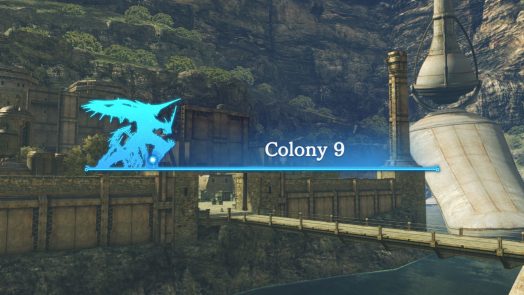
Speaking of expansive and satisfying, the visuals and atmosphere of Xenoblade Chronicles are some of the most highly regarded parts of the game, and for good reason. Considering the game takes place on the remains of a deity, it is unsurprising that the locations visited are mixtures of grand, beautiful, and massive. From the quaint and cozy dwellings of Colony 9 and the valley it is nestled in, to the massive, sprawling fields of Gaur Plain, it’s impossible to avoid soaking in the beauty and detail of each area. There’s also the fact that each new area is an obvious part of Bionis’ body, an example being how Gaur Plains rests on Bionis’ Knee. Time moves in Xenoblade Chronicles as well, so when day turns to night, you can expect to see many of the environments change from one type of beautiful to another. The world of Xenoblade Chronicles almost seems incapable of disappointing players with what it presents.
Gaur Plain is the first massive and open area explored, and it sets high expectations that are met throughout the rest of the adventure.
The views are spectacular, but I think that is my issue with the locales: So much of it is merely presentation. It’s a problem I’ve had with many RPGs and even some sections of certain The Legend of Zelda games. (I’m looking at you, Ocarina of Time and Twilight Princess.) Many of the environments exist to only be put on display. It’s all a set piece, which I always find disappointing. I prefer when a game lets me dig deep and find secrets within its environment. It’s not a critical setback, but the show-to-substance ratio might let you down if you prefer locales with more interactive features.
The landmarks, and even the story events, are sights to behold, but they would be incredibly dull without the accompanying music track. Any Xenoblade fan, RPG fan, or even Super Smash Bros. fan could tell you that this game’s songs are worth the praise they get.
Every new location earns its own special title introduction.
Every track matches the location and moment in tone, scope, and intensity. You can feel the same tension Shulk and his friends do as Metal Face flies down to confront them. The serenity and sense of home that Colony 9 offers can be heard in its theme. The thrill of wide-open adventure that covers every bit of Gaur Plain is brought to life by an epic melody. There are also multiple themes for each location for day and night cycles. Monolith Soft knew they needed the soundtrack to reach a level far beyond that of background notes, and it’s impossible to deny that the level has been reached.
Cody (veteran):XenobladeChronicles was always a stylish game, by which I mean that the theme of traveling around a giant body and seeing the different locales and how the environment has adapted to them was always really interesting. A lot of the actual prettiness of the game, though, was lost in the kind of muddy-looking original Wii release, so it’s good to see the improvements here. The character designs, too, have been updated to be more in line with the art style of Xenoblade Chronicles 2, which I have personally appreciated, though it’s worth noting that the original art style did have its own kind of grungy charm, if you put aside the graphical quality itself.
I agree that it’s unfortunate that the environments are mostly set pieces rather than interactive, but to be fair that’s also how I feel about a lot of 3D games in a post-Breath of the Wild world.I’d love to see a more substantial change to the way players interact with the environment of Xenoblade Chronicles, similarly to the way that a game like Monster Hunter World reworked the more finicky parts of that series, but I suppose that can wait until the next game in the franchise.
As for the music, there’s not much to say other than that XenobladeChronicles has a fantastic soundtrack. It features remade versions of the original, but you can also go ahead and change it back to the original music in the settings.
Final Words
Zac (the noob): Having finally played Xenoblade Chronicles: Definitive Edition, I can now understand why so many people adore this game, but that does not mean it is without flaw. I played this game for ten hours before knowing if I enjoyed the direction this game was leading me, which is nine hours more than I typically give any game. I of course gave an extended grace period, considering the slower-paced nature of RPGs, but if I wasn’t playing for the sake of reviewing it, I know there would have been a good chance of me calling it quits before reaching my point of investment. I won’t take away from this game’s achievements, but I still cannot say there is an RPG out there that conquered my indifference to the genre.
Cody (the veteran): In my view, Xenoblade Chronicles is a game with high replay value, as there are a lot of interesting systems in the game, giving you plenty to do even if you remember the story. The additions to the Definitive Edition aren’t massive, but the upgraded graphics, better menus, various other tweaks, and an all-new epilogue make it so that it’s definitely the best version of the game to play.
If you are a fan of classic RPG games, then there is a lot for you to love about Xenoblade Chronicles: Definitive Edition. A story that grips your attention, characters and enemies that bring the world to life, intricate mechanics and side content that make the battles and the adventure fulfilling, and a spectacular world paired with an equally spectacular soundtrack: These all add up to a well-polished experience. Anyone who loves a complex RPG really has no reason why Xenoblade Chronicles: Definitive Edition should be absent from their list of must-play games. But if you are someone who is less dedicated to the genre and are unsure that you’d love this game for what it is, you might want to consider playing other, simpler titles first.


 by Zac Pricener & Cody Davies on June 17, 2020