Review copy provided by Square Enix.This game was reviewed on Nintendo Switch 2. It is also available on PS5, Xbox Series X/S, and PC.
Despite the series’ reputation and popularity, we actually don’t get many games that resemble classic Legend of Zelda titles. Top-down action adventure games are plentiful, but the moniker “Zelda-like” hasn’t quite caught on. The tightly constructed, puzzle- and combat-filled adventure games are iconic pieces of art and difficult to replicate in terms of design. But every so often, a game developer will try their hand. Already this year we received the excellent Game Boy-homaging Mina the Hollower and now, Square Enix and Team Asano are releasing The Adventures of Elliot: The Millennium Tales. And this is a risky play: Thus far they’ve only published turn-based RPG’s with the Octopath Traveler series, and the tactical RPG Triangle Strategy — both of which are genres Square has a great track record with. How do they fare with a straight-up action-adventure title in the same vein as the 2D Zelda titles? After playing through the full game ahead of its release, I think the answer will depend on your patience.
A Tale of the Ages
You play as the aforementioned Elliot, an adventurer who is tasked with traveling across time to save the world of Philabieldia from an imminent threat. It’s a standard premise, but there’s something very intriguing about venturing through four different eras of history. From a worldbuilding perspective, it can be really interesting to see characters reference events that seem ancient to them, and then go live those events yourself. The main throughline to keep track of each era is magic: whether humans have discovered it, wield it, or are still trying to figure it out. You get to meet the ancestors of certain characters and experience stories that become myths and legends in later eras. It’s not the first game to use time-travel in its storytelling, but the way it’s used here is really well-implemented.
I can’t quite say the same for the characters. Everyone is fairly by-the-numbers: Princess Heuria is the soft-spoken, self-sacrificing Zelda stand-in, Euygene is the glasses-wearing smartie who shares historical facts on magic when exposition is needed, and Elliot himself is perhaps the most basic hero you can imagine. He’s unabashedly good, accepting every quest put to him, donating to orphans, and being extremely polite in each scene. There’s nothing inherently wrong with a blank-slatey protagonist, but as Elliot is the game’s namesake, it would have been nice to give him some more distinguishing features (ironically, a character in the game’s opening moments mentions Elliot saying “he does have his quirks”… yet I have to disagree. He would have been a much more interesting character if he was quirky!).
The story still has some genuinely heartfelt moments though, particularly in its very satisfying conclusion, which neatly ties several disparate threads from each era together. It is worth noting that this game has a couple of different endings, and the requirements to unlock the “true” one aren’t readily apparent unless you’re thorough in seeing each era’s main storyline to its conclusion. Going through all of them is certainly worth it, but there were a few annoying moments where it was unclear what I should do next until I eventually talked to a random unmarked NPC who pointed me in the right direction.
Pixels, Polygons, Production Value
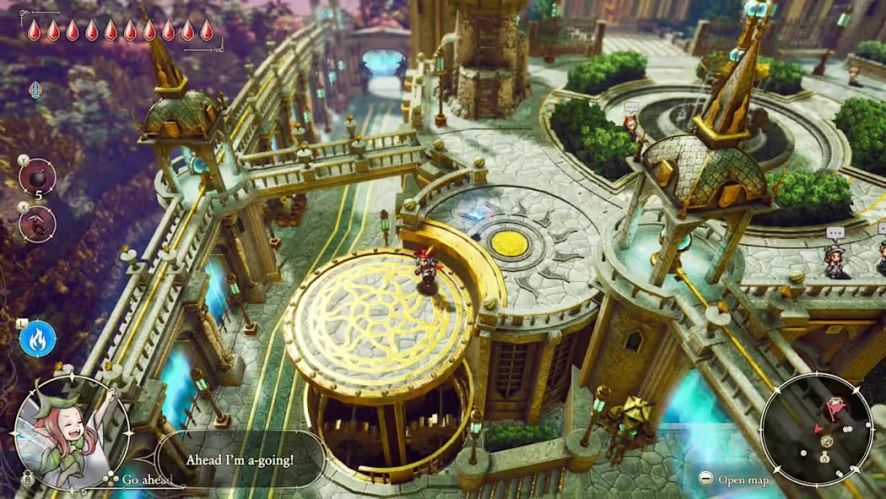
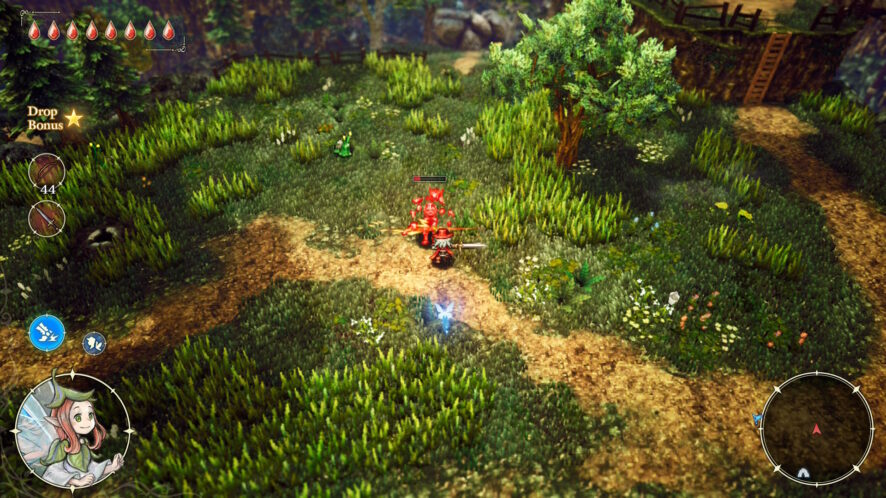
Team Asano has once again used their signature HD-2D art style for their newest title, and it still impresses. Traditionally-animated character sprites don’t feel out of place in the three-dimensional world thanks to clever use of texturing and impressive lighting effects. Philabieldia is a pretty world to explore with several different biomes, and in true Square Enix fashion, all aspects of the game’s presentation are top-tier. The fully-orchestrated soundtrack is perhaps the biggest highlight, and more proof that even traditional top-down adventure games can have sweeping scores that rival big-budget, triple-A titles.
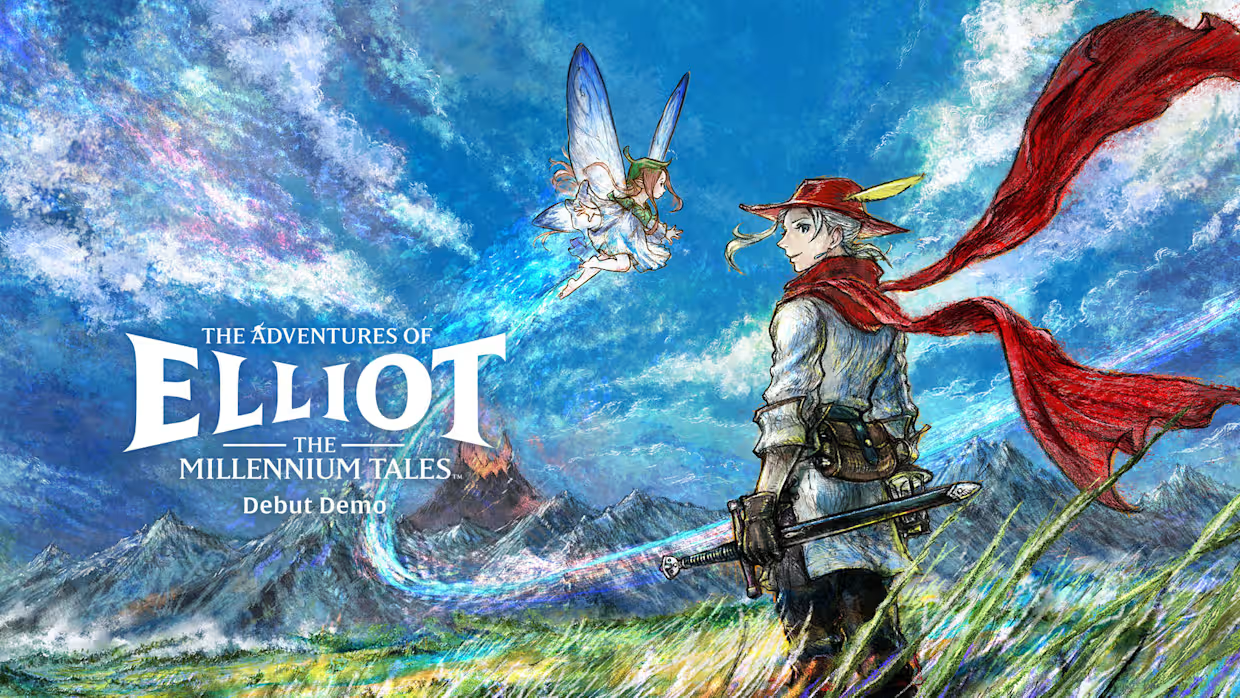
I may have qualms about Elliot’s lack of interesting traits, but I do think his character design is great, with a strongly identifiable sprite and a gorgeous character portrait to match during dialogue sequences. The game has a myriad of cutscenes — perhaps too many. Considering how much of the game’s run time they take up, less patient players may be tempted to skip most of them. Each is fully voice-acted, and the acting itself is well-done, if a little flat at times. I found Elliot’s fairy companion, Faie, to be a real standout. She’s bursting with enthusiasm and childlike wonder in each step of your journey, though much like everyone’s favorite fairy Navi from Ocarina of Time, you are going to hear the same voice clips from her a lot. The developers did include a “chattiness” option in the settings, but even after switching her to “reticent”, she still frequently chirped up whenever I activated one of her abilities…and never failed every few minutes to remind me that “you should consider using your shield every once in a while!” when I took damage.
Fighting with Fairy
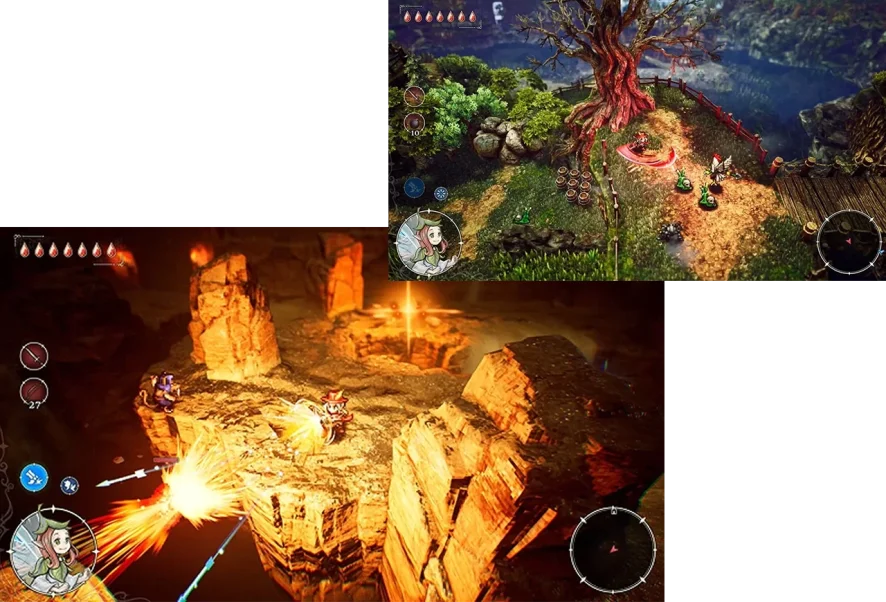
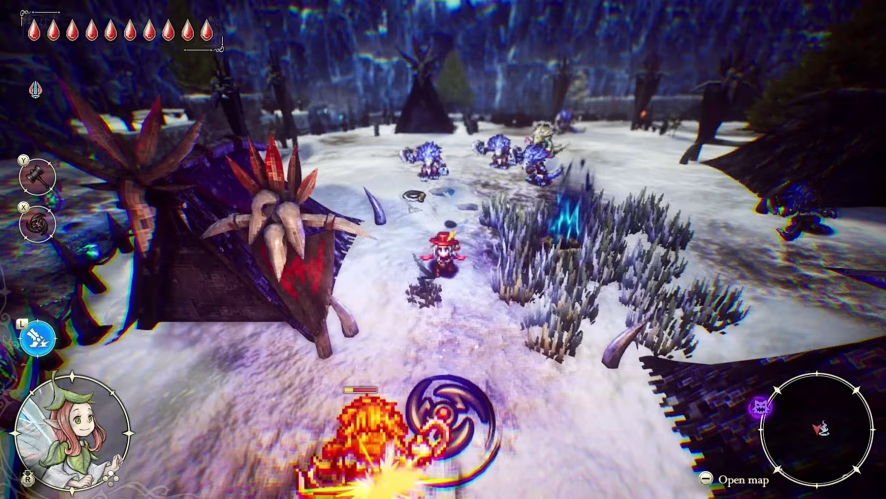
You can rest assured that my pension for not using a shield is a purely personal failing: The combat in The Adventures of Elliot is excellent. You are given seven different weapons to play with, and each is a joy to wield. Despite this being the first title Team Asano has created where they had to consider hit boxes in combat, they really honed in on how fun it is to vanquish large groups of enemies in almost any way you choose, with haptic feedback and screen shake adding to the satisfying feelings of landing your blows. There’s not a great deal of enemy variety, but the ones on offer are fun to take on, and all have aggressive patterns that keep you on your toes.
Early on, your movement options are pretty limited. Getting around does not feel slow per se, but you are encouraged to use your shield a lot in battle, as there is no traditional dodge roll or dash at the start. Eventually, you do get fairy abilities, such as a vortex that can suck enemies away into pits, or a dash that makes you positively fly across the screen until you hit an obstacle or run out of energy. Add in the fact that Faie can attack enemies on her own and can be independently controlled with the right stick, and there are enough layers and variety to keep combat fresh throughout the adventure. It’s usually worth changing up your approach on the fly, as the game incentivizes you to use play smartly thanks to its “drop” system: as you maintain an unbroken streak of defeating enemies without getting hit, they drop better rewards, such as magicite.
Magicite is the one big “RPG” element in this action-RPG. It’s a resource that mainly comes from enemies but occasionally also appears in overworld chests, and it can be converted into buffs for your weapons. Think of it like a badge system of modifiers, but each of your seven weapons has its own slots to equip. These are locked not behind experience but economy, as you have to pay to upgrade your capacity to equip more modifiers. Examples include basic improvements such as a higher chance of critical hits or faster special attack charging times, but there’s also a handful of unique combat-changing aspects, such as making your bombs freeze enemies or having your spear hit twice with each successive attack. Even though these abilities are mostly unlocked randomly via a “gacha” style, I had a lot of fun tinkering with each of my weapons and making them fit my personal play style.
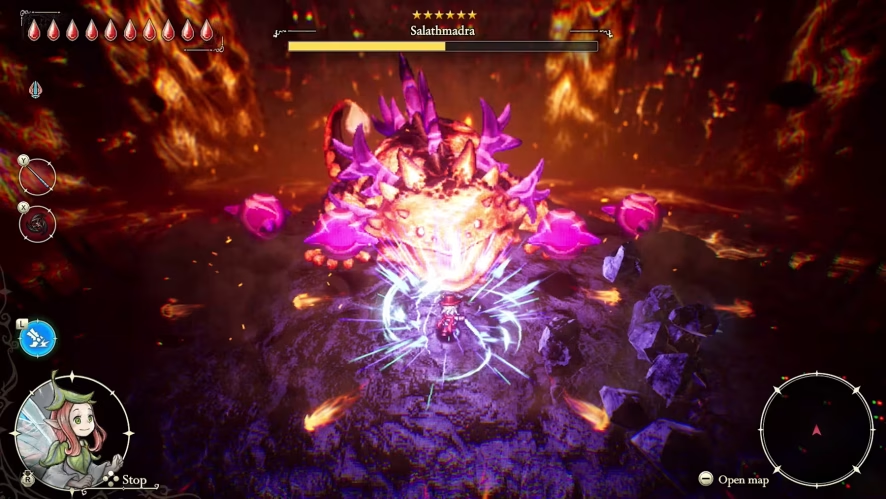
The bosses in Elliot are also great. They offer a lot of spectacle, and a lot of them were genuinely challenging. For anyone’s first playthrough, I highly recommend playing the game on “normal,” despite the difficulty option being labeled as “for players new to action games.” I died quite a lot in both the normal and hard difficulties. There are options to mitigate the game’s challenge, such as letting Faie revive you by giving up some of your currency, but overall, the game felt just hard enough on the default difficulty to keep me on my toes without getting too frustrating.
A Fun But Flawed Structure
The moment-to-moment gameplay is solid, but no game inspired by The Legend of Zelda is complete without dungeons, and I’m pleased to report that The Adventures ofElliot does not disappoint in that department. Throughout the main story, you’ll traverse large caverns, trees, and volcanoes. Each is a standard lock-and-key affair, but they’re very good takes on that classic dungeon type. There are plenty of core tenets Zelda fans will recognize: multiple floors, boss keys, sliding block puzzles, changing water levels, and rooms that stay locked until you clear all the enemies within them. Interestingly, each dungeon can also be found in other eras, which means you could potentially stumble into one that isn’t relevant to the story yet. Thankfully, if you enter a dungeon in the wrong era, they usually block off the majority of accessible rooms, meaning that you can only get so far before finding a dead end (and are usually given a treasure chest for your trouble). More on that later.
Elliot also takes a page from Breath of the Wild‘s book by including shrines throughout the overworld that offer short but sweet challenges. Some are combat-focused, while others have platforming or puzzles, but all were decently fun to complete, even though they don’t boast much of a challenge. The game also features a ton of side quests. They’re not especially interesting (they all boil down to fetch quests), but they do flesh out the NPCs more, and for some players, the sheer quantity of them will outweigh the quality. If you’re a completionist, you’ll have a field day trying to do them all, especially because several of them span across multiple eras. But this finally brings us to perhaps the game’s biggest flaw: because of how its structure works, you’ll play through the exact same locations and combat scenarios multiple times.
I mentioned how each era of Philabieldia’s history is interesting from a lore perspective, but truthfully, there’s not much difference when hopping between them. Apart from the main town, the overworld is practically identical in each era. Not only that, but to progress the story of each era you have to use the exact same routes — effectively clearing out the fog on the exact same map — four times. Each guidepost does not give you fast-travel until you’ve manually travelled there again, meaning you will be retreading the same ground a lot. One can’t help but wonder why the game doesn’t let you unlock a shortcut or warp point in one era (such as in the past) that then allows you to use it in other eras. Thankfully it’s not too hard to get around in Elliot, but so much of the map requires going through lengthy cave routes to emerge in other biomes, and entering a cave takes several seconds to load. That really adds up when you’re trying to get back to a dungeon you’ve already seen before, taking the same route you did before, but in the era where it actually matters.
That isn’t to say exploration is a total slog. It still feels rewarding to discover secret chests or shrines, especially after unlocking fairy abilities that enable you to unpick the overworld more. And the fast travel system, while unfortunately also having long-ish loading times, does make popping between eras convenient. The game will track treasure chests and shrines you can’t access yet but have gotten close enough to see, which is also great for those looking to 100% the game. On the other hand, this does make your map a cluttered sea of icons — and with four maps to juggle, this may run the risk of feeling pretty overwhelming to those looking for a breezier jaunt.
Great For Fans of the Classics
The Adventures of Elliot may not reach the impossibly high bar set by The Legend of Zelda series, but it still stands on its own as a modern take on the classic top-down action-adventure genre. The combat feels great with plenty of customizable weapons, and the fairy powers you unlock enhances both combat and exploration. The story and characters are unfortunately much less memorable than the gameplay is, and exploring four versions of the same overworld can tend to add to the late-game feeling of repetition, but if you’ve got the patience for it and are craving a 30+ hour adventure with plenty to do, these aspects will be easy to overlook. I recommend Elliot to Zelda fans who miss the traditional 2D formula and are looking for a sizable alternative until the next game is inevitable announced.
SCORE: 7.5/10
Jared Richardson
Jared Richardson is a professional sound designer, an avid game collector, and a brand new dad! He's also the host of the podcast Level With Us, where he and his co-host Marcus review indie games and challenge each other to nerdy trivia contests about them.


 by Jared Richardson on June 17, 2026