Zelda II: The Adventure of Link often gets a bad rap. Perhaps it’s because of how much it differs from the original game, or perhaps it’s because of its absolutely brutal, Dark Souls-like difficulty, but many players either hate the game or have avoided it altogether. Despite all this negativity, The Adventure of Link does tell an interesting story that introduces many concepts that have become extremely important in the canon of the series.
In her series of stained glass-inspired art based on the Zelda games, Ranefea boils down the essential elements of each game in the series in order to artistically highlight what makes each game important and unique. Through her piece on The Adventure of Link, Ranefea makes a clear case for why this often maligned game is actually extremely important to the series and to the players’ understanding of this and all future Links.
In the piece, there are two main figures featured: Zelda and Link. In terms of their position, Zelda floats above Link, suspended in a blue orb similar to how she is seen floating imprisoned in a blue crystal in A Link to the Past. Unlike in that game though, she’s not standing up within the orb, she’s laying down. This is because, in The Adventure of Link, this Zelda has been cursed into doing her best Aurora-from-Sleeping-Beauty impression as she has been asleep for many, many years.

In addition to the background and pose that Zelda is found in, her location above Link is also interesting. Why does she float above his head rather than appearing below or behind him? The primary reason may be simply that, in the limited frame of the stained glass, she fits better there. There are a couple of other reasons why she may be found above Link though. It could symbolize that she is constantly in Link’s thoughts as he continues on his quest. Link’s goal in this game is three-fold: defeat the guardians of each palace and place a crystal into a statue erected there, then travel to the Great Palace and claim the Triforce of Courage, and finally, break the curse on Princess Zelda. Zelda’s position above Link may be a visual manifestation of this goal. His mind is set on waking the sleeping princess.
The lotus flowers in the frame’s corners offer another hint as to why she has been placed above Link. Lotus flowers often symbolize concepts such as purity, enlightenment, and rebirth. By placing Zelda above Link and framing her with lotus flowers, Ranefea is telling the viewer some crucial information about this incarnation of Zelda. In the instruction booklet to The Adventure of Link, we learn that the reason for Zelda being cursed is that her brother, who was set to inherit the kingdom with their father’s passing, was looking for the Triforce of Courage. A magician, who the prince trusted, revealed that the only person alive who knew the relic’s location was Zelda. When the prince asked Zelda to reveal the location, she refused, and in retaliation, the magician cursed Zelda by placing her under a spell of eternal sleep. By staying silent, Zelda reveals both her purity and enlightenment. She understood that the prince and magician were not pure of heart and giving them access to the united Triforce would spell disaster for the kingdom. Zelda’s current slumbering state demonstrates her purity and wisdom in the face of adversity, which is symbolized in the art by both her position high above everything else as well as the lotus flowers that surround her.
The image of Link initially seems to reveal quite a bit less than Zelda, but with a closer analysis, he does hold a couple of interesting insights for the viewer. First, the sword in Link’s hand is not the Master Sword, as it doesn’t appear until the next game in the series, A Link to the Past. The sword on display here is the Magical Sword. This blade is first found in the original Legend of Zelda, and he continues to wield it in The Adventure of Link. The second visually intriguing aspect when it comes to Link is that he has a thicker black line around him in comparison to everything else. While all the elements in the piece are surrounded by black lines, similar to the lead that often holds together stained glass, the line surrounding Link is wider. This may be referencing the final boss in the game. When Link nears the completion of his quest and finally enters the Great Palace, he is confronted by a new enemy: his shadow. This game marks the first appearance of Link’s inky black doppelganger who mirrors Link’s moves in order to test the hero’s courage. By having Link surrounded by a thicker black line, Ranefea may be hinting at the shadowy darkness that Link must face and defeat in order to purify himself and claim the newly introduced Triforce of Courage.
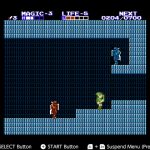
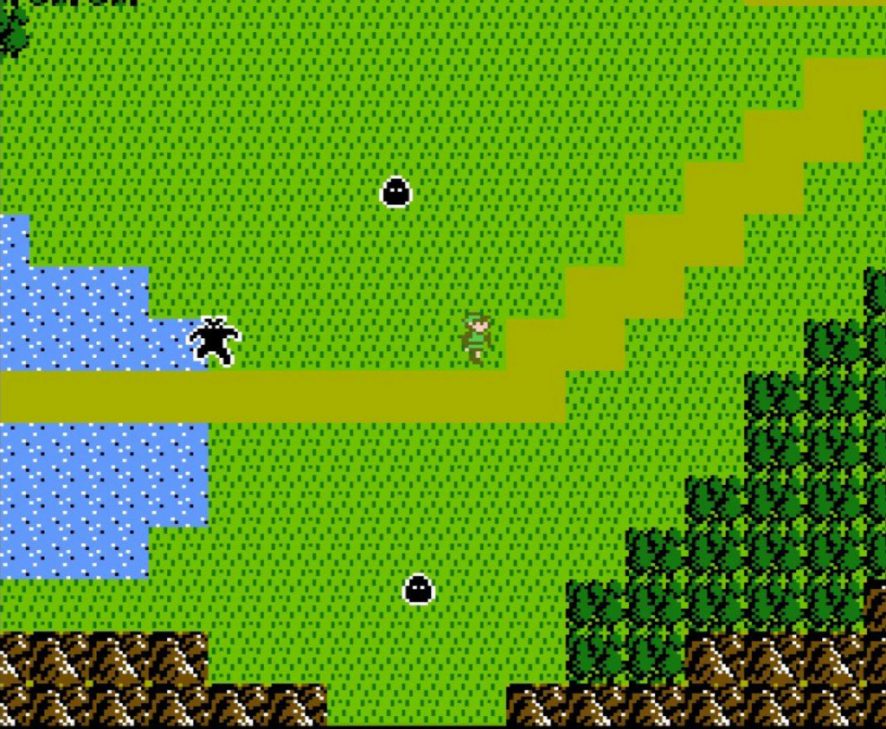
In addition to the main figures in the picture, there are a few other background figures to look at. One is the wilderness that Link is walking on. He is walking on what appears to be grass while surrounded by mountains. This brings to mind the overworld of The Adventure of Link which is unique in the Zelda series as it offers a top-down, tiled perspective of the world. Link’s stance on the grass while surrounded by mountains mirrors that idea. He is standing on a tile of grass with mountainous tiles on either side of him.
The other background elements to look at are the way that the flora is displayed: Both the tufts of grass under Link’s feet and the lotus flowers are divided into three points. The grass often has three leaves in it while the lotus has two leaves on either side of the flower in the middle. The number three is heavily emphasized. Besides providing some nice symmetry, this may tie into the symbolic importance of the number three in the Zelda series. The number three is obviously very important in the series with there being three parts of the Triforce, three goddesses, and three inheritors to Demise’s curse. It’s in The Adventure of Link that this concept of three being important is first introduced. In the original Legend of Zelda, only two pieces of the Triforce, those of Power and Wisdom, are mentioned. The Triforce of Courage is not introduced until the sequel, thereby, explicitly introducing the importance of three where before its importance was only implied through the prefix “tri” in the name Triforce.

[Source: Zelda Wiki]
Through her artwork, Ranefea has impressed upon me a new appreciation for The Adventure of Link. While it will never be my favorite game in the series, it has added many crucial elements to the lore of Zelda. Without it, we would have a completely different understanding of Link. He wouldn’t be tied to courage except as an adjective. He would always act courageously under our guidance, but there would be no Triforce of Courage to sanctify him and eternally tie him to the other two possessors of the sacred triangles. The recurring trials by which Link purifies himself by facing down his dark shadow, similar to an Arthurian grail quest, would also be left untold. In many ways, The Adventure of Link could have been called “The Importance of Link” as Ranefea’s art helps reveal that without this crucial game, we would have a very different Hero of Hyrule.