Though the industry has gotten much better at it these days, it has always been a struggle for video games to make their way out of their country of origin. Back when the internet was less prevalent, it generally took a lot more time for video games to go through the neccessary localization and translation processes that they needed to before they were released in another country. Sometimes, developers would even update the gameplay of their titles before sending them off to another country in an effort to make the game more suitable for a different culture.
There are many famous examples of Japanese companies making a game easier before sending it to America for fear of American consumers not enjoying high difficulty, such as the “Normal” mode Capcom added to Megaman 2. However, not every game was made easier. In fact, Adventure of Link, the second game released in the Zelda series, was made significantly harder when it was brought to America, alongside many other interesting changes.
As mentioned previously, the Japanese version of Adventure of Link is suprisingly easier than the version that was eventually brought to the West. Many enemies give more EXP and Link requires less EXP to level up, which made it much easier for the player to quickly reach high levels. This allowed the player to quickly upgrade their damage to high levels very early on in the game, making bosses significantly easier.
If you knew what you were doing, you could get to level 6 damage and three shot the first boss without much issue. This is somewhat balanced by the fact that, in the Japanese version, all of the levels would revert back to 1 whenever the player ran out of lives. In the American version, players only lost their EXP on a Game Over, keeping their levels and saving them the time of getting their levels back. It’s possible that the game developers didn’t make this change for difficulty reasons, but instead because they felt that Japanese players were abusing the low EXP to level up in a way they didn’t intend.
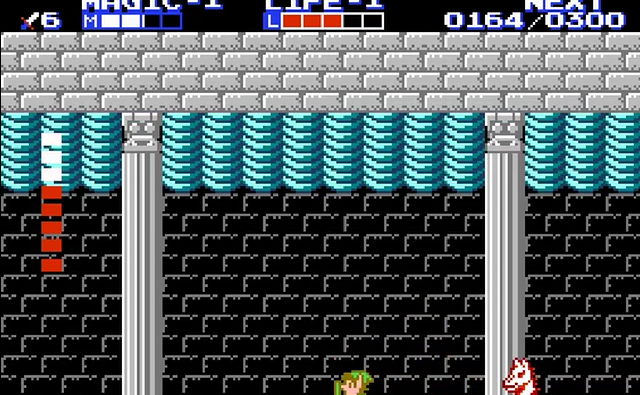
Speaking of the first boss, many bosses in Adventure of Link, including the first boss, Horsehead, make a screaming sound when they’re struck in the JP version only, similar to the roaring that bosses from The Legend of Zelda did in their chambers. This sound effect tended to be a bit glitchy, sometimes coming out as a long droning or buzzing noise, so it may have been removed to avoid the glitch being encountered in American versions. There were several other minor audio differences, such as the lack of a dedicated combat theme in the Japanese version, instead using a slowed down version of the boss theme.
Audio wasn’t the only thing changed either. Some graphical differences also existed, such as overworld water animations being cut in the American version and the Game Over screen being toned down. The Game Over screen in the original, Japanese, version has much more vibrant and potentially seizure inducing flashing colors and it also lacks the Ganon visual.
This is, by no means, is a comprehensive list of all differences between the two versions. Most of the changes are uninteresting small details such as translation and censorship, so I wanted to highlight some of the more interesting differences in my opinion. I’m embarassed to admit, I actually didn’t know until doing research for this article that you could skip levels in order to preserve your EXP and continue to focus upgrading one statistic. I have played Adventure of Link many times and love it, but somehow I never tried skipping the level pop up. In any case, if you haven’t given Adventure of Link a shot due to the slow leveling and high difficulty, you might want to give turbo levelling your damage in the Japanese version a try!