Few video game franchises embrace the timeless adage that relationships are more important than the accumulation of knowledge quite like the Zelda series. By assisting strangers throughout the course of his adventures, Link develops relationships that frequently lead to new skills and abilities. Ever the defender of virtue, Link uses these tools to safeguard communities and defeat the evil forces that routinely plaque Hyrule.
But on rare occasions, the paradigm shifts, and Link becomes the one who needs assistance. Though examples can be found throughout the Zelda canon, this is the story of the first-ever character who helped Link resolve a problem that he could not settle on his own: Bagu.
After returning the first two crystals to the Parapa and Midoro Palaces, Link sets out to cross Death Mountain with the goal of reaching the Island Palace. Saria Town borders this treacherous cliff, and a river strategically divides the village in half. As Link approaches the town’s watery divide, he notices that the bridge is raised. Entering the nearby building, Link discovers that the River Man only permits town folk to cross.
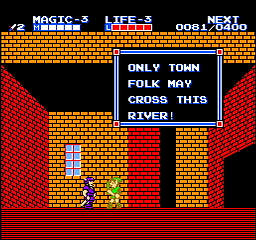
For the first time in a Zelda game, Link is forced to seek the help of another to continue his quest. The River Man’s position is firm; therefore, a Saria Town resident must vouch in order for Link to cross the river. Despite talking to every villager, Link is unsuccessful in persuading the community to grant him citizenship. Feeling helpless and defeated, Link enters the home of a strange character who reveals a clue regarding the whereabouts of an important person.
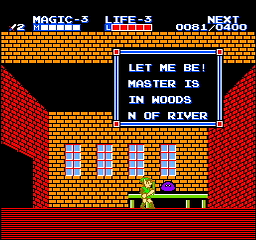
Upon entering the villa, Link discovers a friendly purple Bot fast asleep on top of a table. After several attempts to awaken the slumbering creature, the Bot tells Link that the “Master” of the house can be found in the woods north of the river.
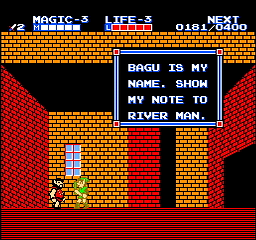
Located north of Saria Town, Moruge Forest holds the secret to securing Link’s passage to Death Mountain. After avoiding a series of traps, Link enters the cabin of a well-dressed man. The esteemed occupant introduces himself as Bagu and offers to help Link with his predicament. Bagu crafts a short letter and instructs Link to deliver the message to the River Man.
Returning to Saria Town with Bagu’s letter in hand, Link revisits the building of the River Man. The hero is relieved that the guardian of Saria Town’s bridge not only recognizes Bagu’s handwriting but also holds the letter’s author in the highest regard. The River Man quickly lowers the bridge and grants Link passage to the Death Mountain cave.

Though courageous and bold, a hero cannot rescue a kingdom alone; however, up to this point in the series, Link played the role of the stoic champion who needed little help in rescuing those in need. But for the first time in Zelda history, Shigeru Miyamoto added vulnerability to the hero’s path by forcing Link to seek the help of another character. This creative decision humanized Link’s personality, which in turn solicited an emotional response from players and laid an important foundation for storytelling in future games.
The word “bug” might be the Japanese transliteration for Bagu, but his significance in the pantheon of Zelda characters is no programming Error. On the surface, the engagement with Bagu might appear trivial; however, this unusual exchange was pivotal in creating emotional depth for the Zelda franchise. Without Bagu, the emotional “link” between player and protagonist might not be as strong or nostalgic as it is today.