The Gerudo is the most distinct and enigmatic of all the tribes to me within the Zelda series. With their warrior way of life, strong designs, and secretive traditions, the Gerudo have progressed far through the series in both appearance and use within the lore. From their first appearance to their latest portrayal, they are a big contributor to writing the history of Hyrule. Since the Gerudo consists of almost exclusively of women, and today happens to be the International Women’s Day, I thought it would be a perfect opportunity to remind ourselves of these strong women.
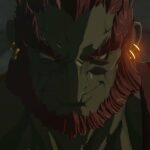
The Gerudo were first seen in Ocarina of Time and are described as a society of strong thieves comprised of predominantly women, with a single male being born every hundred years who is destined to be their king. The game introduced the unforgettable Gerudo Valley, and the harsh desert as the Gerudo’s native place. It also introduced a king who would become a classic antagonist, Ganondorf, and his surrogate mothers, the twin witches Kotake and Koume who together become Twinrova.
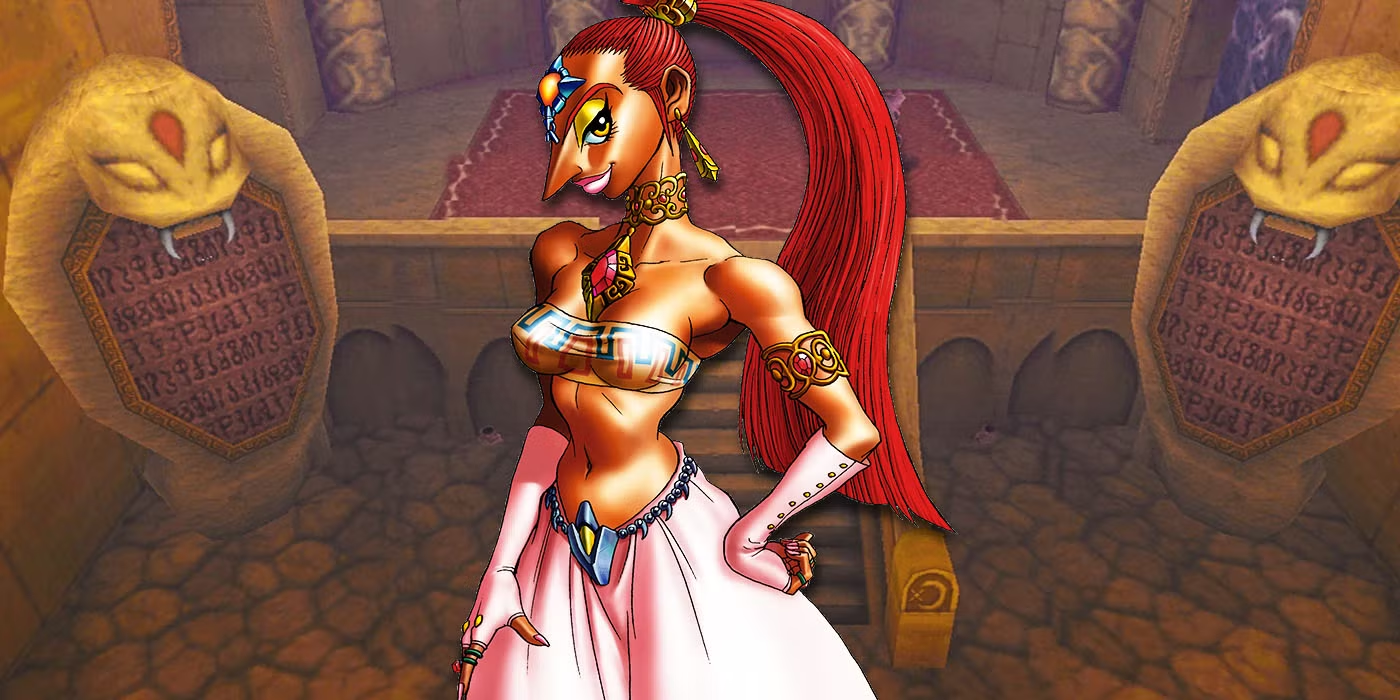
In the game, the Gerudo and their buildings were designed with inspiration taken from the Middle East; they carry curved swords, wear ornate pieces of jewelry, and are dressed in flowing fabrics which isn’t too dissimilar with what we might think of a belly dancer’s costume today. The star and crescent moon symbol which can be seen in early versions of the game even looked a bit too similar to the symbol for Islam, and was replaced with the Gerudo Crest in later versions.
The Gerudo value power and strength, and, although they are rumored to look for boyfriends in Hyrule Castle Town, don’t seem to be kind towards men. One way this is noticeable is how Nabooru, a highly respected member of society as Ganondorf’s second-in-command, acknowledges Link’s skills and gifts him a Gerudo Token only after he has freed the kidnapped carpenters from the Gerudo Fortress by defeating the guards. This token is very special since non-Gerudos can’t enter Gerudo territory without it, and is the ultimate sign of their approval. Even though the Gerudo are initially aggressive and hostile towards him, they come to accept his presence.
Later, in the Spirit Temple, Link is tested on his agility and combat skills, and gets to witness how Nabooru, who rebelled against Ganondorf’s evil plans in secret, awakens as the Sage of Spirit after he defeats Twinrova. Nabooru, now a Sage, is an important character to not only Hyrule’s history but also the Gerudo’s. Her name and legacy is most likely honored in Breath of the Wild‘s Divine Beast Vah Naboris.
The Gerudo might seem similar to the Goron tribe since they both value power and strength, but I think they differ in the ways they value them. The Gerudo show strength through their self-reliance, resilience and protective nature, which is different from the Gorons due to their different struggles. The Gerudo women have to fight the stigma that may lay against them because of Ganondorf.
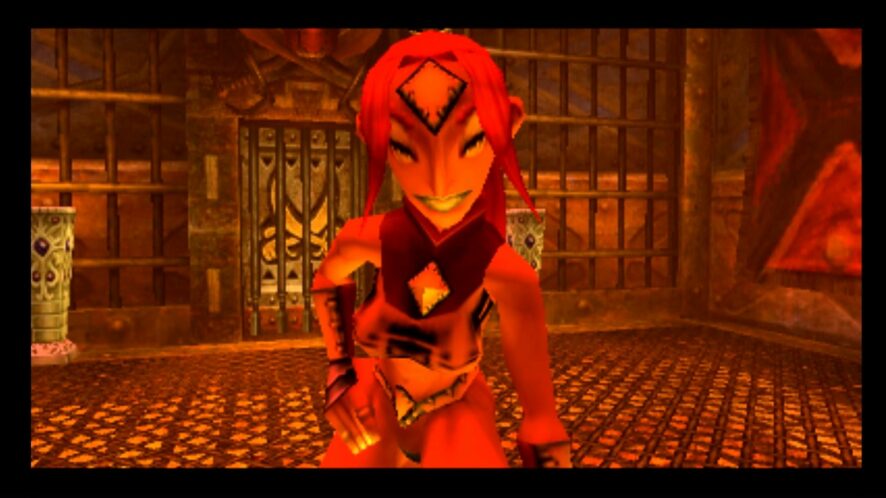
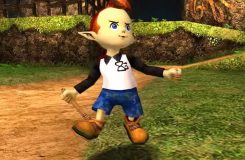
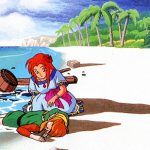
In Majora’s Mask, we have the Gerudo Pirates, another aggressive band of thieves who reside at Termina’s Great Bay. While they appear similarly designed to their Ocarina of Time counterparts, they are much more overtly antagonistic in their characteristics, and follow their leader Aveil instead of a king. They create a lot of trouble by stealing Lulu’s Zora Eggs in hopes that they’ll give a hint on how to reach a treasure which is said to be hidden inside the Great Bay Temple. They even injure her friend, Mikau, so badly when he attempts to take them back that he eventually dies on the beach.
Although Kotake and Koume appear in the game too, they’re not confirmed to be Gerudo. They’re also much more gentler, compared to Ocarina of Time, in their roles as a Potion shop owner and boat cruise hostess.

The Gerudo appear in Four Swords Adventures as well. Their new home, Gerudo Village, consists of what look like tents, and lies in Desert of Doubts. There’s a Gerudo welcoming Link when he arrives, not with a sword in hand this time. In fact, every Gerudo he meets is kind. Their friendly nature comes from their desire to restore their ties with the Hylians by denouncing their former leader.
These Gerudo women are friendly but still have similarities with the Gerudo introduced in Ocarina of Time. They appear similarly and also mention that a “special child” is born once every hundred years who is destined to become their guardian. Unfortunately, this latest child is Ganondorf and grew so power hungry that he violated their own law by entering the sacred Pyramid where the incredibly powerful Trident lies.
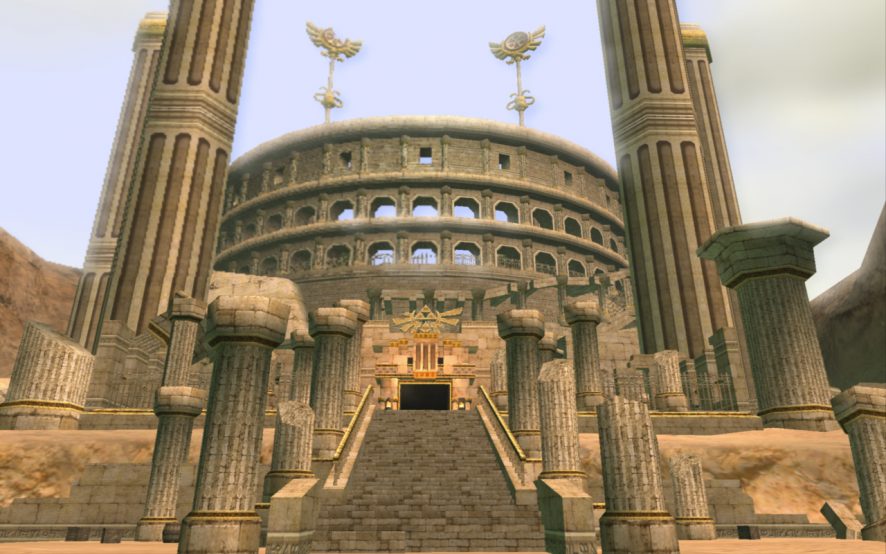
The Gerudo are gone by the time of Twilight Princess, but their existence is implied from the design of the Arbiter’s Grounds, and exiled or fallen status is intimated. The Arbiter’s Grounds showcases substantial, stone constructions with a desert-inspired look, characterized by lofty, sharp-edged walls and arches. These architectural features bear similarity to Gerudo design found in Ocarina of Time, where the Gerudo Fortress and other areas in the desert also display rugged stone, expansive areas, and grand structures. Statues and engravings within the Arbiter’s Grounds also evoke Gerudo-style artwork, frequently depicting bold, animalistic motifs and geometric designs, which might represent strength and the martial traditions of the Gerudo.
There is speculation among Zelda fans of a potential Gerudo descendant in this game, named Telma. Telma is a bar owner who runs her own tavern in Hyrule Castle Town. Although nothing is confirmed by Nintendo, Telma’s ability to stand for what she believes in by being a member of The Resistance, along with her red hair which is a typical trait of the Gerudo, led a lot of players to this particular theory.

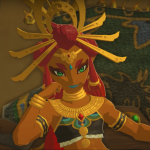
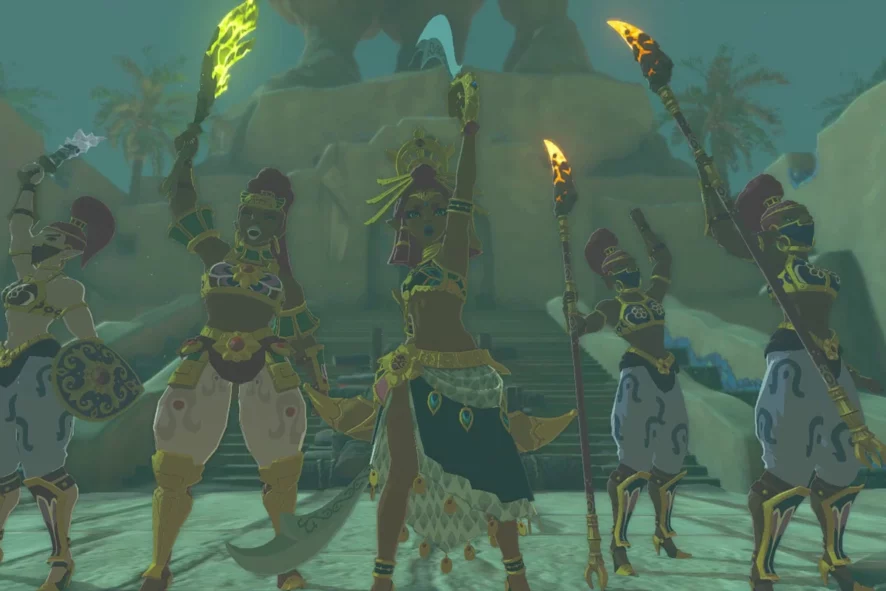
A major update happened to the Gerudo in Breath of the Wild. For the first time, the Gerudo is presented as a thriving desert people ruled by a young chieftain, Riju. Their attire is more intricate and with a heavy focus on independence and identity, they are curious travelers and saleswomen, and even have their own, spoken, language. Also for the first time, we get to see Gerudo children almost everywhere in Gerudo Town. The Gerudo keep strict rules barring men (“voe” in their own language) from entry, and Link must dress up as one of their own to enter, find Riju, and then enter the Divine Beast Vah Naboris to defeat the Thunderblight Ganon residing there.
Although Riju is their current leader, Lady Urbosa still lingers on their minds. Urbosa, a chosen Champion by Princess Zelda, was, and still is, incredibly admired and loved by her people. She is so highly respected that it makes Riju wonder if she can become just as great as her, and as her late mother.

In Tears of the Kingdom, the Gerudo remain front and center, further fleshing out their ties to Hyrule. Riju remains their leader, struggling with traditions within their clan as well as with new external threats. The game continues to expand the Gerudo cultural depth, integrating a town that has stronger ties to the surrounding desert environment. They expand on their weaponry with the introduction of Zonai devices to help strengthen their defences, leading back to their core values of strength, resilience and endurance. Riju is more confident in her role as the chief of the tribe unlike before, seeing as she was only a child when she had to take on the position.
Most recently, the Gerudo made their presence noticed in Echoes of Wisdom. The game deepens their history by the addition of a new tribe leader, Seera. The difference is stark compared to the friendship we saw between Princess Zelda and Riju in Breath of the Wild, to the hesitance of Seera. The game’s new design and layout of the desert brings some of the nostalgia of the older games while maintaining the sense of newness in the story, characters, and conflict.
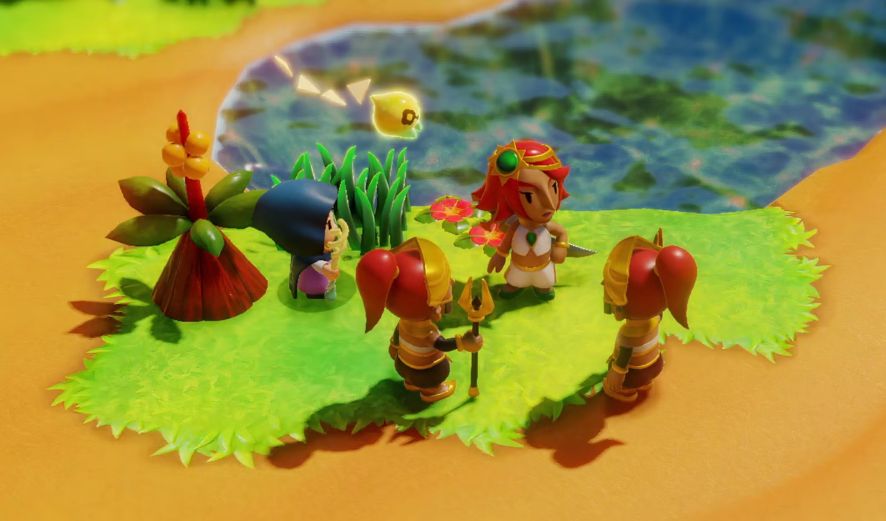
The Gerudo have a significant role in the larger Zelda universe. The most evil member of the group, Ganondorf, has been one of Hyrule’s biggest threats several times. However, it’s important to notice that the tribe itself isn’t evil, which touched upon in the games, and the Gerudo break their initial characteristics to help Link. This contrast gives moral complexity to the world of Zelda.
To the Gerudo, tradition is important. Characters such as Riju and Urbosa, represent strength and leadership in discovering the balance between their heritage and how things constantly need to evolve, while keeping tradition alive.
From their first appearance in Ocarina of Time to their nuanced portrayal in Breath of the Wild and beyond, the Gerudo has one of the most fascinating cultures. Their evolution is not only a reflection of technical advancements in game design but also of growing emphasis on storytelling depth, and cultural diversity. As the series continues to evolve, the Gerudo will undoubtedly remain an interesting and integral part of Hyrule’s heritage.