Before we had Majora’s Mask and the ability to change form, I was obsessed with mask quests in Ocarina of Time. Was it the dress-up aspect that drew me in, the strange masks themselves, or the shop and its bizarre proprietor?
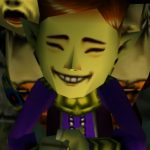
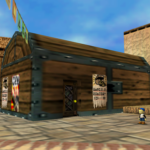
The Happy Mask shop is the first location where The Legend of Zelda gets weird in a very specific way. Sure, we had monsters and wizards, magic and weaponry, even princesses and fairies, but this was the first step in a different direction, both in terms of art and themes.

The star of the show is of course, the giant mask surrounding the counter. To me, it looks like a twist on a Noh theatre mask made from the same porcelain as a Venetian mask. Its face is a caricature of laughter, the mouth the opening for the counter and display, its eyes closed in mirth, and little marks beneath denoting the anime-style laughter often seen in cartoons and manga.
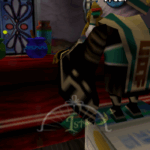
The stone floor, wooden frame, and plaster walls look the same as other buildings in Hyrule, but the decor here is totally unique. Pink curtains are draped lavishly around the room, so much richer and fuller looking than mere bunting. Flowers, presumably wooden or paper, adorning the posts are a brighter pink compared to the lighter curtains, making the curtains look even more velvety and lush.
The mask is a mirror of the owner, the Happy Mask Salesman. While it would seem silly not to design the shop with a giant mask as the display, it also mirrors the products in more than appearance — a mask is a mirror and a window for the actor or player, allowing them to inhabit a role and reveal truths about themselves or the world to the audience. Later, this idea is taken a step further in Majora’s Mask by literally transforming Link’s body with masks that are made from powerful emotions and deep grief.
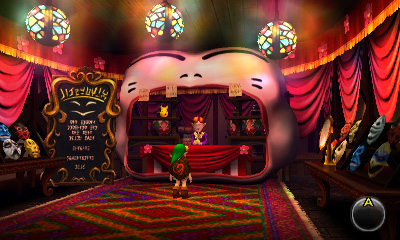
Overall, the effect is that of a carnival or circus; even more so in the 3D update of Ocarina of Time. The lushness of the original remains with thick carpets, stained glass lamps, and a gilt frame around the sign. What was hinted at before with the curtains is made clear here—the curtain of a stage could only be hinted at with lower quality graphics, but here it is clear as day.
All of these elements are the first stages of many whacky and beloved Zelda design choices to come. The Clocktown Carnival, Agitha and her Castle in Twilight Princess, even Beedle and his various shops seem inspired by the Happy Mask Salesman. So many quirky locations came after The Happy Mask shop that explore different elements of culture, and not just Eurocentric-fantasy-castles. While they’re not all directly inspired by it, you can see that when they broke the mold for Ocarina of Time, these designers created new traditions for each subsequent game to evolve.
But what of our Salesman? Was that the last we’ll see of him and his shop? I hope not, and I hope they keep Zelda weird and wonderful with every new game.