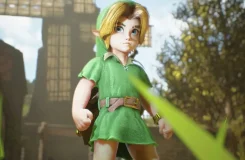
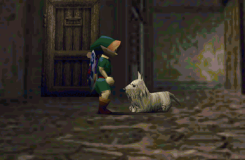
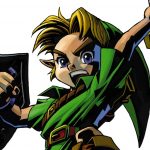
After navigating four dungeons, wearing various masks, and living the same three days over and over again to help the citizens of Termina solve their personal issues before the Moon crashes into the city and wipes their problems out of existence, Link finally finds himself face to face with the villain to end the vicious cycle. The climax of Majora’s Mask, watching the Four Giants catch the Moon and get ready push it back into space, is a beautiful conclusion to the time-looping adventure. The game is nearly over, but there is still one thing to do. Finish off Majora. Here, the Hero of Time follows Majora to battle inside the Moon.
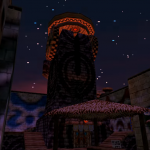
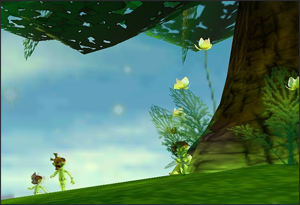
After leaving the chaotic Termina, which is about to be destroyed by the Moon, the Hero of Time is teleported inside to a strangely serene sight. Link is placed in the middle of a lush, green meadow underneath a clear sky. In the distance, a lonely oak (I don’t know trees, I’m guessing it’s an oak) stands on a single, short hill. It is really jarring coming from the chaotic, red, and scary clocktower to this beautiful, silent location. The world is slowly coming to an end outside, people are likely screaming and panicking, yet it is so peaceful here inside the Moon, yet strangely uncomfortable.
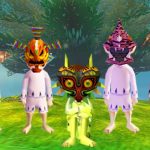
Getting closer to the tree, Link will soon be able to see children. Children that play and run around the tree, a very strange sight to find inside the sentient Moon who just told you it wanted to “consume everything.” Even stranger is when you get up close and find these children all wear the masks of the four bosses: Odalwa, Goht, Gyorg, and Twinmold. One also wears Majora’s Mask. I also noticed that the kid wearing Majora’s Mask sort of looks like the Happy Mask Salesman from the side. This peaceful sight has now become rather uncomfortable and off-putting.

Probably the most memorable part about this location, for me anyways, is the eerie dialogue we get from these children after completing their challenges. The atmosphere already gives me an uneasy feeling, but the words from the playing children are what I really love about this place. It is difficult to tell what exactly these lines mean as it is all up to interpretation.
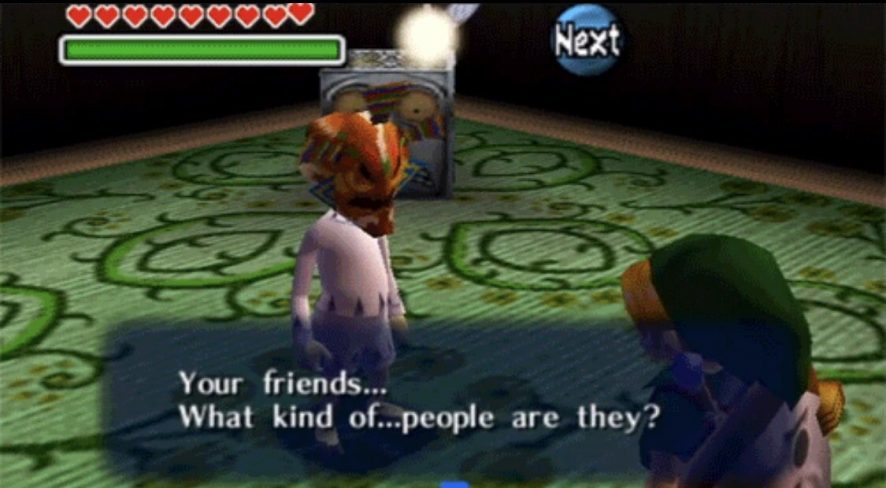
The child wearing the Odalwa mask says to Link, “Your friends… What kind of… people are they? I wonder… Do those people… think of you… as a friend?” The Odalwa child poses a simple question, yet this question may prove to be a difficult one for Link to answer. Link is only here to track down his friend, Navi. She was his only friend throughout the lonely adventure he took in Ocarina of Time, yet she left him at the end of his adventure, without an explanation. Navi is of course Link’s only way to go through the Lost Woods and get back to his only home of Kokiri Forest, so Navi leaving brings a huge problem for him. Without her, Link is disconnected from his home and the friends he knows. I wonder if Link does begin to question his friendship with Navi. Why would she just leave? Did she view him as a friend? And now his longing for Navi has led him into this mess in Termina. At the same time, Skull Kid has lost his friends. Being possessed by Majora, he loses his friendship with the Four Giants and the fairies, Tatl and Tael. Losing sight of himself, he has now ruined the friendships he made and has succumbed to a joint loneliness with Majora.
Next, the Goht child asks Link, “You… What makes you… happy? I wonder… What makes you happy… Does it make… others happy, too?” Skull Kid was possessed by selfishness and greed, which is the power Majora holds over other people. This yearning of the power of Majora has only been driving people away. Similar to Goht child’s question, the child wearing the Gyorg mask asks Link, “The right thing… What is it? I wonder… If you do the right thing… Does it really make… everybody… happy?” This question is a bit more complex to Link. Perhaps doing the right thing is not always going to make you or the people around you happy. Skull Kid battles with making the right decisions while also trying to make the people around him happy. Link battles with this too, when putting on the masks of the dead and pretending to be the loved ones of others. This too is questionable. Is this the right thing to do even though it may make others happy?
The Twinmold child then asks Link, “Your true face… What kind of… face is it? I wonder… The face under the mask… Is that… your true face?” The entire game, Link has been putting on masks, living the lives of dead people, acting as others. Living in this constant time loop, seeing the same things every single day, constantly making other people’s problems his own. Going on this adventure, right after experiencing the stress of living as two different ages in Ocarina of Time, perhaps the Hero of Time is struggling to know who he even is.
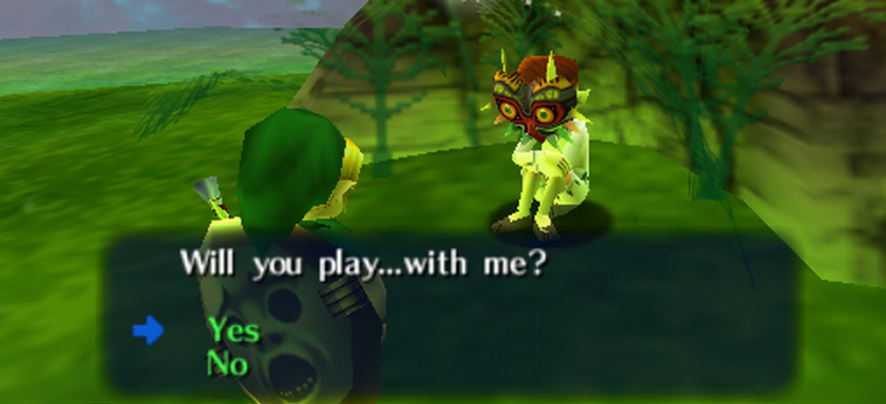
Finally, after all the other moon children have left, the one wearing Majora’s Mask sits under the tree, looking somber. He says to Link, “… Everyone has gone away, haven’t they? Let’s play good guys against bad guys… Yes. Lets play that. Are you ready? You’re the bad guy. And when you’re bad, you just run. That’s fine, right? Well… Shall we play?” Skull Kid has been chasing the desires of Majora that loom over him. His decisions caused him the loss of his only friends. I find it interesting how he labels Link as the bad guy and implies he will play the good guy. From Skull Kid’s perspective, his friends must be the bad ones if they chose to run away from him. Skull Kid clearly is lacking the ability to see what he is doing is wrong. The power of Majora over him clouds his adolescent judgement. Is he good? Is he bad? Skull Kid has no idea what’s right and what’s wrong. I believe that’s the true power of Majora.
I really love this location in Majora’s Mask. One of my favorite things about Zelda games is the vague dialogue and environments that leave things up to interpretation and discussion. This ability to make such simple, yet dark scenes is why I love Majora’s Mask so much. I can only hope to see more things like this in future titles.
Will you?