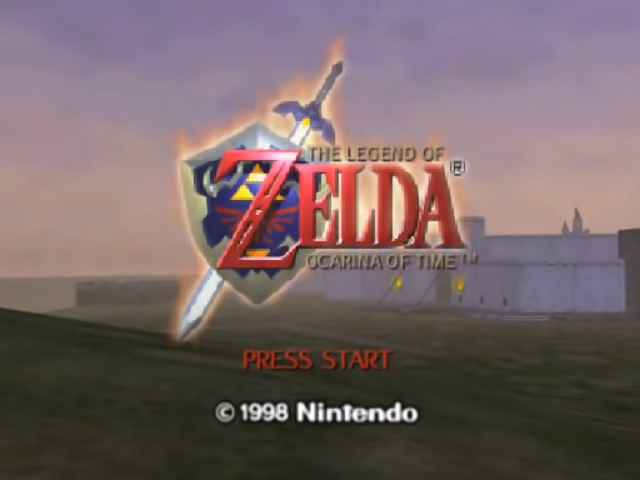
I’ve been listening to some nostalgic gaming podcasts on my commute to work recently, so I’ve got the N64 on my mind. Weighing up whether Ocarina of Time or Majora’s Mask was a more formative playing experience has proved moot: I played them simultaneously and both have different merits.
But Ocarina of Time is such a special game. From the moment you PRESS START, every frame, every pixel, signals to you exactly what the developer’s vision was. The opening is a masterpiece, and although it’s not a location you can explore, the cinematography shows us exactly enough to set the scene.
After the Deku Tree’s intro, the camera zooms in on our hero Link’s sleeping form and then flashes to a stormy night. If it’s your first playthrough, you know nothing about this nightmare, but each frame lets you in on a little of the story.
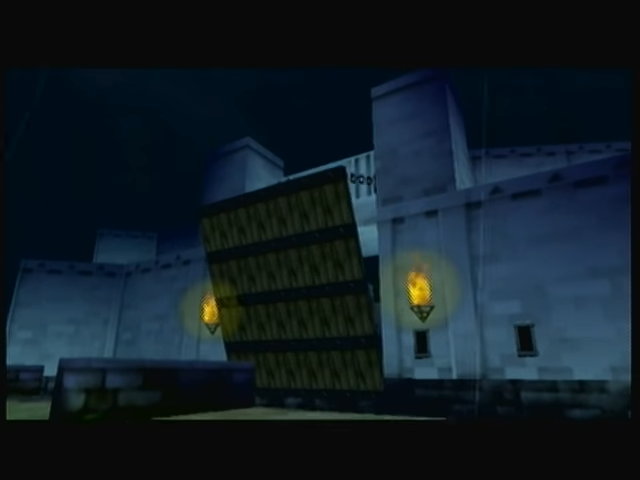
At first, we see a wide drawbridge in the dark. Lit by two massive braziers, it quickly lowers with the sound of chains and thunder, and hoofbeats soon follow. Perfect nightmare fodder. The white stone walls are high, with towers visible behind them. It’s too grand to be a military building, and the wooden drawbridge suggests something vaguely medieval.

Next a shot of the top of the drawbridge and one of the most recognizable symbols in gaming: The Triforce. Carved into the lintel, the Triforce makes up the centrepiece of a larger, ornate crest. This screams that the structure is aligned with a noble house, perhaps even royalty.

Then the drawbridge crashes down and a brilliant white horse gallops across, two riders on its back. We can see from its tack that it belongs to nobility, though as the riders draw closer they paint a confusing picture. A little girl in a modest headdress with a tough-looking woman protecting her. But look beyond them, through the rainy night, and you can see buildings beyond the wall.
This is our first little glimpse of Hyrule Castle Town. Tucked behind high walls, this is the center of the game, where most of the political moves happen. And here it is, centered on our screens from the start, introduced as a place of intrigue. It also shows that it’s not one colossal castle behind the gate, but a place with many inhabitants. Having citizens at risk raises the stakes, even if it’s deep in our minds.
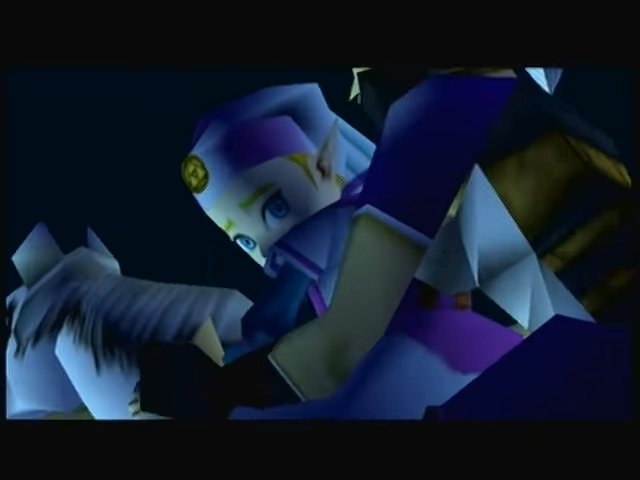
As Princess Zelda and Impa ride away, Link is confronted by Ganondorf, the Demon Prince himself. Reaching out his hand, he does something to Link, trapped in his nightmare. He lies there, shuddering, until Navi is sent by the Deku Tree to wake him.
Once awoken, Link’s nightmare is soon forgotten, both by him and probably by you as the player. When the vision later comes true, there are several key differences. First, Zelda throws the Ocarina of Time behind her and into the moat for Link to find. Second, Ganondorf isn’t immediately aggressive towards Link, first asking him for help, and then knocking him back for drawing his sword.
Link’s Nightmare isn’t a location you can walk around. Sure, you can swim in the moat later, walk across the bridge, and look around the town and Hyrule Field. But by the time you can look around, you’ve already had a flashforward to doing so. That first glimpse sets up the whole game, though. It’s full of intrigue, a dark and stormy night opening. Even walking around it on a rainy night doesn’t have that same feeling. Link’s Nightmare gives the game its tension from the start.
Maybe more importantly, it sets us up with both Link and Zelda, showing us that Hylia has once again brought these souls together to save Hyrule.