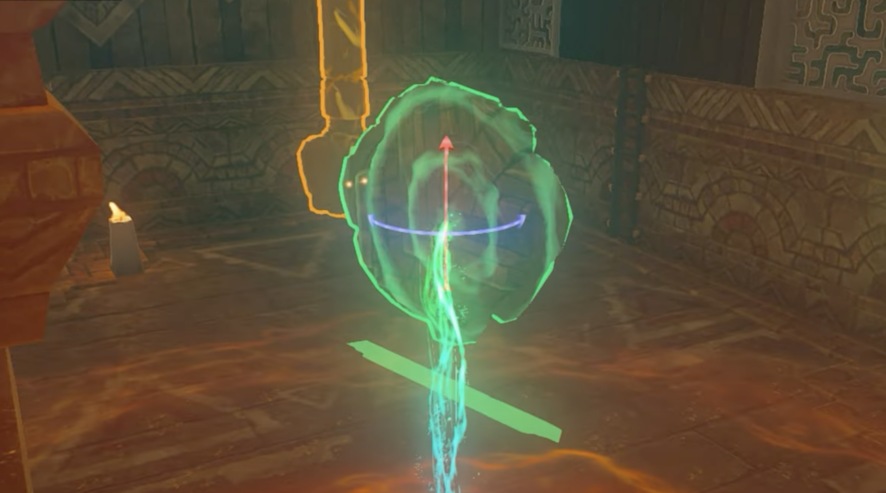
At last month’s Game Developers Conference (GDC), technical director Takuhiro Dohta, lead physics engineer Takahiro Takayama, and sound programmer Junya Osada, led a talk that gave gamers great insight into the accomplishment that was the development of Tears of the Kingdom. While most players of the game will readily admit that Tears felt like a massive DLC for its predecessor, the talk at GDC made it clear the game’s development was anything but simple.
During the talk at GDC, the developers communicated that a goal of Breath of the Wild and Tears of the Kingdom was to create a world that was both vast and seamless. However, bigger doesn’t always mean better. To fix this issue, the developers sought to implement the concept of “multiplicative gameplay.” To put it simply, multiplicative gameplay allows players to interact with the game’s environment in a way that lets them solve problems the way they want them to be solved by “sticking two things together to make something new”. Takayama stated that this was a great idea and it would make a great game, but “this was going to be very, very difficult.”
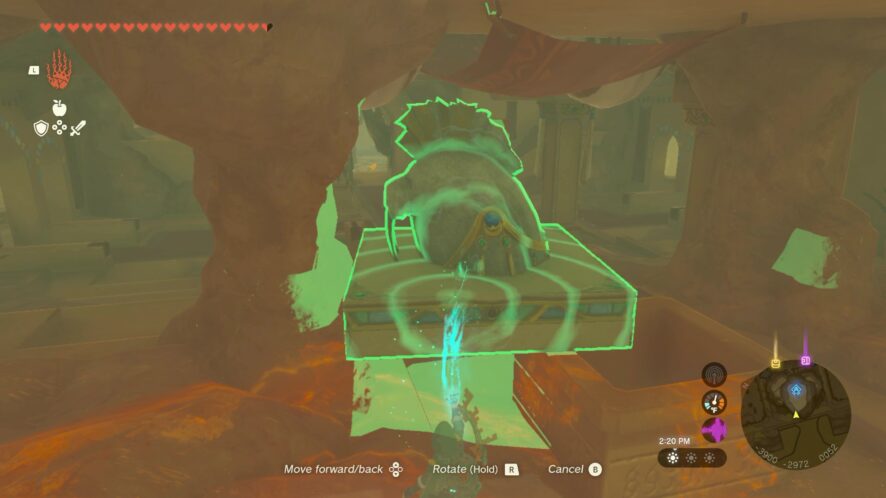
Development was plagued with bugs and crashes, but Takayama stated it was important to have courage and press on despite the difficulty. The biggest challenge was the fact that the world was physics-driven, while certain objects were known as “kinematic rigid bodies”. According to Takayama, “when we say physics-driven, what we mean is objects have mass and moments of inertia – and they can be controlled using things like velocity and acceleration.” Kinematic rigid bodies on the other hand had infinite game mass and did not move. The interaction of these two types of objects within the same world produced chaos during the developmental stages of the game. Objects would collapse in on themselves or be sent off flying in a particular direction. Takayama related that in order to solve these issues the development team needed to rely on their experience developing Breath of the Wild, which eventually let to the world of Tears of the Kingdom being entirely physics driven.
While this did fix many of the development issues with Tears, it also came with some unforeseen yet welcome consequences. Players who were creative and perceptive enough could use objects in their Ultrahand creations that were never intended to be used in said creations. This created what the development team called “multiplicative gameplay.” Multiplicative gameplay is the idea that the player has the ability to either solve gameplay challenges the way the developers intended, or through whatever means the player devises. The key idea here is player freedom. The physics based world in which every object has its own properties provided players with an abundant amount of gameplay methods and play styles.
The result of this physics driven world also produced other effects in the area of sound. Each object in the game had its own sound, and therefore when objects were connected together and movement was applied they produced a “new” sound. The horse drawn carriage sounds like a horse drawn carriage not because the development team recorded a horse drawn carriage, but because the horse sound, the wheel sound, and the cart body sounds all combined together as the cart moved to sound like a horse drawn carriage. The resulting audio of unique sounds from unique objects dramatically changed the way the sound team worked in the creation of Tears of the Kingdom. Rather than create every single unique sound individually, they created a system that created even more unique sounds by combining the sounds on its own.
This leads us to the ultimate goal of the Tears of the Kingdom design team. “The concept of multiplicative gameplay was: rather than creating something fun, create a system that makes fun things happen,” stated the team. Judging by the positive reception of Tears of the Kingdom, and the endless hours of unique creation videos online, I would say this goal was achieved and well earned.