Sometimes a core location is small and unassuming. The plot leads Link to a locale and reveals a great truth or new ability. In some Zelda games, this moment will occur in Hyrule Castle, the Great Deku Tree, or somewhere equally immense. But The Wind Waker follows a different path. After all, when does it not?
Link finally receives the titular Wind Waker upon arrival at Dragon Roost Island. Tucked behind this Island is a little islet that looks insignificant, almost bare, but nevertheless inviting.
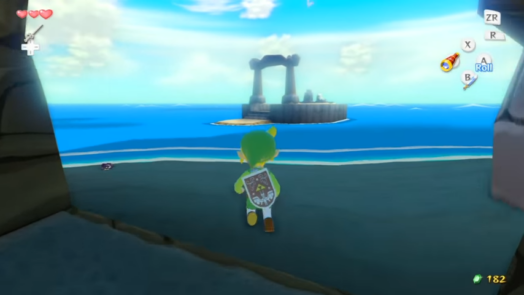
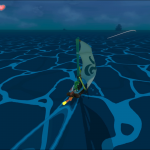
You first see the Shrine in the panorama clip when you approach Dragon Roost Island. Exit the boat and the King of Red Lions will gift you the Wind Waker. As you move to explore the Island, there’s a signpost pointing you up to the Mail Centre, or Left to the Wind Shrine. Everything in the game’s design nudges you to the Shrine first: from the focus on it in the VT to the detritus on the ground literally pointing you towards the cove beyond.
Swim across the little stretch of water and you’ll be met with a gate that is clearly inspired by Japanese Tori Gates. However, these differ from traditional designs by having scrolls at the end of the crossbeam, rather than being flat or slightly curved. This scrolling could be part of the wider wind motif throughout the game, alongside signalling that this is the Shrine of the Wind God.
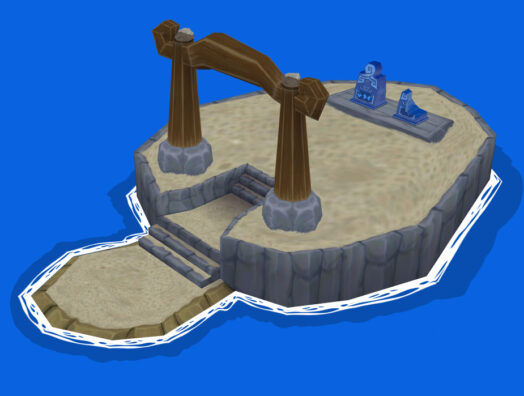
The bare sandy floor is also reminiscent of sacred areas, either worn away by the feet of many pilgrims, or to match the color of zen gardens raked in beautiful designs.
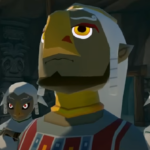
The shrine itself is interesting both in terms of plot and in terms of design. Here, you find your first song to conduct. Do so, and you meet Zephos, God of Winds, who’ll give you a further explanation of how to conduct the wind and thus be able to navigate the Great Sea.
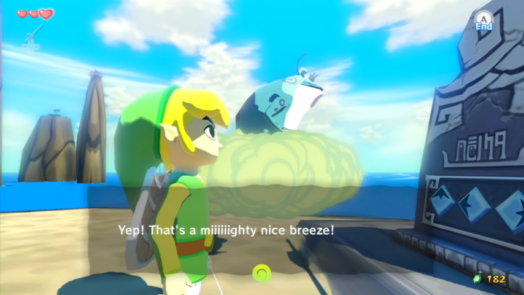
This little island is almost a tutorial, showing you how to collect songs for the Wind Waker, and what their effects can be. It also gives you the little side-quest of confronting Cyclos if you get the chance. He’s out creating cyclones because he’s upset his shrine is broken.
The little shrine that is remaining has the scroll design at the top, matching the gate, and some ancient language beneath. The details are picked out in gray and blue, and the stone looks weathered but well maintained. The same can’t be said for the second shrine, which is cracked almost to its base and most of the stone is missing.
These slabs look like memorials, and it’s interesting that the designers didn’t make them reflect the Wind God’s design more closely, as sacred frogs or toads are frequently found among sacred foxes at traditional shrines. Maybe that design would have been too busy and wouldn’t have been as instructional as what we have now.
Plus, you wouldn’t have that moment of delight when a big blue frog raced in on a floating cloud. It’s just so whimsical. So much thought goes into designing even the smallest of areas in these games and I’m constantly amazed every time I replay them.