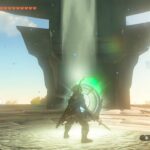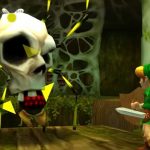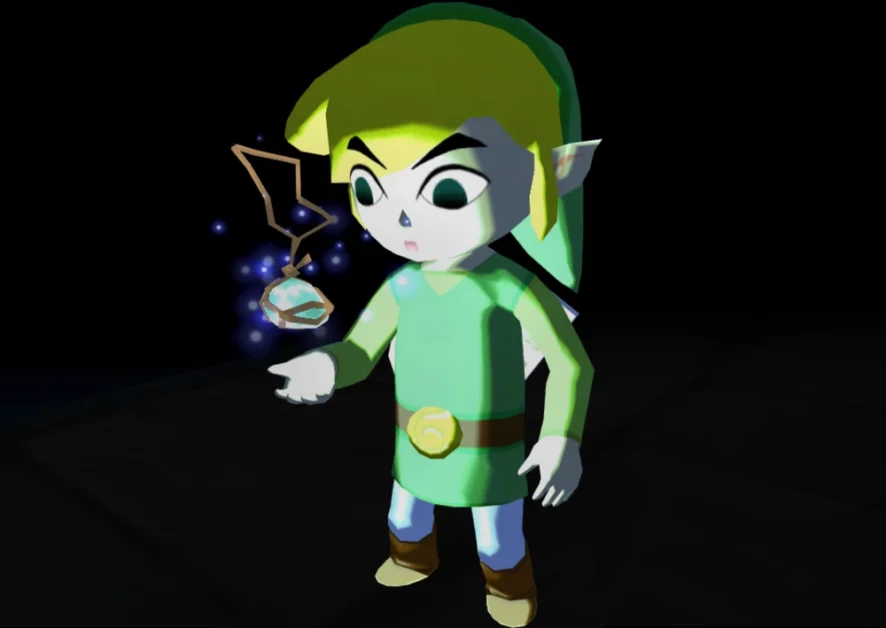
The concept of a tutorial level in video games is long-historied, replacing a longer game guide as the storage space available for the game itself increased. Some games will give you prompts at certain intervals or triggers to teach you new mechanics, like how Breath of the Wild has control pop-ups when Link first picks up a weapon, shield, or bow. Other games will take a low-risk environment, like Mario’s iconic World 1-1, to allow the player to explore all of the available controls at their leisure. Different approaches exist for games of varying complexity, and the Zelda franchise, with its multitudinous items all holding specific uses, is a series that has perfected this formula over the years.
I recently replayed Wind Waker in the middle of a move away from college, simply because I had nothing unpacked but my laptop and a small library of emulator games. Any seasoned gamer knows the frustration of trying to jump back into a game you haven’t played in a long time, forgetting the control mapping, and I decided to relive the whole story and relearn the controls and items as I went. Some people have praised – and others criticized – the use of the tutorial ‘island’ in both Breath of the Wild and Tears of the Kingdom, the latter claiming it is too repetitive. I think, though, that Wind Waker was the game that demonstrated that the tutorial island was the perfect format for the Zelda series as it grew in mechanical complexity with the 3D format.
The Hero of Winds is one of my favorite iterations of Link, much like the Hero of Twilight who I’ve written about before, because he is a hero of circumstance. He rises to the occasion when his sister is kidnapped. Understandably, he is unskilled with the sword, and not knowledgeable about the sea and the rest of Hyrule. This gives us a narrative purpose to the numerous mentors Link has in Wind Waker, in both the blademaster Orca and the pirate crew.
In Outset Island, we learn the basics of mobility and combat. Link can swim, for a very limited amount of time. He can jump short distances to clear the gap on the bridge between the peaks. He can crawl through small spaces, like under homes and through logs. We learn the basics of the sword in the form of the slices, jab, parry, jump attack, and iconic spin attack. There are very few enemies in Outset Island: only a handful of Blue Bokoblins and the sea if you swim too long.
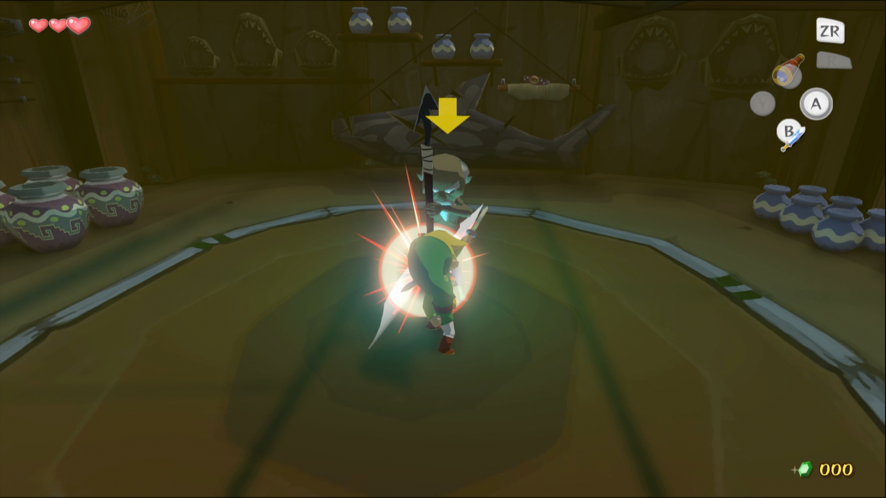
The Pirate Ship presents us with an opportunity to learn more complex controls, like camera adjustment and dynamic movement and environments. Niko’s trial also exposes us to an iconic Zelda dungeon puzzle, the timed button. It takes a number of lessons we learned on Outset Island and allows us to practice a more complex version of the skills we gained. It also gives us access to the Spoils Bag, which may become one of our primary forms of Rupees across the game, in true piratical fashion.
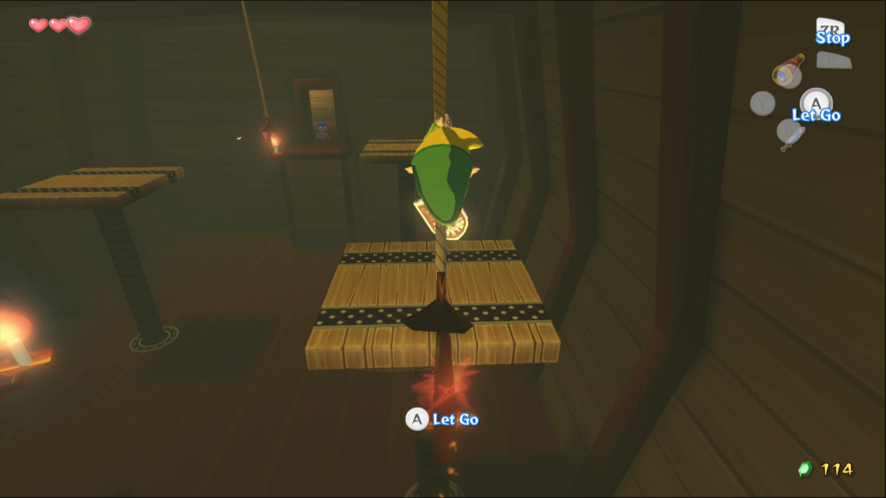
Finally, the Forsaken Fortress gives us a glimpse into another mechanic that exists in the game, and a newer one at that: stealth. Link spends a majority of his first excursion through the Forsaken Fortress with no weapon, or way to defend himself. We must use the environment and the abundance of empty, open-bottomed barrels to Solid Snake our way to our sword. The required path also introduces a new mobility mechanic, sidling, for those gaps too wide to jump but with a small protrusion. It leaves you defenseless, as we will learn at later points in the game like Dragon Roost Island, but that is after the mechanic is introduced to us.
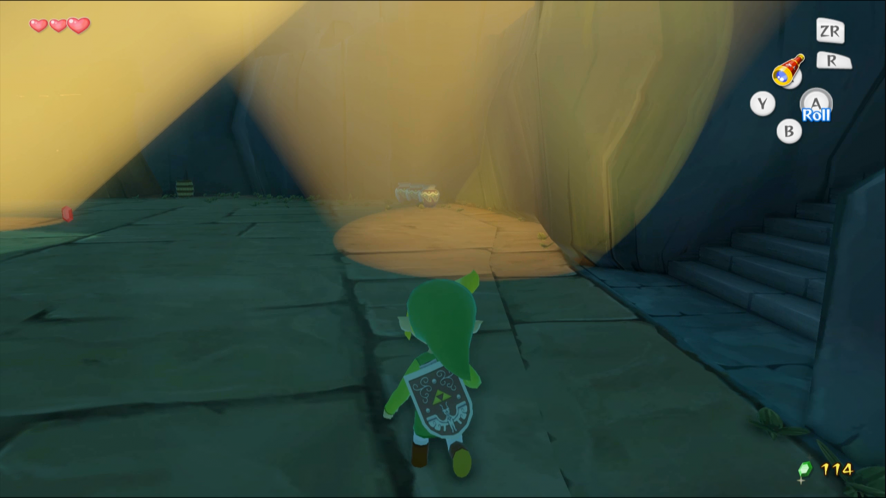
The fact that stands out across all of these cases is that the mechanic and its usefulness is demonstrated early, rather than just told to us in a manual or pop-up. Much like other Zelda titles, Wind Waker’s items are introduced in places they are needed. The Grappling Hook is found in and needed to complete the Dragon Roost Island dungeon, but is given early because of its usefulness in vertical mobility. I could go on, but beyond the tutorial, Wind Waker follows in other titles’ stride where the introductions of item mechanics are useful where they are found, continue to be useful going forward, and are mandatory for their area’s boss. In a way, the progression I described with the mobility options between Outset and the Pirate Ship mirror this pattern: learn the use through practice, hone the use through a difficult challenge, and apply the skill throughout the title.
Many games follow this same philosophy, Celeste comes to mind as one where that was their intention with each new mechanic, and Breath of the Wild and Tears of the Kingdom replicate it well in their beginner trials without making the lessons so linear as to encroach on the open-world nature of the game. Call it repetitive, maybe, but Wind Waker truly perfected Zelda’s tutorials, and I wouldn’t have it any other way.