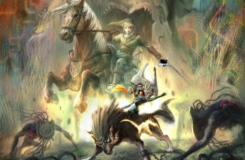
Many people complain that the hero’s journey is an overused storytelling trope as stale as week-old bread and as wrung of creative potential as an old dishrag is wrung of water, but it has endured for so many years for one simple reason: These kinds of stories emotionally resonate with the common man. The idea that someone of humble origin can undergo trials and tribulations and emerge a hero capable of bringing salvation to a ravaged land is quite inspiring, giving people hope that they, too, can overcome the obstacles in their lives and make the world a better place. I think this is exactly why Link remains one of the most popular figures in the fantasy genre of video games. Whether he’s bounding through the woods with his fellow Kokiri, herding goats atop his beloved horse, or literally emerging from a cave with no clothes, no supplies, and no sense of self (how much more humble could you possibly get?), Link always establishes himself as an everyman who must start from the ground up and work incredibly hard to earn his status as a hero, which immediately endears him to most players.
Still, this hasn’t stopped some Zelda fans from wondering how the story would change if Link started out at the opposite end of the social spectrum as a member of the Royal Family. Would his heroic journey be just as compelling if he swapped out his woven green tunic for colorful silk robes, his carved wooden shield for a polished suit of armor, and his rustic treehouse abode for a castle of white marble and stained glass?
The SNES version of A Link to the Past is where the debate most likely originated, due to Uncle’s cryptic last words that seemed to imply a familial connection between Link and Princess Zelda. This has since been dismissed as a simple translation error, but as I recently discovered, Link does indeed have a traceable connection to real-world royalty within the game. In fact, if the Hylian Royal Family adhered to the same traditions as the Imperial House of Japan, then not only would Link qualify as a member, but he would actually have a right to the throne as the first Emperor of Hyrule.
Of all the monarchies that have ruled throughout the course of human history, the House of Yamato has the longest unbroken line of hereditary succession. The first emperor whose existence can be verified by historical records is Emperor Kinmei from the 6th century, and each subsequent ruler has been a blood relative. Hereditary government is essential to Japanese culture because, according to Shinto belief, the emperor (referred to in Japanese as the Tennō, which means “Heavenly Sovereign”) is always a direct descendant of the sun goddess Amaterasu, thus making him a spiritual leader as well as a political one. The legend goes that Amaterasu entrusted her grandson, Ninigi-no-Mikoto, with bringing stability and order to the troubled land of Nippon; he succeeded at this task and went on to sire children with the goddess Princess Sakuya, and his great-grandson, the mythical Emperor Jimmu, would go on to found the Imperial Family.
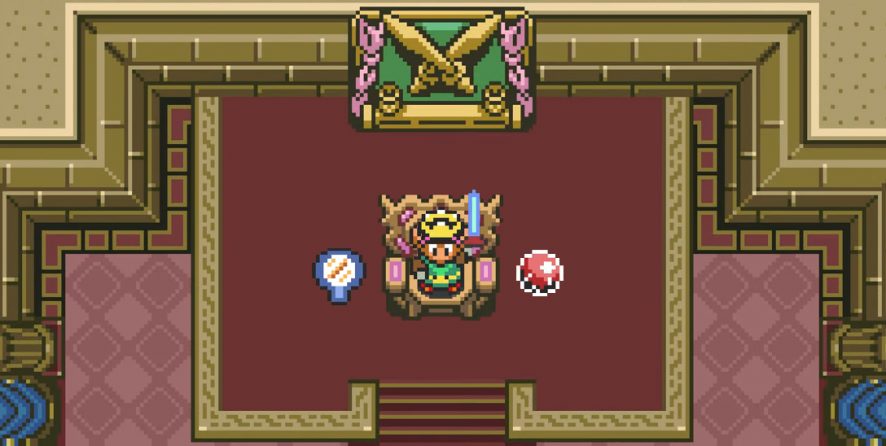
Anyway, it is said that when Ninigi first descended to earth, he carried three celestial gifts meant to aid him in his mission to pacify the land. Since then, these Three Sacred Treasures have been passed down from emperor to emperor, with the rite of succession ensuring that they only pass into the hands of a legitimate heir to the throne. And this is what ultimately connects Link from A Link to the Past to the House of Yamato: the three key items that enable him to venture through the Dark World — the Master Sword, the Magic Mirror, and the Moon Pearl — directly parallel the heavenly artifacts that inspire such reverence and awe in the Japanese people.
The Master Sword
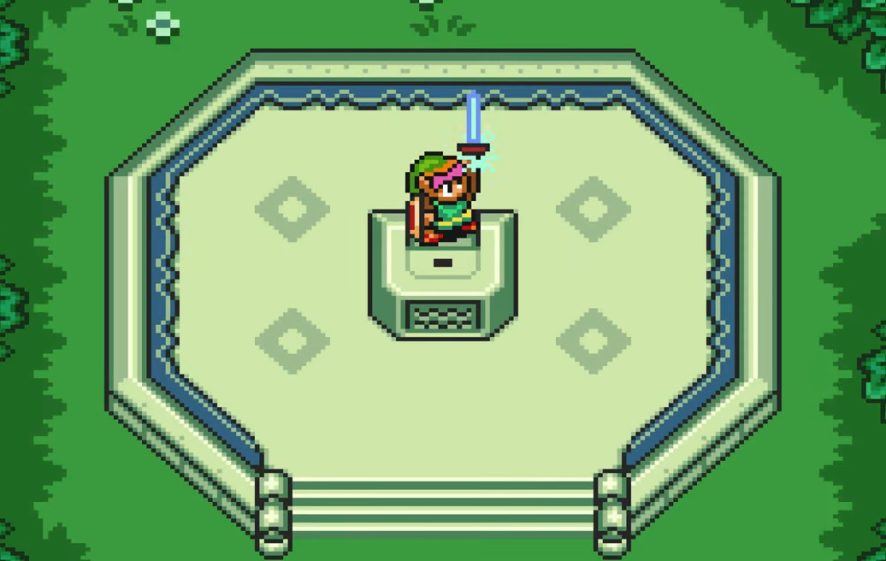
A Link to the Past marks the first appearance of the Master Sword in the Zelda series. As a sacred blade imbued with the power to repel evil, it can only be wielded by an individual of pure heart and tremendous courage. Before he can pull the sword from its resting place deep within the Lost Woods, Link must prove his worthiness by obtaining the Pendants of Virtue from the Eastern Palace, the Desert Palace, and the Tower of Hera. Most people credit the Arthurian legend as the original source of inspiration for the Master Sword (the French version of A Link to the Past even refers to it as “Excalibur”), but evidence suggests that the venerated Kusanagi Sword, the first of the Three Sacred Treasures, also played a prominent role in its conception.
The story of Kusanagi begins with the storm god Susanoo being exiled from the heavens and sent down to Nippon, where he comes across a family of lesser earth gods who are being tormented by Orochi, an eight-headed reptilian monster. They have been forced to sacrifice seven of their daughters to this ruthless beast, and now it wishes to consume their eighth and final child, Princess Kushinada. In exchange for the girl’s hand in marriage, Susanoo agrees to slay Orochi and end its reign of terror once and for all. After successfully luring the giant serpent out of its lair by tempting it with vats of rice wine, he slices off all eight of its heads and dismembers its body, discovering that a sword had been slumbering inside one of its tails. Susanoo christens this weapon “Heavenly Sword of Gathering Clouds” and presents it to his sister Amaterasu as an apology for his past actions, thus cementing its status as a holy sword.
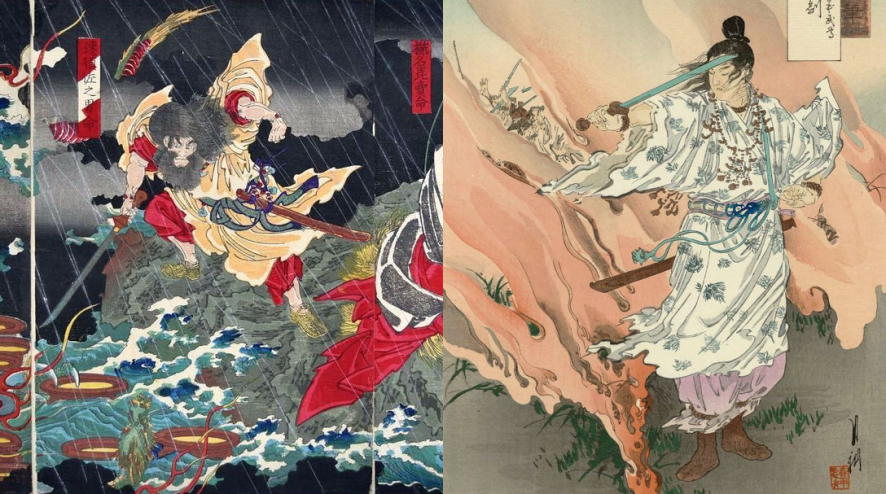
But the Master Sword’s role as a weapon blessed by the gods isn’t the only thing it has in common with Kusanagi, as the actual plot of A Link to the Past contains a couple of allusions to the Tale of Orochi. In order to liberate the Sacred Realm, Link must rescue seven descendants of the Sages, who were sacrificed by Agahnim in an effort to release Ganon from the seal that the Sages placed on him so long ago. These Seven Maidens could be seen as the Hyrulean counterparts to the seven daughters devoured by Orochi, and if you wanted to push the metaphor even further, you could say that defeating the bosses who guard them is like cutting off seven of Ganon’s “heads”, with Agahnim serving as the eighth.
Another legend worthy of a brief mention is that of Prince Yamato Takeru, a warrior to whom Kusanagi was gifted by the High Priestess of Ise Shrine. One day, the prince was cornered in a large grassy field by a barbaric warlord, who set the grass ablaze in an attempt to murder the young man. Yamato Takeru began cutting back the grass in order to slow the fire’s progress, and in doing so, he made a startling discovery: every time he swung Kusanagi, a powerful gust of wind would be flung in the direction of the swing. This magical ability is what ultimately saved his life, as he used it to redirect the fire and turn the tables on the warlord. Why do I bring this up? Well, I’m not trying to claim that the Master Sword allows Link to control the wind, but it is rather interesting that the Sword Beams in A Link to the Past look a bit like bursts of swirling air, rather than the standard blade-shaped beams we see in other Zelda games. It’s probably just a coincidence, but I like to think that the design was intentional.

The Magic Mirror

Before Link acquires the Flute, the only way he can scale Death Mountain is to rely on the meager glow of his Lantern to navigate a pitch-black cave labyrinth. Colonies of carnivorous blue bats hang from the ceiling, hoping that a delicious Hylian will wander by for them to nibble on, and if said Hylian doesn’t watch his step, he’ll find himself plunging headfirst into an endless abyss. Along the way, Link stumbles across a disoriented old gentleman who has lost his own light source, and by working together, the two manage to exit the cave and emerge at the top of the mountain. To thank him for being his escort, the elderly man gives Link the Magic Mirror, an extremely valuable tool that will allow the young hero to return to the Light World after Agahnim attempts to strand him in the Dark World. But one has to wonder: Why is this random fellow the one in possession of such a priceless relic? Shouldn’t an artifact like that be locked up in a temple and closely guarded by Ganon’s minions? Well, the answer to this query lies in the Magic Mirror’s connection to the legendary Yata no Kagami, the “Eight Ata Mirror.”
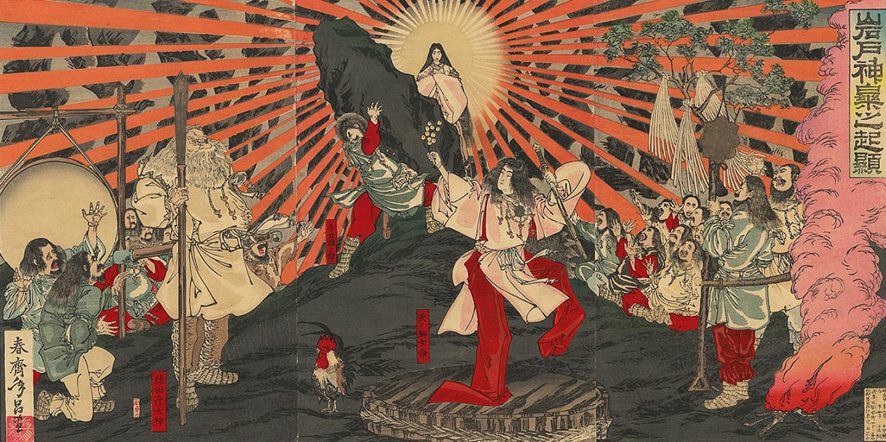
Remember me mentioning earlier that Susanoo was banished from the celestial plain prior to his battle with Orochi? This came about because of an intense feud between Susanoo and Amaterasu, which came to a head when the former, whipped into a frenzy, cut a swathe through the latter’s palace and wantonly murdered one of her weaving maidens. Deeply affronted by this, Amaterasu secluded herself inside a cave, taking with her the power of the sun and thus bathing the world in darkness. In response, the gods constructed an extraordinarily beautiful mirror and positioned it outside the entrance to the cave, along with a lovely jade magatama (which we’ll talk about shortly). They then threw a party, and Uzume, the goddess of mirth, began to dance in a way that elicited uproarious laughter. Intrigued by the commotion, Amaterasu peeked out and caught sight of her reflection in the mirror. She froze, utterly transfixed by her own heavenly visage, and the other gods used this opportunity to yank her out and seal the cave shut, allowing the heavens and the earth to once again bask in golden rays of sunshine.
With this story in mind, I now have a better appreciation for how Link comes to possess the Magic Mirror in the game. The Lost Old Man may not be a deity like Amaterasu, but by guiding him out of a cave where the darkness seems almost supernatural, Link is granted the ability to “restore light to the world” by opening a portal back to Hyrule and escaping the Evil Realm. It’s a subtle, clever homage to the Shinto legend, and Link’s pure heart makes him the ideal person to wield the Mirror, just as Amaterasu intended when she gave Yata no Kagami to her grandson: “Serve this mirror as my soul, just as you’d serve me, with clean mind and body.”
The Moon Pearl

Before Link continues on his journey, the old man from the cave offers him one last piece of sage advice: locate the Moon Pearl that sleeps within the Tower of Hera. The function of this enigmatic stone isn’t really made clear until Link steps into a transporter and is whisked away to the Dark World for the first time. Anyone who enters the corrupted Sacred Realm without an amulet of protection is transformed into a shape that reflects their true nature, and Link, being a softhearted pacifist deep down, becomes a little pink bunny. While adorable, this bunny persona is utterly defenseless, unable to use any items, and thus unable to cope with the unrelenting horrors of the Dark World. The Moon Pearl enables Link to retain his human form by “protecting its bearer from the power of the Triforce”, mirroring the function of the lustrous Yasakani no Magatama, the final Sacred Treasure.
Magatama are ancient “jewels” shaped like the dotted teardrops that constitute a yin-yang symbol. They date all the way back to the Final Jōmon Period of Japanese history (around 1000 BCE) and were originally carved from rocks such as slate, but by the time the Kofun Period rolled around (300-538 AD), it was common practice to use the mineral jade. These stones have been recovered from countless archaeological sites across the country, and research indicates that they gradually evolved from a purely decorative object to a relic of great religious and cultural importance.
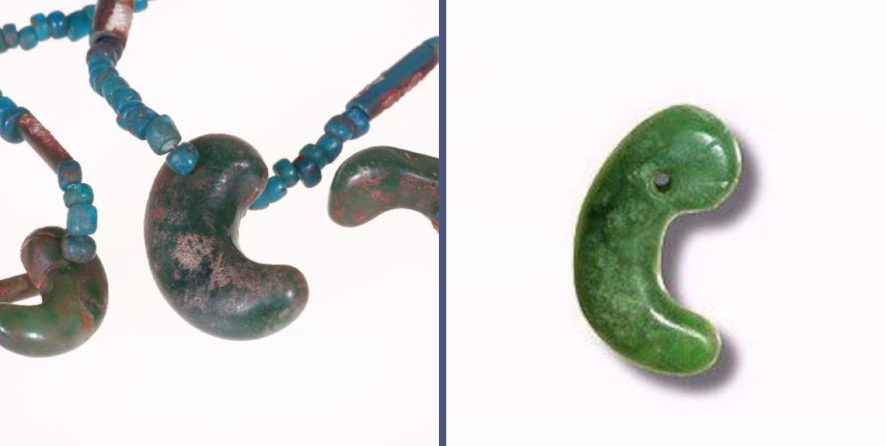
In Shinto, Amaterasu is known to have an affinity for magatama, as she is often depicted with beads woven around her wrists and through her hair. That’s why, when she was stewing away in the Heavenly Rock Cave, one of these stones — the one that would become known as Yasakani no Magatama — was hung next to the mirror in order to lure her out. For its role in bringing the sun back to the world, the jewel became a holy talisman blessed by the gods, said to drive away evil spirits and bring good luck to its wearer. So while the Moon Pearl is round (like a pearl, funnily enough) and not comma-shaped like a magatama, it essentially serves the same purpose: shielding the one chosen to bring peace and prosperity to the land of mortals.
So, to answer the question that I posed at the beginning of this article, yes, I wholeheartedly believe that Link’s adventures would be just as epic if he started out as a refined prince rather than an ignoble pauper. After all, the Master Sword has never dictated that the one reincarnated with the spirit of the hero must be born a farmer or a nomad to be worthy of its power; it only demands that the Chosen One be courageous of soul and compassionate at heart, which is something that anyone, rich or poor, lowly or divine, is capable of. So I look forward to the day when I get to see Emperor Link rise up from his gilded throne, grip the bejeweled hilt of his sword, and lock eyes with the terrible beast laying waste to his kingdom, ready to continue the proud legacy of his humble predecessors.