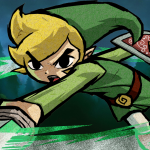
“Zelda? That’s the guy in the green hat and skirt, right?”
This is the joke that all The Legend of Zelda fans have heard, hated, and repeated throughout the years. The games we love are all part of The Legend of Zelda series — every game’s title tells us as much — but the main character is not Zelda, it is Link. We’re used to this. It makes sense to all Zelda fans, and we just know to correct or ignore people when they make the mistake. I guess it could be worse. It’s not as if the games are named after one of the villains instead of the hero. (I’m looking at you, Metroid.)
What is in a name?
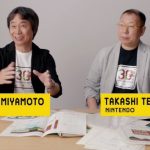
Jokes aside, when you really think about it, why is The Legend of Zelda series named “The Legend of Zelda”? Why is the series named after someone whose role in the games ranges from being a damsel in distress to a major supporting role, but is still never a primary or playable character? Well, the short and easy answer is found in Shigeru Miyamoto’s explanation of the origins of the name: “Zelda was the name of the wife of the famous novelist Francis Scott Fitzgerald. She was a famous and beautiful woman from all accounts, and I liked the sound of her name. So, I took the liberty of using her name for the very first Zelda title.”
It’s pretty underwhelming, but Mr. Miyamoto’s explanation is how the series got its name. That’s often the case when creating a work of fiction. Someone will simply like the way something sounds or looks or how “cool” it is to them. They know when something is going to work. Every creator is guilty of this if their material is scrutinized thoroughly enough. Metroid is a portmanteau of “metro” and “android,” for example. It may seem odd or even lazy to some, but the developers know when their choice is the correct one.
This is further proved by how the series originally used to carry the subtitle The Hyrule Fantasy. The initial plan was to create names that focused on the land of Hyrule, but that concept was dropped to keep the titles concise. Going back to my previous point about name choices, the shorter name did sound better, but the choice unfortunately came with the side effect of perpetuating the confusion about the series’ protagonist.
The only problem is that this naming origin isn’t enough of a reason for a lot of people. I of course speak of nerds, who have nothing better to do than to speculate on pointless theories. And when I say “nerds,” I am almost exclusively referring to myself. Perhaps it’s nothing to be proud of, but least I can be honest about how passionate I become when talking about Zelda.
I’ve thought (obsessed) over the origin of the name for years, and it wasn’t until the release of Skyward Sword that I and other fans were finally given a true origin for Hyrule’s history, as well as a starting point for Princess Zelda, Link, and Ganon. While many people now know and understand this origin, my favorite consequence of the game’s exciting lore pertains to what it did for the franchise’s name: Skyward Sword allowed us to learn why Zelda deserves the honor of being the titular character and why this is Zelda’s legend.
This explanation, which took twenty-five years to develop, comes by way of the mysterious new goddess, Hylia.
The best-laid plans
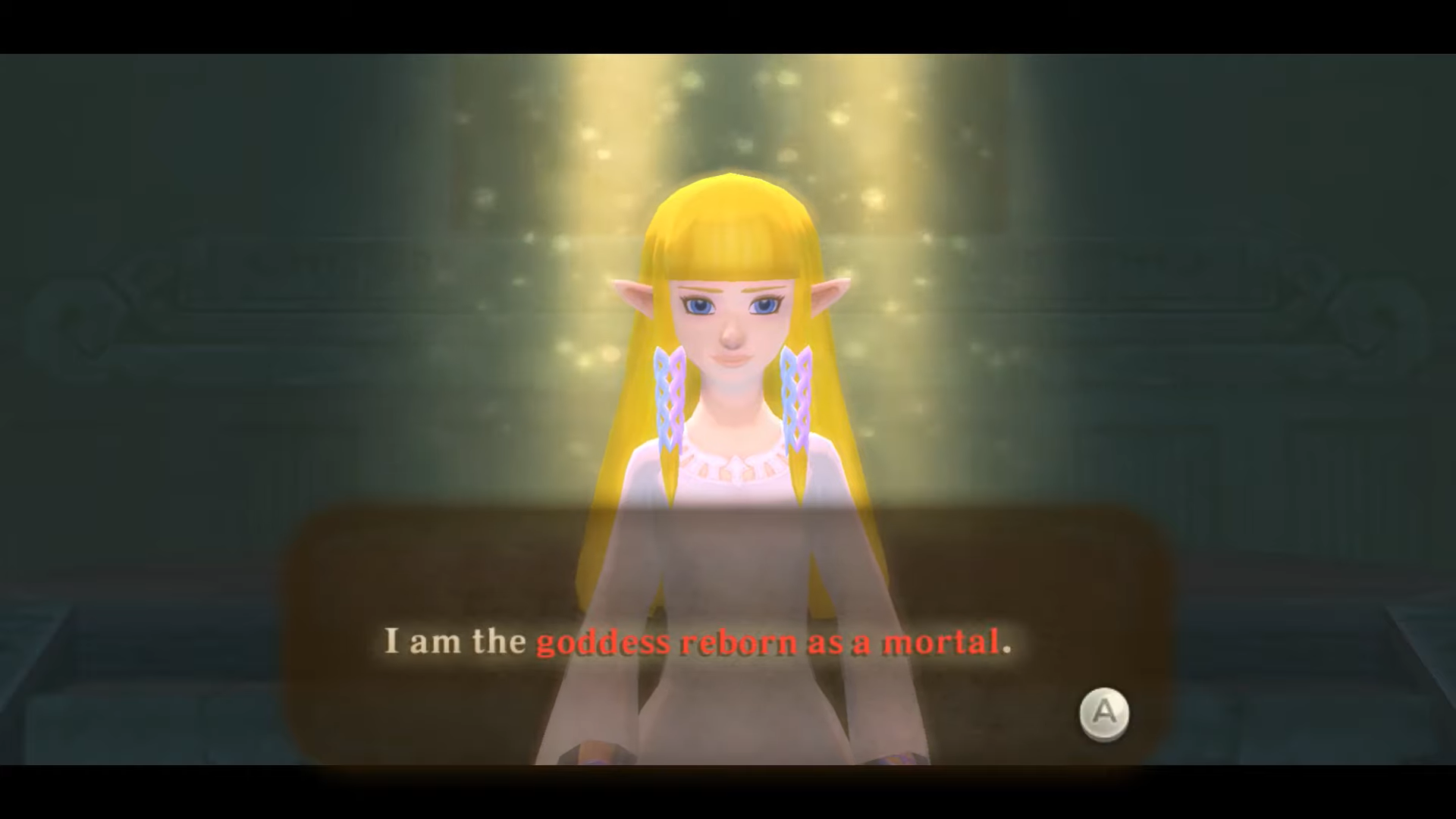
As revealed in Skyward Sword, Zelda is in fact the human reincarnation of the goddess Hylia, who was sent to act as a protector of the Triforce and the mortal beings living in Hyrule. Although she was not one of the Golden Goddesses — she served them and followed their orders — Hylia was evidently a powerful, loving, and exceptionally wise deity respected by the people she led. She was dedicated to her role as the guardian of the world, and she would do anything and go to any extremes to protect everyone and everything under the sun.
The devoted passion and love are why, during the costly and seemingly endless war with the Demon King Demise and his armies, Hylia began to understand what she needed to do in order to save her subjects, both at the present time and for all time to come.
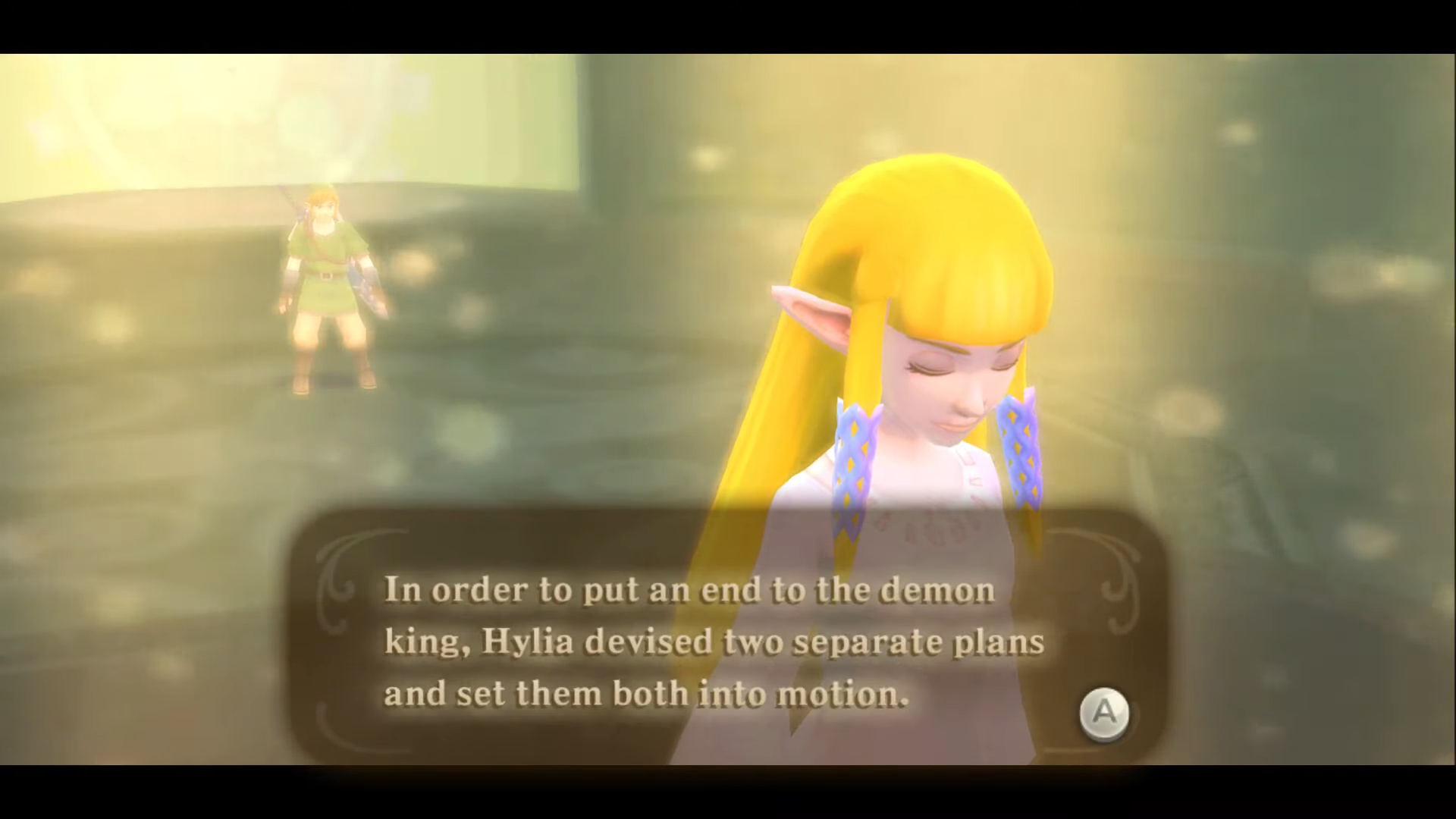
While Hylia was able to defeat Demise and seal him away at the end of the war, she also came very close to being destroyed. Her power was limited, and she knew that the seal placed on Demise would break eventually. Nothing short of the Triforce would be able to permanently stop him. So, in order to guarantee Demise’s demise, Hylia set in motion a plan to obtain the power of the Triforce, create a weapon that could banish evil, and summon a hero who would put a permanent end to the Demon King.
The first step in her plan was to create the weapon that would be used to battle Demise. She forged the Goddess Sword and created Fi, who would reside within the sword and guide the future hero in his quest. This was made possible by the weapon’s potential to be enhanced and strengthened far beyond its original design, with this full potential being enough to vanquish even Demise’s full might.
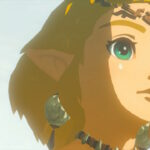
The next step was to create a way to gain access to the Triforce. Hylia knew that the hero would need her help to find and wield the power of the goddesses, but she was also aware this power could not be harnessed by a deity. Hylia gave up her status as a divine being and transferred her soul into the body of a mortal in order to ensure she and her chosen hero would both be able to summon the Triforce’s power. She restructured her soul into that of a Hylian’s and placed it in an unbreakable reincarnation cycle. Now, though the world had lost its goddess protector, it gained the blessing of an ever-present leader, one who would be more connected to the land and never be separated from it by the limitations placed on divine beings. This new guardian would be the bridge between gods and mortals, and she would be known throughout history as Zelda.
The final step of her plan came in two phases.
First, Hylia needed to ensure that a hero would arise to defend the world, much like her original champion did during the war with Demise. When the time was right, the Golden Goddesses would bring forth the hero of legend, but this hero would still need to prove himself worthy of that title. To help this hero fulfill his destiny, Hylia left clues behind for him to follow so he could find and face challenges that would test his power, wisdom, and courage. One of these challenges was finding Sacred Flames that would be used to turn the Goddess Sword into the Master Sword. This blade, infused by the power of the goddesses and eventually blessed by Zelda, could only be wielded by the chosen champion, and the hero’s ability to earn it was essential for Hylia’s plans to succeed.
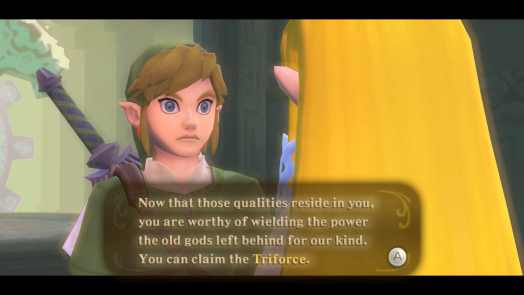
Second, Hylia needed to help the hero find the Triforce. Once the hero had faced all of the presented trials and obtained the Blade of Evil’s Bane, he would be considered worthy by the goddesses to obtain the Triforce. Hylia had hidden each piece of the Triforce on Skyloft, which she had also sent to the heavens as a means to protect both the humans and the sacred power from Demise. She left a way for Link to find the Triforce’s location in the Skyloft’s Sacred Realm, knowing that the hero would eventually find his way there. Once he had the pieces, his destiny would be fulfilled and Demise would finally perish.
What does all of the goddess’s scheming mean? It means Hylia, now reborn as Zelda, orchestrated the creation of the timeless good that would always appear to stop the relentless evil. She set in motion the crucial elements that return in every era of Hyrule’s history to save the world: The birth of a princess, the arrival of a hero, the access to a sacred weapon, and the power needed to restore the land. Without her, the hero would never have been found, his ties to Triforce, the Master Sword would have never been forged, and the spirit of the hero would have never returned. Demise would have taken the Triforce for himself and destroyed everything and everyone.
A legendary choice
I am aware that Hylia’s history is known by most fans, but my point is not to simply give her biography. The story in Skyward Sword has been influential for reasons beyond the lore it added. It now made sense, from a narrative standpoint, to call the series The Legend of Zelda. Hylia’s plan was more than the start of the endless cycle of heroes and villains. Zelda is Hylia, her reincarnation and new self, which means she is the physical embodiment of the goddess’s enduring and loving legacy. Zelda is not simply a character. Skyward Sword and Hylia both helped her elevate to the role of being a symbol.
This was a fantastic and incredibly clever way for Nintendo to forever cement the validity of their name choice. They took what was a source of bafflement and turned it into a remarkable tale that has made Zelda games and their characters endearing on a whole new level. I often compare this tactic to what Disney did in Rogue One: A Star Wars Story. (Well, it’s more appropriate to say I compare Rogue One to Skyward Sword.) Disney took what was considered a plot convenience — the weakness in the Death Star’s design — and transformed it into a full and amazing tale that had a permanent impact on the entire Star Wars franchise. Whether it’s Nintendo or Disney, it’s hard to avoid giving the creators credit for their ingenuity.
I suppose the creation of this retroactive origin for Hyrule means it would be more appropriate to call the series “The Legacy of Zelda,” but going back to what was learned from Mr. Miyamoto and other creators, “legend” simply sounds better.
Zac Pricener
Zac Pricener has been an avid Zelda fan for twenty years. The series has been a source of creative inspiration for him and fueled his desire to become a writer. That desire to write in turn led him to now serve as the Features Manager, Assistant Columns Manager, and Assistant News Manger for Zelda Universe.


 by Zac Pricener on May 4, 2020