The Temple stage was first introduced to the Super Smash Bros. series in Super Smash Bros. Melee and would go on to be featured in every subsequent entry. While not the first stage to represent the Zelda franchise (that honor goes to Hyrule Castle in the original game), it definitely remains the most iconic. In Melee, Temple naturally serves as the home stage for our Zelda heroes, but since Fire Emblem was not able to get any stage representation, Marth and Roy were also permitted to use Temple as their home base. Because of this, Temple was the only place where you could hear the one Fire Emblem song featured in the game, a remix of Together, We Ride! (the coolest song in the game, by the way).
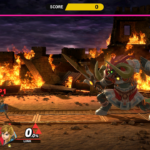
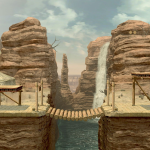
This stage’s appearance is mostly based on the palaces of Zelda II: The Adventure of Link. This stage is massive, with several different sections. This is probably not the stage you want to choose for a quick battle. The top of the stage is split into two sections. To the right and center is the main platform. The floating piece of earth holds the rubble of some broken down castle or other stone construct, with the broken pieces acting as uneven platforms. All the way to the right we have two more more high platforms, good for escaping your opponent, before reaching the very edge of the stage. To the left, a stone bridges connects two platforms. Going too far left will lead the fighter to the edge of the stage. Large stone structures similar to that of castles and palaces in Zelda II can be seen in the background giving the stage a lot of depth.
Moving downwards, a tunnel in the center of the stage leads down to another floating piece of earth below. This “underground” area of the stage is where the true chaos of Super Smash Bros. becomes evident. This main platform below is surrounded by walls and ceilings with only a few narrow escapes. This can lead to lots of fighters getting hit and bouncing off walls and greatly increases the difficulty of actually getting a KO. Nintendo Power comically dubbed this area of the stage as the “Fight Club.” Lastly, one tiny platform floats at the bottom of the stage where fighters desperately cling to as to not have to enter the horrendous “Fight Club” area again.

While the stage is based on Zelda II, there are few direct references to the game. The top left of the stage mostly resembles the entrances to the palaces in the game, as well as the stone building in the background resembles that of the sprites used to represent locations in the overworld. The platforms have Hylian script on them that can be translated to “The Legend of Zelda: Ocarina of Time” in Melee, but in Brawl and every other game going forward, it simply reads “Smash Brothers.” Other than that, the stage mostly tries to reflect the game’s dungeons by keeping a subterranean and labyrinthian design. Fun Fact: in early builds of the game, the map actually had an elevator that lead to the bottom of the stage, much like in the dungeons of Zelda II. Unfortunately, this was not included in the final build of the game.

As far as tournament legality, Temple is going to remain as a “for fun” stage only. The stage is just too massive for serious competition. The several walls can lead to fighters staying alive much longer than they would on standard stages, and the labyrinthian design can lead to endless camping by characters like Meta Knight or Jigglypuff that can easily navigate the weird pathways and fly away from the fight. But this still remains a fun stage, especially when it comes to chaotic eight-player sessions. I am one of the few people who actually like Zelda II, and I like that we are able to get some representation in Super Smash Bros., even if the references are a bit vague.