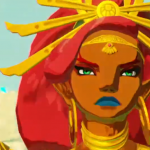
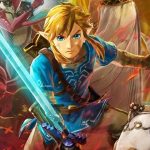
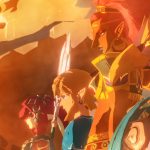
Nintendo Treehouse Live returned this week with an extended look at Pikmin 3 and Hyrule Warriors: Age of Calamity. While I’m sure many people are also excited for Pikmin 3, let’s go ahead and get to some of what we saw for the upcoming Zelda Musou.* We’ve already reported on some story beats and some gameplay featuring lovely shots of Urbosa in action, but one of the biggest draws was getting a better look at the world map and the game’s structure outside of slashing and dashing.
I had never played a Dynasty Warriors game, but when they said The Legend of Zelda was going to mash up with it, I decided to give it a shot. What happened was I had suddenly found what would be one of my favorite video games on Wii U, and again on Switch. I’m not going to sit here and tell you that Hyrule Warriors is some kind of bold step in video games. It’s not the most intricate, complex beast to tame, and for all of its attempted systems, it’s fairly simple. But it’s fun. That’s it: just incredibly fun. One of the things that made it that way was all the ways the characters were designed with their abilities and the surprising amount of mission variety and content. But seeing the changes to the content outside of individual battles has me even more excited for the upcoming prequel.
A familiar map
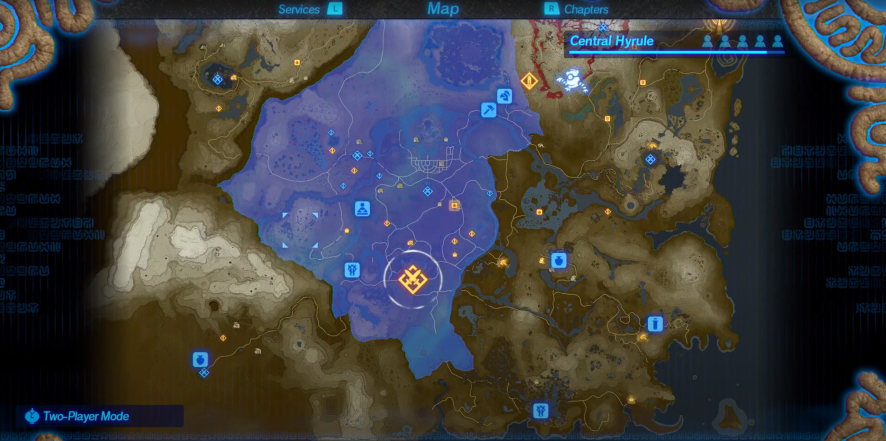
We were shown a world map, and it is the one we are all very accustomed to from our time in Breath of the Wild. In the previous musou spin-off, there was a linear story mode and a more sprawling “Adventure Mode” that took place on the original NES Hyrule map. Later content would add different 8-bit styles of other world maps, but each square on the map was a different event. I was curious if this was going to carry over to Age of Calamity, and it does not appear to. As much as I liked that retro-themed style of Adventure Mode, what they’re doing now is so much more interesting.
Map icons
So of course we know the map, and that knowledge helped me immediately start picking things out. The first thing would likely be the smattering of blue and orange icons. We recognize those as the symbols for things like towns and shrines, but there’s a lot of new ones when you start looking closer. From what I gather, blue icons and orange versions of icons fit the same way shrines did, with orange being the ones that you still need to explore. Looking a bit closer we can see icons for two swords crossing, a single sword, the horse head for stables, and others.

They went over a lot of this in the presentation, which you can watch here, so I’ll just give a quick rundown.
- Crossing sword icons are your main battle icons. These are the big story battles and likely how you progress through the campaign.
- Single sword icons look to be combat-focused side missions. The one we saw was a quick “beat x enemies in x time”-style trial, and I can imagine this is where a lot of the variety will come from.
- Character icons are yellow and represented by the same art style of the main characters on the loading screens. Each one of these is a mini-quest relative to the character whose icon you’ve selected. You’ll get a little story flavor and then have to turn in a certain amount of different materials to complete the quest. This is very similar to Breath of the Wild‘s quest structure, but also the structure of the talent trees in Hyrule Warriors. Turning in the materials you get from battles allows you to complete the mission to unlock things like new combat moves or new abilities.
- Cooking pot icons are where you take some hard-earned materials from battle to make new recipes. These are similar to Potions from the apothecary in the previous Hyrule Warriors.
- The hammer icon is your blacksmith, which mostly functions exactly like it did in the previous title. You combine various weapons with similar weapons to level them up and mix abilities. In short, these last three icons are the various “Bazaar” services where you just shifted through menus. While I think the presentation makes this feel very Breath of the Wild-esque, it looks like the L and R buttons can swap menus to visit individual chapters and services you’ve unlocked. It’s the best of both worlds!
- The pointy Mystery Guardian appears to be an adorable way for the game to suggest content you should visit next.

Armor and weapon select
When you select a mission, you first outfit Link with one of the weapons you’ve been crafting. Interestingly, it would appear that any two-handed weapon fights the same way for Link; or at least, you can combine them by that designation. You then fit him with some of the armor you’ve collected. Much like Breath of the Wild, you can mix and match sets. They didn’t appear to offer any other than an aesthetic change, but perhaps wearing a complete set will give a set bonus of some sort.
Map zones
It appears the zones are split up into slightly larger areas than Breath of the Wild. There’s also a meter of some kind with some character icons on it, which differed in size depending on the zone selected. I assume this is a progress bar for how much has been completed in each zone, but I’m curious if those blank character icons represent characters unlocked. I’m also wondering if this game will have a more open-ended style for approaching the different Champions that lets you pick what to do, or if it’s all going to open up in a set order.

Overall, it’s great to see how they are reworking systems and making them new and interesting through a proper presentation. As we approach the game’s impending release with each passing day, I just find myself more and more excited.
Want a refresher for the ins and outs of Breath of the Wild’s Hyrule? Check out our interactive Breath of the Wild map over on Zelda Maps!
*”Musou” is the title given to Dynasty Warriors and Dynasty Warriors-related games in Japan.