I have wondered many times why Zelda games stand out to me in comparison to most other adventure games. Many games share the same themes, the same fantasy and medieval setting, and the same focus on combat and exploration. But I can only ever say that Zelda games exist in a class all their own. They leave a mark that has affected millions of people who come to love the games in this series.
There are many reasons why this is the case, but the one reason I have never taken the time to carefully observe, at least until these past few years, is the use of the camera in the games — or at least the use of the camera in the 3D games. Nintendo has always done a great job with the camerawork in all of their games, both in terms of cutscenes and player-controllable cameras, but the Legend of Zelda games are among the best in this regard. What I will do is explain what I see, how I see it, and why I believe our invisible friend the camera is responsible for a lot of the love the series receives.
Art in motion
How memorable (or in this case, hilarious) a moment will be to a player depends heavily on a game’s use of the camera.
Nothing ruins the enjoyment of a fictional environment and narrative like the disruption of immersion. I can think of multiple games where the shoddy camera work during cutscenes made it difficult to focus on what was happening. (Exhibit “A” would be almost every early and mid-2000s Sonic game). Luckily Nintendo does a fantastic job and has been doing so since the beginning.
To start, let’s look back to the beginning of the 3D era. Ocarina of Time makes great use of the camera during its cutscenes, something crucial for it to accomplish. Being the first 3D Zelda game meant Ocarina has to get everything right, especially its focus on storytelling. The player needs to be engaged in what was happening, and that starts by catching their attention by showing what is important.
Almost every time Link reaches a new location, the gameplay is interrupted to show us the area. The camera starts on a particular focus point and then either pans around, zooms out, or shows jump cuts to convey the importance of where Link and the player are.
When Link first enters Zora’s Domain, the camera moves to the position of the waterfall to show the water plummeting to the pond below. It then pans to the right and across the area to show Link as he walks in just before cutting to the player camera. In these few seconds, the game conveys how oasis-like the domain is. It is a large and secluded area, but is also peaceful and full of life, and both of these attributes are sustained by the water. The music, which matches the area perfectly, seems to flow with the camera, with both of them helping establish that Zora’s Domain is a mystical and elegant place.
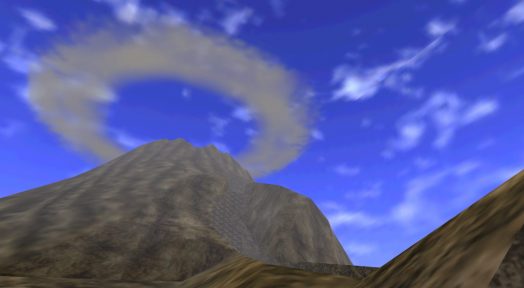
While this approach works for less busy areas, a different method is best for introducing something that should carry more magnitude. When Link first passes through Kakariko Village to begin the trek up to Death Mountain, the camera first angles up to show the peak of the mountain. It then moves back a small amount before cutting to a short, sweeping shot of the first part of the trail and finally rejoining Link. The whole sequence is a single cut, but taking that extra second to change cameras tells the player that this a very large area, what you want is way up there, and you are starting way down here. It helps establish scope, which is done multiple times throughout Ocarina of Time. It was a focus of the game to demonstrate how massive, engaging, and detailed this 3D world was. These short and seemingly simple area introductions were crucial in accomplishing this goal.
That the camera pans up to show your ultimate destination makes you feel small in the face of Death Mountain.
The camera was put to great use in all scenes, not just establishing shots. The angles, points of view, and cuts during crucial or tense narrative moments are also incredible.
Nintendo clearly wanted the player to see how big the world is, and, in addition to the opening views, this was best accomplished by the angles the camera was placed at. This is most obvious during scenes played while the player is in control of Child Link. Many times an object or enemy would tower over him. It created a sense of intimidation, which gives a scene more emotional impact.
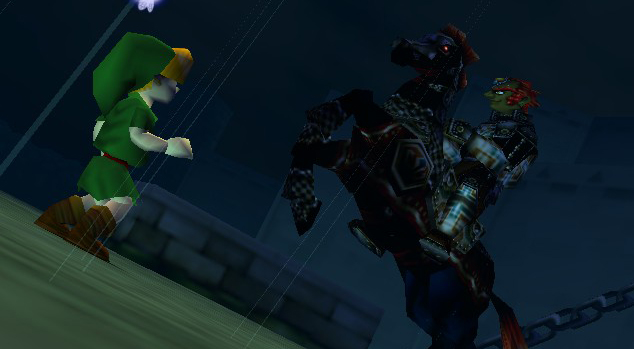
When Link arrives at Hyrule Castle Town’s gate after collecting all of the Spiritual Stones, only to be met by a fleeing Princess Zelda and Impa, it’s clear something bad has happened. Then, while the camera is close to Link, he turns to see Ganondorf, who looks larger than life while atop his black steed. The camera stays down by Link, allowing the player to feel what Link feels in that moment. He is a child in presence of towering evil, both metaphorically and literally. Ganondorf is a threat. He is a monster. Making the player feel small next to him fuels the motivation to vanquish this evil being. Again, a simple adjustment of the camera does so much for the overall experience.
The intensity of this moment, even two decades later, is awe-inspiring.
Power to the players
I hope I didn’t lose too many people with that Gamestop reference, but it is appropriate for what’s next. The camerawork in nearly every Zelda game is always stellar, but would ultimately be meaningless if everything between the cutscenes isn’t watchable. All that filler. The actual “game” part of the video game.
The player camera has never been bad, but my personal favorite, and the one I think serves as a high point of the series and a gold standard, is the camera from Wind Waker.
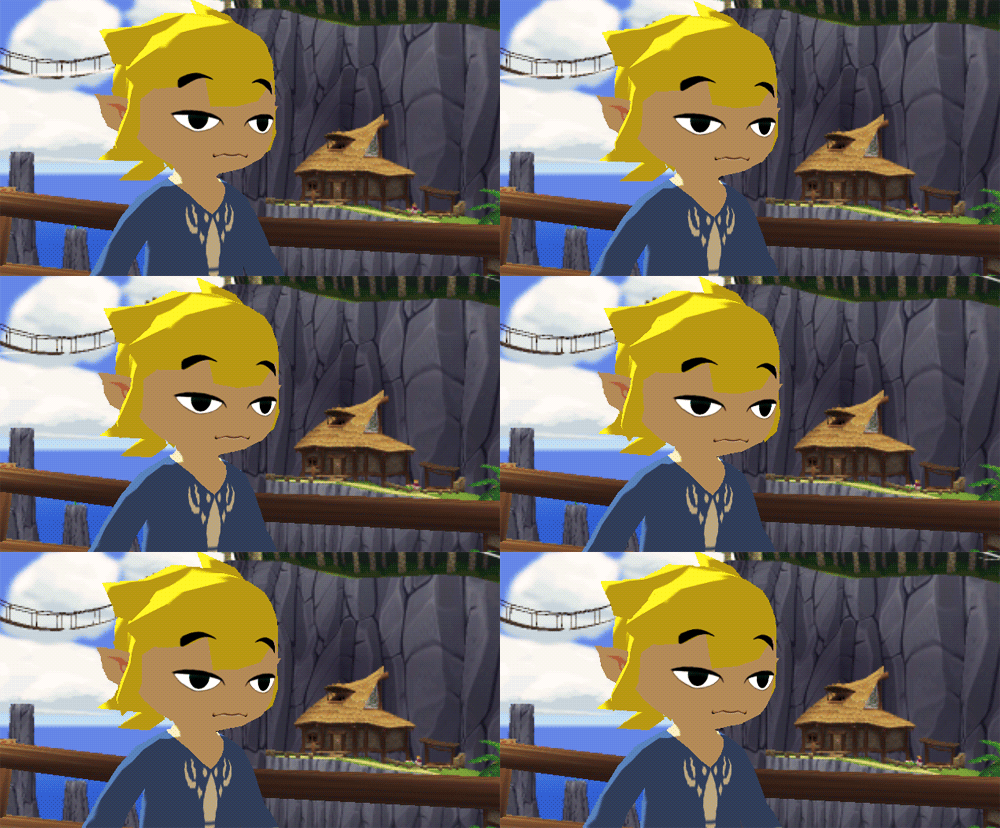
Taking control of Link, while enjoyable in its own right, offers the immeasurable pleasure of also controlling the seamless and refined motions of the camera. I remember panning around in circles around Link as he stood in Aryll’s Lookout. The camera’s range of motion is instantly noticeable. It can be positioned almost anywhere. It moves at the perfect speed, able to pan around quickly enough so that it never becomes tedious to survey an area but not too fast as to cause motion sickness, which is a major issue for me while playing 3D adventure games. You are in complete control.
He doesn’t look it, but, trust me, Link’s very impressed by the camera.
The recentering of the camera behind Link, even if a minor detail, makes a big difference. Again, it snaps back at a perfect speed, and knows which angle is best for Link’s current position. The goal of the camera is to always grant the player the best vantage point to make him or her feel in control of the situation.
Even switching to first-person view is smooth and enjoyable. The thought, detail, and consideration to this crucial part of the player’s experience is commendable. I used to take all of this for granted, but now testing and experiencing the camera’s quality is one the first things I do in any 3D game.
Then, of course, there is the Z-Targeting that the Zelda series is famous for. The ability to lock Link’s focus onto the desired enemy, character, or object. How quickly the camera will snap to the target while moving behind Link, the smooth transition from one target to another, and the ability to key in on a nearby target even while Link is not looking at them are all the features that make Z-Targeting so revolutionary. Again, Wind Waker further refined the camera mechanics that have become the standard in not just Zelda games but many more video games as well.
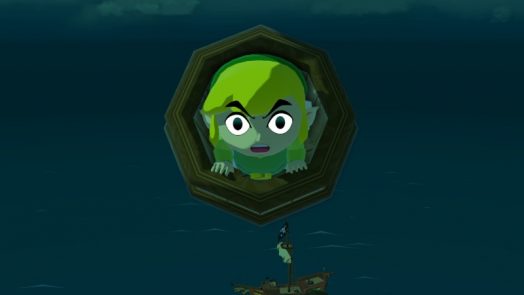
The camera lets us get shots like this, which alone validates my point.
The last and most crucial aspect of the player camera is the focus, and this feature distinguishes the use of cameras in Zelda games from that in other, comparable titles. The camera always centers on Link and what he is doing. You can move it to freely look around, but the default position is slightly behind and above Link. It is also at a perfect distance, not too far or close. Zelda games are all about the players, us, becoming Link. So, once we become him, it shifts to a focus on his and our interaction with the world. The camera keeps this focus in, well, focus by centering on him, and moving whenever it is convenient for us. Other games’ cameras work this way, but never to the same extent, at least as I have seen. Many games will split the difference. They try to show the character and the majority of the environment simultaneously. This places the focus on the levels and the action rather than allowing the player dictate the path and pace for most of the game. That’s where Zelda games are different.
Sailing is a good example of this. When Link begins to sail, the camera moves to that sweet spot I mentioned earlier. You can then freely move the camera to see everything around Link and the King of Red Lions. The game gives you the reins. I can’t stress the importance of this balance between focus and control enough. It’s such a simple way to draw anyone into a game’s world.
The camera loves you, baby
The care put into the mechanics of the camera is actually incredible when the time is taken to observe them. For me, it was something I subconsciously adored but never actively noted. It itched at the back of my mind for so long, the idea that I knew there was something subtle about these games that I loved but couldn’t describe. There are unseen elements in games that make them great. As it turns out, one of these elements is unseen because its purpose is to do all the seeing for you.
Zac Pricener
Zac Pricener has been an avid Zelda fan for twenty years. The series has been a source of creative inspiration for him and fueled his desire to become a writer. That desire to write in turn led him to now serve as the Features Manager, Assistant Columns Manager, and Assistant News Manger for Zelda Universe.


 by Zac Pricener on July 25, 2019