How empty would life be without music? Whether it’s the sound of yesteryear’s top forties playing in the background at a retail store, the off-key group effort of a birthday song, or a concert that draws thousands to hear the masterful efforts of a performer, any day without some form of music feels incomplete. As you have probably assumed about where I’m going with this, video games are an aspect of life that must supply excellent music to make the whole experience feel worthwhile. And, of course, no one can praise The Legend of Zelda series enough for its remarkable use of unforgettable melodies.
I’m not a musician, and I’ve never been by any stretch of the imagination “musically inclined.” When the songs start at church, I refine my lip-syncing skills. I say this to curb any hope that insightful or technical knowledge will come from what I am going to discuss. Music falls into two categories for me: “I like it,” and “I don’t like it.” Perhaps there are better people to talk about how music is made or performed (go read our interview with FamilyJules), but I am certainly willing to give my take on how it is used. That is the key when discussing music in games.
Pulling at the heartstrings
“Music hath charms to soothe a savage breast.” In a sense, a player’s emotional indifference is a beast that game designers must slay in order to fully draw them into their creations. Music has always had a deep psychological impact on people to help summon emotions and memories that can — among many other things — calm, depress, anger, or inspire them.
In Ocarina of Time, the title’s theme peacefully brings us to a place of comfort. It plays gently and evenly as the scene unfolds and moves across Hyrule while Link does the same atop Epona. We see Hyrule, this wide and beautiful world, in its full splendor, and the song is there to make the beauty all the more vibrant.
A sad farewell made even more impactful by the music.
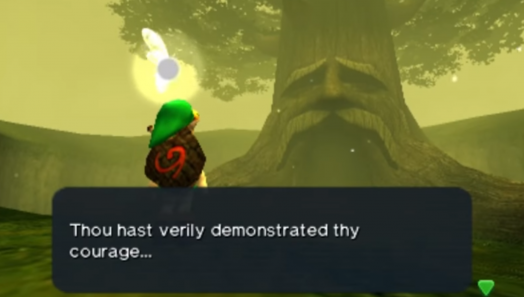
Later in the adventure, as we listen to the slow and heavy theme that plays every time Link speak with the Great Deku Tree, the prolonged pace reveals the weight of the Great Deku Tree’s burden, of the fate inflicted on him. And when the song fades away and is replaced by the creaking and unsettling sounds of the tree passing away, we are able to share in Link’s somber moment.
Further still into the game, after rescuing four of the sages, and after watching as the fifth sage, Nabooru, be abused and brainwashed by the twin hags Koume and Koutake, anyone would be ready to silence their crackling arrogance. When confronting them in the boss chamber of the Spirit Temple, their theme, a song that is undeniably fun and catching, is still also their calling card, and it sets a burning desire to rid Hyrule of these troublesome twins once and for all.
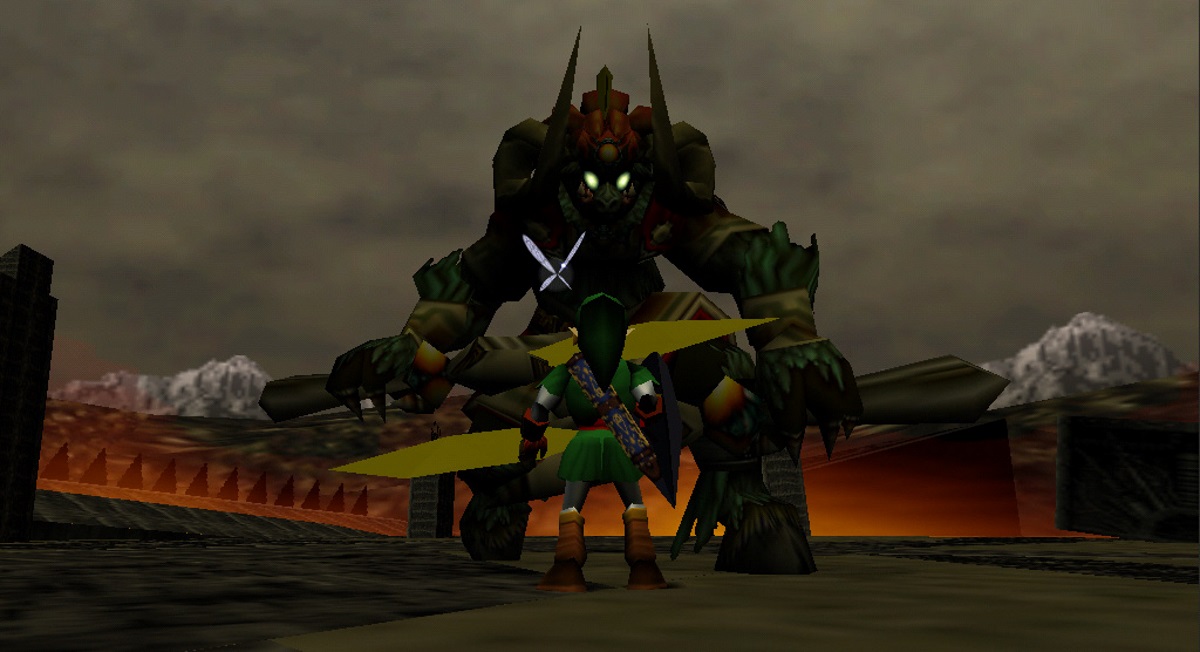
And at the end of the quest, with the stage being the dust and ash-covered ruins of an evil king’s castle, the castmate being an unleashed and relentless demon, Link being the star with the role as the salvation of a world in peril, and the audience being a hopeful princess, that final boss theme begins to play. It’s a dramatic and intense tune, but it is also purposeful and steady in its tempo and notes. This is it. This moment will decide everything. It is just Link and Ganon, and the song reminds the player of the consequences of failure, but it does so for the sake of motivating them. And it does. It definitely does.
The sheer combined intensity of this moment and the song is incredible.
The emotional range of Ocarina of Time‘s songs varies wildly, from the dramatic, like with the examples above, to the comical, such as the melody heard while playing many of the minigames. The music knows how to add impact and depth to every situation Link ends up in, and it’s hard to imagine Ocarina of Time without it.
From headliner to ambience and everything in between
Music takes an active role in our lives. So much so that it slips into an actively passive role more often than not. That doesn’t make sense right now, but bear with me. This is seen in many Zelda games, Ocarina of Time is an obvious example, but for the sake of proving my point and sharing the love, I can let Skyward Sword be the star for now.
Near the beginning of Skyward Sword, we learn that Link is soon to graduate to the rank of a full knight for Skyloft. At his ceremony, Zelda, Link’s oldest and dearest friend, is set to complete the graduation by bestowing Link with his title, uniform, and sail. But in addition to all of this, she also performs a song: “Ballad of the Goddess.”
It’s safe to assume she rehearsed it repeatedly and tirelessly for this occasion and is committed to performing it exactly right. A song dedicated to the goddess Hylia, who saved the Hylians long ago, “Ballad of the Goddess” is an essential step in Link’s knighthood. It is a sacred melody for the people of Skyloft, one of their greatest connections to the gods. From this moment, with Link achieving his status as a knight, the song will follow him throughout his adventure, serving as a catalyst for many of his actions, a symbol of hope, and a signal of Zelda’s true nature. To my earlier point, music is a crucial and motivating element in the story.
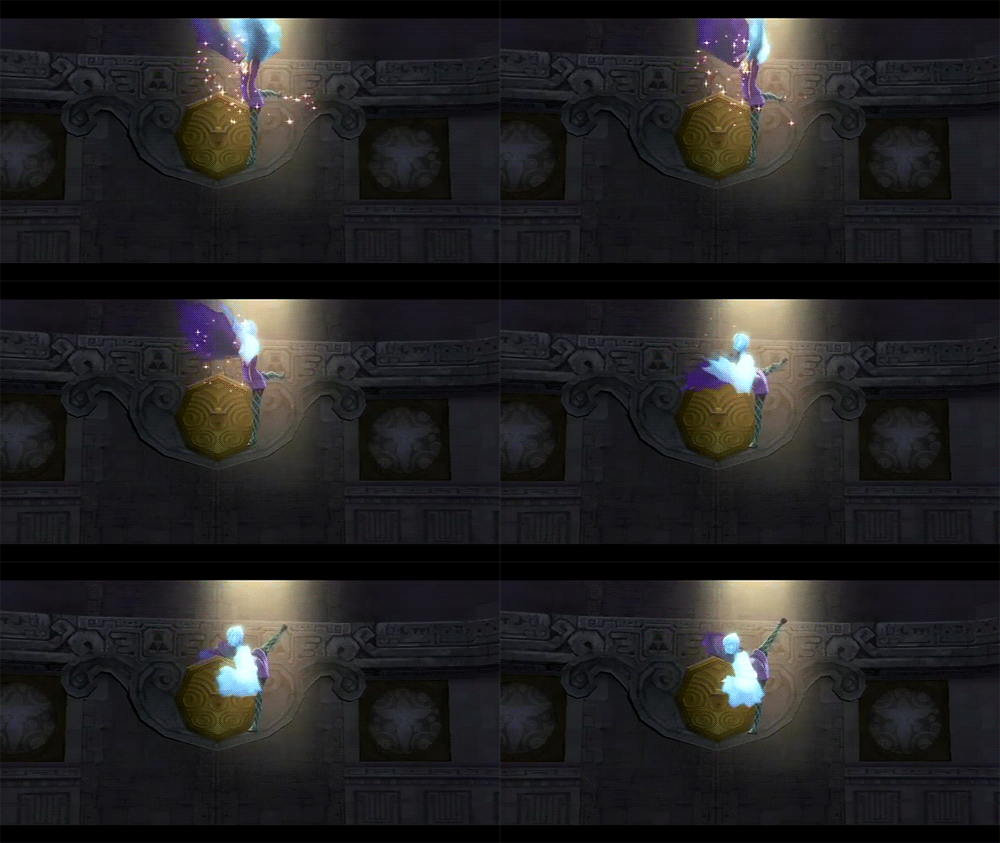
Paired with music’s prominence came a subtle presence. Music is integrated into every part of Hyrule’s culture and customs, even down to the fanfare surrounding Link’s achievements. When Link finds each Sacred Flame, the sources of power necessary to transform the Goddess Sword into the Master Sword, Fi bestows the power upon Link, but she also performs a sweet song and dance number each time. They can be seen as prayers to the Golden Goddesses, but they don’t actually do anything, at least not when compared to other songs from the series, such as the “Song of Time,” which caused literal magical events to unfold. Fi’s songs are merely meant to bridge a gap between Link and the goddesses. They are communication. Music is so important to the divine that it is essentially a language. It is everywhere.
♪She can dance if she wants to♪
From active engines of fate to elaborate signals, music has an omnipresence in Skyward Sword, and the same could be said of all other Zelda games if one looks deeply enough at them. In that sense, it mirrors the real world beautifully.
A high note of quality
Stepping away from the deeper emotional, societal, and psychological impacts of music (especially since I’m pressing my luck by talking about the topics at all), I want to examine one last detail about the music of Zelda. It’s a small detail, really. Barely worth mentioning: The music, as a whole and in general, is outstanding.
There’s a reason Nintendo has been able to partner with multiple orchestras to perform a critically acclaimed symphony around the world for the past decade. From the original theme that introduced the first Zelda fans to the fantastical land of Hyrule, to the Breath of the Wild Switch Presentation Trailer theme that dropped the jaws of everyone watching the video, the series’ songs have earned a reputation for being some of the best examples of what video games and the entertainment industry as a whole can offer the world in terms of cherished and compelling music.
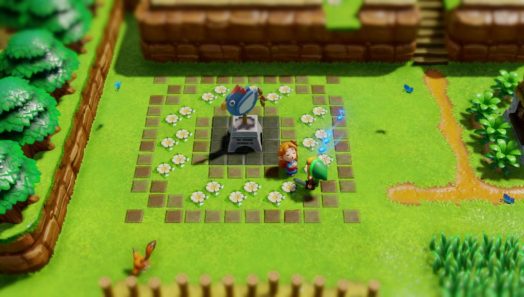
Consider “Ballad of the Wind Fish.” That song was created for a game on the Game Boy, that little outdated-at-launch piece of tech with one speaker. Many games made for that handheld could claim to have soundtracks, but only in the academic sense. Listening to audio on that device wasn’t always a joy, is what I’m saying. Yet, “Ballad of the Wind Fish” is one of the most beloved songs in the series, and many of my friends can point to that song as a source of both fond memories and profound emotional impact. The greatest quality possible was a minimum requirement for Zelda games back then, and it still is now.
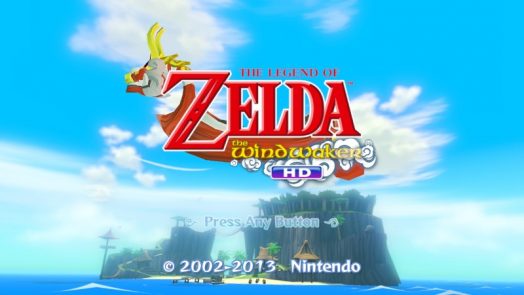
Now, let’s jump forward briefly to The Wind Waker, because we haven’t talked about the music from my baby yet. With the subtitle being The Wind Waker, and the Wind Waker being a magical conductor’s baton, the amount of effort put into the game’s soundtrack comes as no surprise. You can hear the push for quality during the game’s startup, when the title screen’s theme plays.
The game’s whole tone is set before you begin to play.
A beautiful piece that takes inspiration from Celtic sources, the title song sets the game’s tone before anyone can even begin to play it. “This is going to be an adventure that shapes you and makes you grow,” that song says. The message is clear, and, at least for me, accurate. The song told everyone this at the start, guided us along the way by having both portions of the song being used as playable songs in the game, and it led us to the end of the journey by taking a new form as the end credit theme. Going back to my idea of music being used as a language, this song was essentially an incarnation of the game’s story and had a beginning, middle, and end.
Cherished memories and beloved melodies
I can’t thank Nintendo enough for the effort they put into the music of Zelda. The songs in many ways carry the games to success much like Epona carries Link to his victories over evil. The series is immediately recognizable by the songs birthed from it. I know many people don’t share my level of obsession with the songs, but I had spent years missing out on these games and their music, at least compared to many other Zelda fans. I guess I’m making up for lost time, but at least I can say that I’m happy there was a time in my life when I made the choice to stop and listen.
Zac Pricener
Zac Pricener has been an avid Zelda fan for twenty years. The series has been a source of creative inspiration for him and fueled his desire to become a writer. That desire to write in turn led him to now serve as the Features Manager, Assistant Columns Manager, and Assistant News Manger for Zelda Universe.


 by Zac Pricener on November 10, 2020