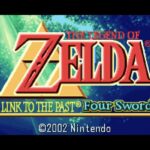
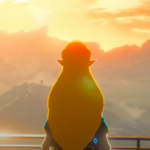
Let’s get this out of the way up front: If you’re a fan of 2D Zelda titles, you should at least take a look at Swords of Ditto. It very clearly borrows some game design inspirations from 2D titles like A Link to the Past, Link’s Awakening, and even a little bit from Breath of the Wild. But it also goes out of its way for a different look, sound, and story while also diverging from Zelda in its gameplay mechanics.
Full Disclosure
Developer Digital, the studio behind Swords of Ditto, graciously provided us with a review copy of the game for PC.
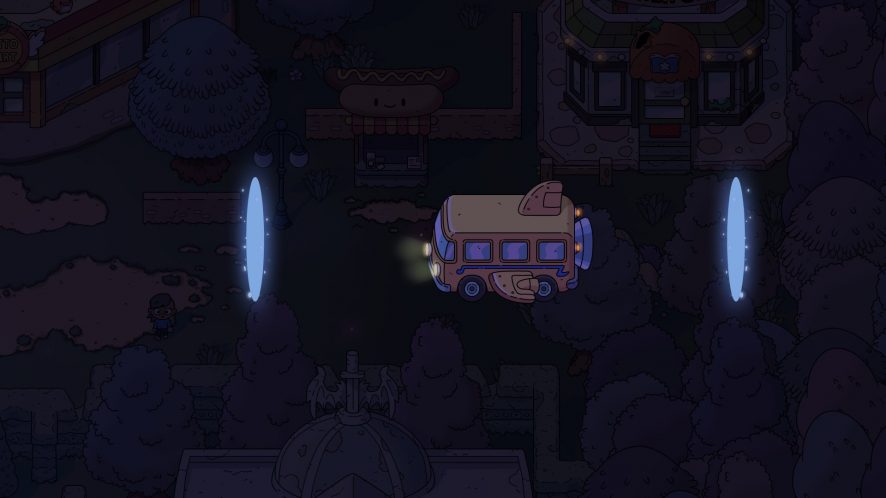
First, this game looks like it popped out of a relatively modern Cartoon Network original cartoon. Visually and audibly, it gives me flashes of Regular Show or Adventure Time, while also being its own thing. The colors stand out in every region and building, popping this almost paper-esque artwork to life. The monsters are particularly cool looking, ranging from vaguely Zelda-like monsters to floating brains that heal other enemies on the field. All and all, everything looks pretty great.
In A Link to the Past, this would be a bird that carries you. Similar mechanics, different flavor.
You start the game off as a fairly generic, randomly generated, humanoid person washed up on a shore. In little to no time you are treated to a brief tutorial by a floating bug spirit named Puka who tells you to go get a sword. Upon reaching the titular Sword of Ditto, you’re informed that you’re suddenly The Chosen Person who can help stop the evil witch Momor from casting darkness upon the land. That’s basically it for the majority of the story. With that out of the way, you are thrust into the game, albeit along a very fixed path for your first go-around.
I say “first go-around” because, ultimately, you will assuredly fall to the monsters at some point, and thus the world will be cloaked in evil. Upon your death, the game will fast forward to 100 years later, and you’ll reawaken as the next hero chosen by The Sword. This newly randomly generated character, who might even be a cat or a block-headed person, must then retrieve the Sword of Ditto from the graveyard where it was buried with his or her previous incarnation. You’ll get bumped into another short tutorial, going a bit more in-depth than the previous ones before being turned loose on the world once again.
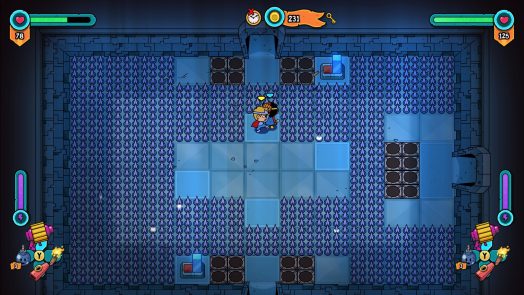
A look at one of the early puzzle dungeons. The nerf-like gun you have doesn’t do damage, but it’s used for puzzles like this.
Several maps fit together like puzzle pieces to form the world map, and these pieces are different every time you die and the next hero awakens. There is a vague resemblance to what many would call a “roguelike” system. The sword remembers the power and level you collected in the previous run. Aside from your gold, that’s about it for the persistence between lives, however, as you’ll have to re-buy stickers, which act as equipment, and re-find key items to progress. You’ll find ways to hold onto more precious items, but it is possible to lose the item anyway in subsequent lives. At the end of four in-game days, you’ll be ushered to Momor’s tower and forced to face her trials, regardless of whether you’re ready or not. (Four in-game days is roughly an hour in real time, not counting for time stopping in dungeons, caves, and towns)
Though I’m not the sufficiently skilled person to ask, it does seem relatively possible to get to Momor on your first actual try. However, the immediate ramp in difficulty might keep that from happening in practice. I honestly can’t say if it’s actually physically possible because I don’t have that skill. The intention behind the game is that you’ll need to keep building levels and skills.
Gaining levels gives you slightly better stats while also raising the difficulty of all the monsters in the world. With sword in hand, you must hack and slash your way through hordes of enemies to find environmental puzzles, secret trials, and main dungeons. To help you along the way, you can obtain extra weapons like bombs, a ranged weapon that initially only really helps to solve puzzles, and stickers. These stickers act as the game’s “Gear” system, granting you different abilities or stat boosts that can be switched out at any time. Ignoring the flavor of the term stickers, this is like a typical Mario and Luigi RPG equipment system. They can make some very interesting changes to your gameplay, including giving you new techniques with which to smash your foes, faster speeds, and hefty defenses. They can be bought in the main town’s Sticker Shop or found as random treasures (usually in the form of a “sealed booster” that you have to take back to the shop to identify.) Overall, what starts off as a fairly simplistic sword slasher starts to feel a bit more nuanced and interesting, although there are several systems that the game does not explain, eventually causing some confusion.
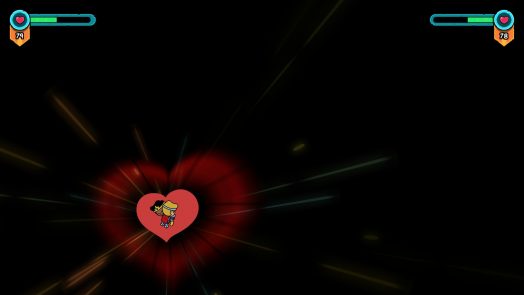
Share half your health with a good ol’ fashioned bro-hug.
Having played this cooperatively (more on that later) with a friend, my partner and I were unable to immediately identify every mechanic going on. Random bars appeared over our head of various colors, and we weren’t entirely sure what was up with them. The green bar, for instance, we had to assume was poison. As soon as one of us got it, we’d take the Poison Cure item and notice nothing happen; the bar slowly drained, but we never lost health. Turns out this is a mechanic similar to some other action games recently where the poison meter builds up the more you’re exposed to it, and once that bar fills, THEN you are poisoned. And boy howdy can you tell the difference when that happens! The poison aggressively rips through your health if you don’t immediately cure it. The best cure, though, is to run out of harm’s way when poison monsters start attacking you so that meter never gets a chance. While some people find these obtuse mechanics fascinating to learn “the old fashioned way,” many might find themselves unsure of what is happening and become flustered by it.
The sound design is pretty great. Nobody really talks, but main characters have their own little laughs and noises to characterize them a bit. Nothing stands out as particularly memorable, but every time I boot it up, I was soothed by the game’s sounds and music. Its music goes a long way to set a tone that manages to straddle an interesting line of being both cheery and colorful but also dreadful and adventurous. It’s that line that brings me back to things like Adventure Time and how it sort of beats around the bush about its darker subjects. I mean, these kids are getting iced by monsters. There’s a hint of hope for the future albeit through dark times ahead. But then again, Link was just a kid too, and we all saw him faceplant more than a few times at some evil creature’s claws.
The similarities to Zelda games can’t be ignored. In fact, I think the game sort of uses the “timeline” concepts to help flesh out the lore of their roguelike mechanics. Rather than Ganon being reborn every so often, it’s Link being reborn as a new Hero to try and save an already defeated kingdom. Similarly, if we see Hyrule change shape many times over every iteration of the game, with few things remaining completely consistent. That is true of his kingdom as well! The hub town gets renamed every time, areas change and elements shift. It’s a randomizer to keep people who think they “figured it out” on their toes, and it’s an effective one at that. The designs of dungeons and hidden “trials,” mini-dungeons found in caves underground, feel very reminiscent of A Link to the Past.
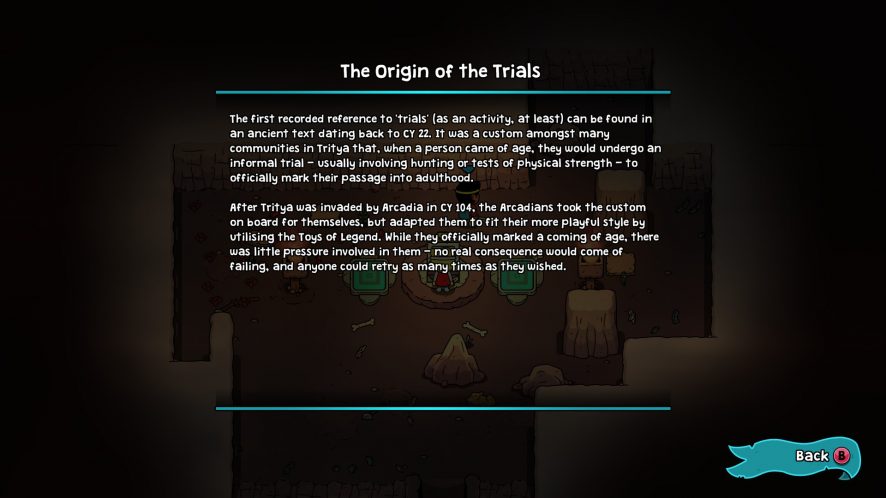
The large bulk of the game’s story can be found in ancient tablets you find throughout the game.
The Swords of Ditto is more than just a clone, but it does clearly wear its homages to Zelda on its sleeve. The ways in which it differentiates itself make it more unique than surface glances provide. Combat is fairly basic, allowing for neat customization along the way, but the game never feels too easy or unfair. It’s destined to delight on the audio-visual front, and the entire game can be played with a drop-in, drop-out cooperative partner. Sadly, a lack of network support keeps this local to your couch.
Currently, the game is available now on Steam and PS4. And yes, here’s our obligatory hope that it comes to Switch because, holy crap, why shouldn’t it?
Score
Similarity to Zelda games
8.0/10
A Link to the Past – ▲▲▲▲△ The Legend of Zelda – ▲▲▲△△ Breath of the Wild – ▲△△△△


 by Randy Marr on May 19, 2018