The finish line might be in sight for the Nintendo Switch, but Mario and pals are partying until the end with Super Mario Party Jamboree. It’s the third entry in the Mario Party series to release on the hybrid console, following up on 2018’s Super Mario Party, and 2021’s Mario Party Superstars. Jam-packed with content familiar and brand new, this is yet another entertaining (and sometimes infuriating) bash in the Mushroom Kingdom that aims to provide a raucous good time whether you’ve been playing since the N64 games, or joining the party for the very first time.
Following in Super Mario Party’s Footsteps
While Super Mario Party Jamboree takes cues from both of the previous Switch Mario Party titles, it is decidedly a successor to the one it shares a name with more than any other. If you enjoyed the first Super Mario Party for its motion control minigames and its variety of single player and co-op game modes, you’ll get all that you could ask for in Jamboree.
You’ll also get the chance to make your way across the party boards with another character at your side from time to time. Jamboree Buddies are a new take on Super Mario Party’s Allies, coming in with some refinements in an attempt to make them more balanced. Most notably, their availability is toned down. Jamboree Buddies appear one at a time, and only stick around for a few turns. They can also be swiped by other players should they pass you by on the board.
Of course, the upside that Jamboree Buddies offer is enormous; so enormous, that under the right circumstances they can single-handedly swing the game in your favor like a miraculous Chance Time. When you have one in tow, you can double up on just about any board-related actions: being able to buy two Stars at once, purchasing two items from a shop in a single trip, using Boo twice to steal coins or Stars from other players, among others. This also applies to negative effects, like having to endure Bowser’s roulette of penalties twice should you land on a Bowser Space, but the rewards are potentially so great that they unquestionably outweigh the risks. Jamboree’s coin economy isn’t exactly the most grounded, so it can be very easy to amass a lot of coins (even without winning minigames) and abuse the Buddies’ benefits.
Thankfully, you at least have to earn Jamboree Buddies’ assistance through more than just landing on a corresponding space. This is done through a new type of contest called Showdown minigames — elaborate challenges associated with the character being fought over, and one of best ideas that Jamboree introduces to the series. Some of the Showdowns are gauntlets that have players battling it out across as many as ten bite-sized challenges; others might be long races over a course laden with obstacles, a marathon bongo session with Donkey Kong, or a marathon pinball session with Waluigi. When most Mario Party minigames have a time limit between thirty to sixty seconds, something like a Showdown minigame that has you playing for several minutes on end is quite the change of pace.
Showdown is just one of several different minigame types found in Jamboree. This latest entry plays host to a grand total of 112 minigames, but a significant number aren’t available in the traditional Party mode. Even fewer are available should you choose to turn off those that use motion control, which are played via a single Joy-Con, similar to the first Super Mario Party. The dilemma with motion control minigames is that the enjoyable ones go a long way toward bolstering what feels like a somewhat slim lineup of 4-player, 2v2, and 1v3 minigames, but those minigames where the motion controls are less than responsive are extremely frustrating.
You need to constantly be on the move in Bowser’s Kaboom Squad.
The game modes designed entirely around motion control will be similarly hit or miss for most players. Toad’s Item Factory is a puzzle-solving challenge that tasks you with guiding orbs to an end goal by manipulating parts of the level with the Joy-Cons’ gyro-sensor. Much like Super Mario Party’s Sound Stage, Jamboree’s Rhythm Kitchen has players taking part in a series of rhythm-based minigames. It doesn’t take long to see everything that Toad’s Item Factory and the Rhythm Kitchen have to offer, but they’re more forgiving with the accuracy of the motion controls, and they’re certainly fun while they last. The Paratroopa Flight School is a very different, very exhausting story, and one we recommend that you skip.
A pretty creative addition to the co-op front is Bowser’s Kaboom Squad. Up to 8 players will work together to take down a towering Imposter Bowser inside a city-themed environment, collecting bombs to return fire while also avoiding Imposter Bowser’s rampage. Interspersed are minigames where all 8 players must work in concert to succeed, upon which they will earn items that can be used in the combat rounds.
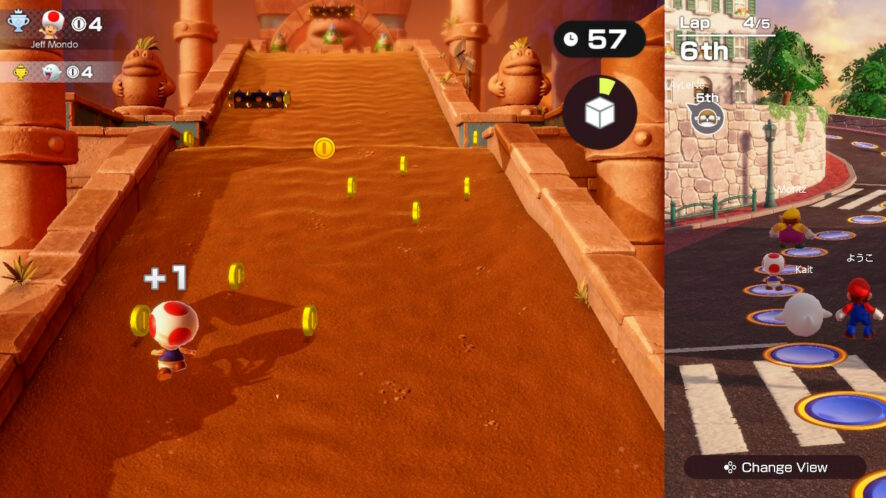
The undisputed home run of Jamboree’s alternative game modes is Koopathon, which will quickly have competitive Mario Party players addicted. A significantly expanded take on Mario Party: Star Rush’s Coinathon, Koopathon has 20 players racing against one another on a board, their progress being determined by the number of coins collected in minigames per round. Only your character will appear within each minigame, making each minigame a test in how quickly you can grab coins while evading hazards. After every three rounds, a special game called Survivathon will bring all 20 players onto the screen and challenge them to outlast Bowser’s deathtraps. Get knocked out, and you’ll get knocked back anywhere from 10 to 40 spaces on the board.
Challenging, hectic, and often nerve-wracking, Koopathon is a standout game mode.
It’s anything but easy crossing the finish line first. A single mistake (especially in one of the Survivathon games) can cost your position in the race for good. You’ll have to pull off a mistake-free run to get on the podium, making Koopathon a serious test in minigame efficiency and performing under pressure.
Not all fun and games
Spreading out 112 minigames across such a wide variety of game modes was inevitably going to come at the expense of the traditional Mario Party experience. This means that for longtime Mario Party enthusiasts, Jamboree’s catalog of competitive minigames isn’t going to compare to something like the one featured in Superstars, a game that specifically catered to the fans who have been playing since the series’ earliest days.
What this doesn’t mean is that the traditional Mario Party experience is completely forgotten in Jamboree. There is still plenty of fun to be had with that tried and true Party format where players navigate tricky maps and battle it out for the most Stars. In fact, one area where Jamboree manages to top Superstars — and arguably tops most Mario Party titles — is in its outstanding selection of boards. Jamboree features five brand new boards, along with updated versions of Mario’s Rainbow Castle from the very first Mario Party, and Western Land from Mario Party 2. After Superstars’ meager five boards, and Super Mario Party’s measly four, having seven is an appreciable increase.
It’s not just the numbers game that Jamboree has in its favor. Pound for pound, space for space, this among the best selection of boards that you’ll find in a single Mario Party title. Outside of the odd rough spot here or there, they’re all well designed, they’re aesthetically pleasing, and they’re filled with points of interest that can be manipulated to help you get the edge in the contest to be the Superstar, or momentarily bring your progress to a grinding halt.
Rainbow Galleria is the front-runner for the very best of the lot. The bright, bustling shopping mall has a dizzying number of possible paths that players can travel, and each one will take them past all kinds of unique shops and stalls where they can stock up on items or coins. King Bowser’s Keep also deserves a shout-out; the Bowser-centric, lava-filled game board has been done plenty of times before, but Jamboree’s incarnation of it is a particularly elaborate bit of level design, with some major risk/reward factors that players will need to tackle with the utmost caution.
Then of course, there’s a good reason why Western Land got the remaster treatment, and has remained such a beloved fan favorite board for all these years.
Western Land looks better than ever in Super Mario Party Jamboree.
Jamboree also introduces Pro Rules, a more competitively-focused way of playing the classic Party format. Pro Rules aim to reduce some of the wonkier, random elements of Mario Party by removing such features like Hidden Blocks, Chance Time Spaces, and the special events during the Homestretch (final five turns). There’s only one Bonus Star awarded, and it’s actually announced before the first turn gets under way, giving players an idea of what strategy to employ. At the same time, Pro Rules raises the stakes considerably in some cases. Bowser Spaces automatically make you lose a Star with zero exceptions, and you can even wager a Star instead of coins should you engage in a Duel minigame with an opponent.
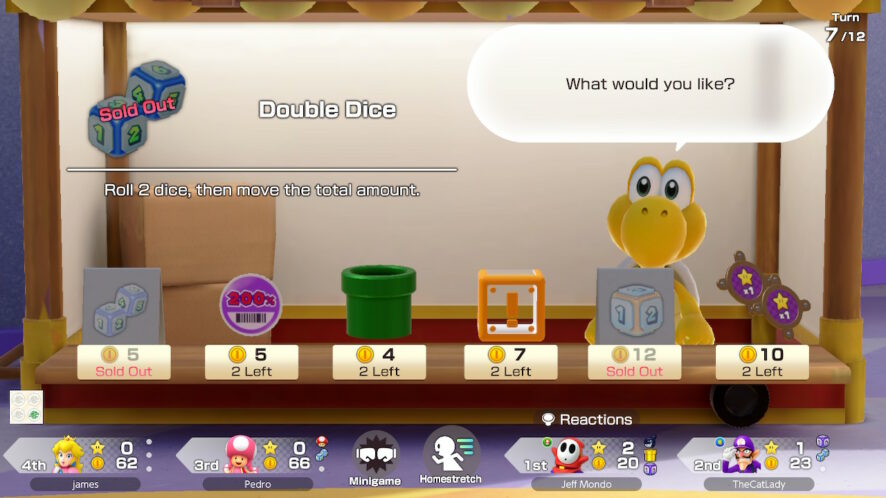
Where Pro Rules cements itself as a more tactical approach to Mario Party is how it handles items. You’ll be able to choose one of eight items to start the game with: Mushroom, Creepy Dice Block, Warp Block, Pipe, Skeleton Key, Chomp Call, Cellular Shopper, or 10-Coin Steal Trap. From there, you can purchase items at shops, but there’s a catch — shops have a hard limit of only two copies per item. Once they sell out, they are gone for good. Movement-related items like Mushrooms and Double or Triple Block Dice are sure to go fast, and you better grab a Golden Pipe while you can should they become available. How you manage your item inventory is more important than ever in Pro Rules, and it will make or break your game every single time.
The only questionable decisions regarding Pro Rules is that Jamboree Buddies can’t be turned off, and you can’t toggle the number of turns that you play for. Pro Rules is locked in at 12 turns, which is ostensibly to keep the parties as structured as possible. An especially long party runs the risk of several turns where items would be totally unavailable at shops after being bought out, as well as the risk of multiple Jamboree Buddies potentially impacting the contest. But then Jamboree Buddies should have just been left out in the first place. Players who would be interested in trying out a prolonged game under Pro Rules should have been afforded that option, even if it was only for playing locally or with Friends online.
For when you want to prove your mettle at Jamboree’s minigames without the pomp and circumstance of party boards, head on over to Minigame Bay. The setup is almost identical to Mt. Minigames from Superstars, with a bevy of different modes to test your minigame skills either locally or online against the rest of the world. Whether you only have a few spare minutes, or all the time in the world, Minigame Bay can accommodate you. Free Play and Daily Challenges are ideal for knocking out a couple minigames in short order to get a quick bit of action. If you would rather lock in and grind away for a personal best score, Survival and Showdown Minigame Battle will be calling your name.
That’s an appropriate sentiment for all that Jamboree offers. No matter your experience with the series, no matter your own personal vision of what the ideal Mario Party should be, Super Mario PartyJamboree is sure to have something to your liking one way or another — maybe even a lot.
Score: 8.0/10
Jeffrey Pawlak
Jeffrey Pawlak is the Features Director for Zelda Universe, and has been a member of the website's community for more than 20 years. He is also a high fantasy author and an aspiring comic book artist.


 by Jeffrey Pawlak on October 24, 2024