The Nintendo Switch has been a powerhouse in terms of providing a robust option of games to play from its ever-expanding library. Puzzle games, platformers, adventure titles, and sport simulators are all available in abundance.
But, what about the genres that aren’t always overflowing with titles? Well, thanks to the Switch’s success, the chances for the more niche titles to please fans are readily available. One of these styles of games is the action shooter, particularly the ones that put you in control of giant robotic crafts. If you are a gamer with a craving for some high-caliber robot action, Daemon X Machina is here, and it’s worth knowing whether it can satisfy those cravings or not.
FULL DISCLOSURE
Nintendo of America graciously gave Zelda Universe a review code for Daemon X Machina.
Mission Briefing
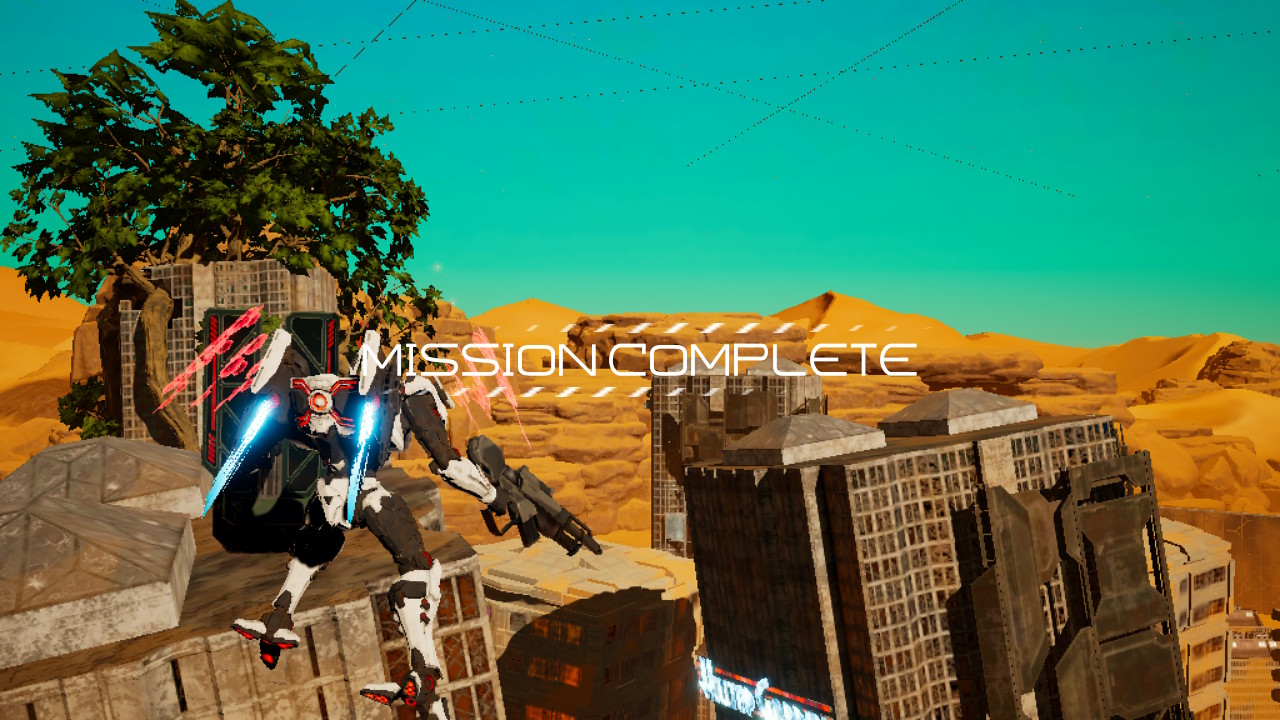
Daemon X Machina is an third-person action shooter that puts the player in control of a large mechanized battle suits called Arsenals. These Arsenals are controlled by their pilots the Outers, highly trained mercenaries belonging to various teams. These mercenaries, in turn, are contracted by certain controlling corporations to help combat and ultimately destroy the Immortals, rouge machines with independent AIs.
The game begins with calamity striking the planet.
The need for giant robots to battle even larger robots can find its origin in the game’s opening cinematic. It doesn’t show us anything too special, aside from the moon colliding with the planet. This means Daemon X Machina also fits comfortably in the “post-apocalyptic” genre. The planet has been ravaged by the event, which was named the Moonfall, and now sectors of the planet are divided up and controlled by corporations that seek to salvage the regions and claim whatever resources they can. One of these resources is Femto, strange particles and a source of energy that was created by the Moonfall and spread across much of the world.
The moon falling was bad enough, but it was also discovered that the Femto particles had a bizarre effect on a large number of AIs, causing them to become rebellious against the humans. These AIs are the ones that became known as the Immortals. They now see people as threats and seek to do everything in their power to destroy humanity and assume control of the planet, and the only ones in their way are the Outers and their Arsenals.
Built for combat
The main draw of Daemon X Machina is definitely the combat, but one of the things that makes the action enjoyable is the option to imprint your own tastes into the game via customization.
The weight of the world is on your shoulders, so being able to truly make the experience personal is a welcomed feature. Before the game truly begins, you must first create your character.
Modifying your character, one of the Outers, is a surprisingly detailed process. The options available for changes to the Outer’s physical appearance are vast, and a lot of time can be spent making every detail exactly how you want it. The choices for eye color, skin tone, hair style, outfit type, and even minute details like eyebrow positions are yours to decide.
Creating an Outer is more fun than one might expect, so it would make sense to assume creating an Arsenal will be even more of a treat. But if creating the Outer is milk chocolate morsels, then building the Arsenal is semisweet chunks.
Once you complete the tutorial level, which is a type of training mission used to assess your Outer’s skill, the option to customize the Arsenal becomes available. The choice to change the Arsenal’s main components — such as its head, arms, and legs — is there, and you can also alter internal components like the system memory. These changes can have strong effect on the Arsenal’s performance in battle, but what is most important are all the options for weapons.
A weapon can be assigned to each arm, one auxiliary weapon can be mounted on the Arsenal’s shoulder, and two additional weapons could be stored on pylons and swapped out during missions. And the styles of weapons are not limited: The Arsenal can be outfitted with guns, grenade launchers, sniper rifles, swords, and more.
Worth noting as well is the option to give the Arsenal a unique paint scheme. This featured worked much the same way as the character creation tools, allowing you to give the Arsenal your preferred color scheme. It is an entirely cosmetic change, but being able to personalize your giant robot is a nice touch.
Customizing an Arsenal’s appearance is a nice feature, but it takes a while before you are given the option make significant changes.
The options, while plentiful, come with a handful of issues. First is that weapons and armor upgrades are not available from the start of the game. Daemon X Machina has certain role-playing elements to it, which means new weapons and upgrades must be earned, found, and bought. I know it’s standard fare for many games to only allow the player enhance their characters gradually, but to me it seemed out of place for a game that focuses on fast-paced, mission-based combat.
The second problem is that while weapons found later on do help make up for the initial limitations, most weapon of similar typing do the same things, so changing them is done solely for technical enhancements like increased damage output and ammo capacity. The majority of upgrades help with efficiency, but they leave a lot to be desired in terms of entertainment. So outside of the paint job, an modified Arsenal doesn’t feel unique.
Welcome to your battlefield
The combat is the core of Daemon X Machina’s draw, and it’s definitely a treat. It also comes in two methods: while piloting your Arsenal or on foot. I’ll start with the Arsenals since, again, that is the reason this game exists.
Arsenals are fun to control and are surprisingly mobile. The controls aren’t perfect, but the Arsenal will typically do what you want it to do. Usually, if something you don’t want to have happen does happen, it will be because you messed up. Whether running or gliding across the ground or soaring through the skies, the Arsenals perform wonderfully and with fluid movement.
My only true complaint is found when flying my Arsenal. One button is use to make the machine ascend while another button makes it descend, but I often found myself flying or falling past my desired altitude. Once I pressed one of the buttons, the Arsenal continued on in that direction until a different direction was chosen. I would have preferred if the Arsenal hovered in the air by default and only moved up or down when I was pressing the corresponding button. It’s a small issue that I was able to eventually compensate for, but it was a pain during the first handful of missions.
Control of each weapon is simple, but juggling the options can be a little odd at first. This is especially true when loading out one weapon for a different one during a mission. Much like controlling the Arsenal’s altitude, it’s simply a matter of learning the controls. But once you do, being able to quickly swap out one weapon for another like you’re a mechanized commando is actually thrilling.
Battles take place at both close and far ranges, but guns are usually the weapons of choice regardless of your position. So things like automatic reloading, automatic target lock on, and an abundance of claimable ammo refills are welcomed features. Lock-on range and ammo capacity can also be increased by acquiring new gear, but that doesn’t mean the weapons you start with feel useless.
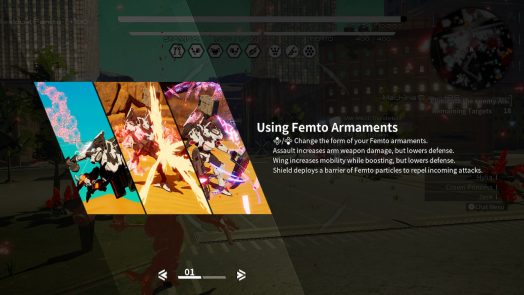
One of the coolest features the Arsenals have at their disposal is the ability to use the Femto particles to power themselves up with armaments. Femto depletes when the armaments are used, but it is automatically absorbed by the Arsenals when in areas containing the energy source. Femto can also be taken from defeated enemies or collected in mineral hot spots. Once you have enough Femto, you can use it to enhance your Arsenal while on the battlefield.
Femto resources need to be managed, but tactical use of the armaments can make a noticeable difference in battle.
These armaments are temporary boosts that come with a trade-off between specific capabilities. One option will allow you to increase your mobility, but it will lower your defense. The same applies to the option to increase the damage output of your weapons. They don’t affect anything drastically, but they are nice options to have when dealing with tough flight-or-fight situations.
The status modifications are decent, but the best use of Femto is the creation of Mirages. Mirages are duplicates of your Arsenal created with the Femto particles and the energy they produce. These Mirages act independently of you, and their support can turn the tide of most battles.
Fighting outside of your Arsenal is an option. It’s one I avoided at all cost, but it’s an option. Most often, Outers only end up fighting on foot after a bail-out situation. They’ll even be forced out of an Arsenal if it ever becomes too damaged in battle and cannot function. At that point you’ll need to fight to survive. Outers do at least have defense options, such as a cannon that hovers nearby and can lock onto enemies. So it’s not like you’ll end up being completely helpless fighting outside of your Arsenal, but it’s still not a great option.
The only real way for your Outer to stand a chance by themselves is alter their body with cybernetic implants. The thing is, these implants come at a cost of making your carefully crafted Outer look like a mechanical monster, which is why I didn’t use them in my play through. Maybe some people don’t care about that, but, if you are like me and don’t want to alter your Outer, my advice is to run from battles whenever necessary to avoid being ejected.
Mission ready?
The combat in Daemon X Machina is solid, but it is weighed down by a number of things. Well, it’s unfortunately weighed down by the rest of the game. The most glaring was the nature of the missions, which I often found held back the fun of piloting the Arsenals. This was typically due to the design and layout of the level as well as the mission objectives.
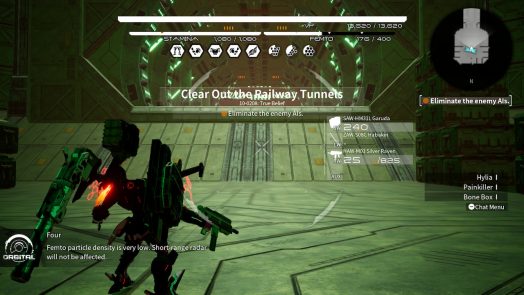
Fighting in confined areas like this railway tunnel were typically frustrating and disorienting.
Levels vary by way of geographical layout, size, and visual design, but sometimes a combination of these will work against the assigned mission. Battling other Arsenals in a dogfight that takes place in a desert outpost is fun, but a similar dogfight within a confining underground system of tunnels is disorienting, cramped, and hectic. The gameplay is great when everything else is designed to work around it, but some levels unfortunately fail in that regard. Losing track of enemies, getting turned around in larger or winding terrain, and repeated shifts between mission priorities are all issue that contribute to the loss of focus on the action. But when your Arsenal is allowed to do what it does best — fly around at high speeds and blast machines out of the sky — it is exhilarating.
These and other conflicts of interest are why I stopped concerning myself with upgrading my Arsenal. I continued to gravitate toward whatever weapons were bigger and better, but adding my personal flare or using my weapons of choice, such as the melee weapons, seemed like a waste of time when I considered that my only goal was to blow stuff up as quickly as possible. It became clear that being attached to my Arsenal was an investment of time that only served my need for pointless customization, and my need for such features has never been that strong.
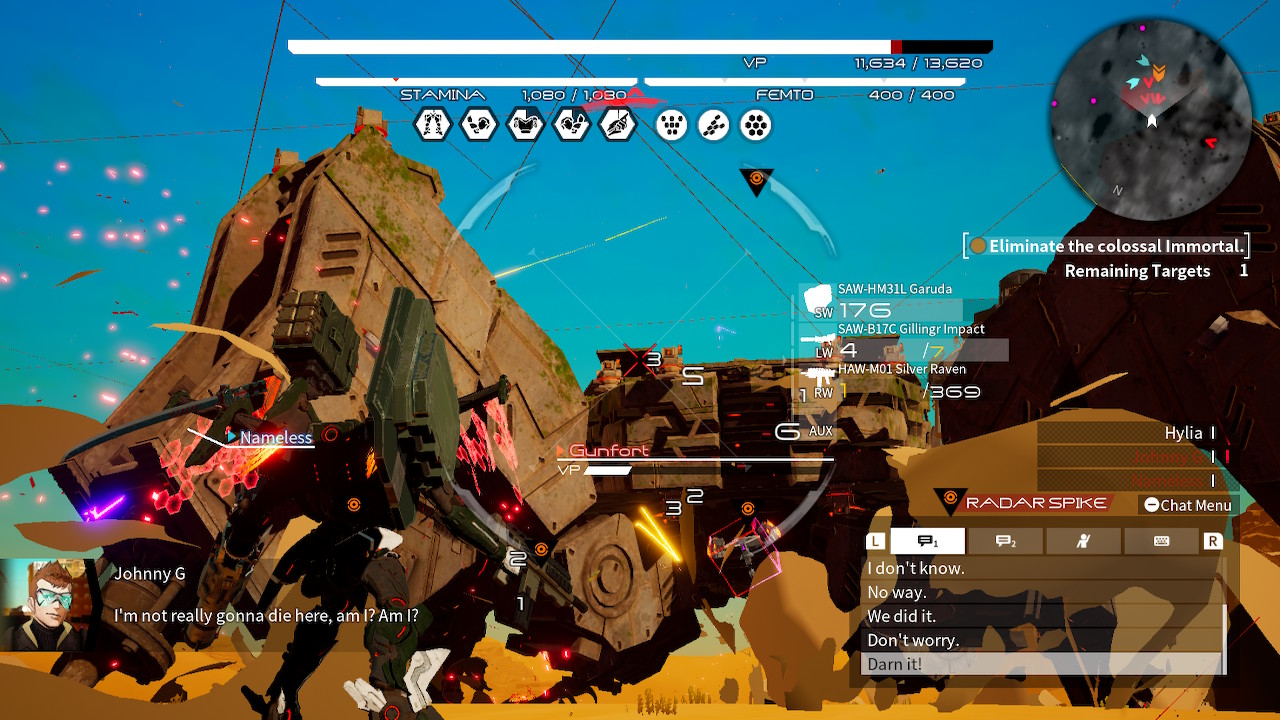
Battles with colossal Immortals such as the Gunfort were easily some of the most entertaining missions.
The missions aren’t always fun, but that’s not to say there aren’t some great ones, though. The dogfights with other Arsenals and the boss battles with the Immortals were definitely highlights. Some of these battles seemed to go on longer than what was necessary, but being able to focus and unleash your Arsenal’s fury onto one opponent is an enjoyable break from doing crowd control with smaller enemies.
A narrative short on ammo
I mentioned earlier that this game has some role-playing elements, and that point is further proved by the game’s characters and story. This is one of the those times when I wish I couldn’t prove my point.
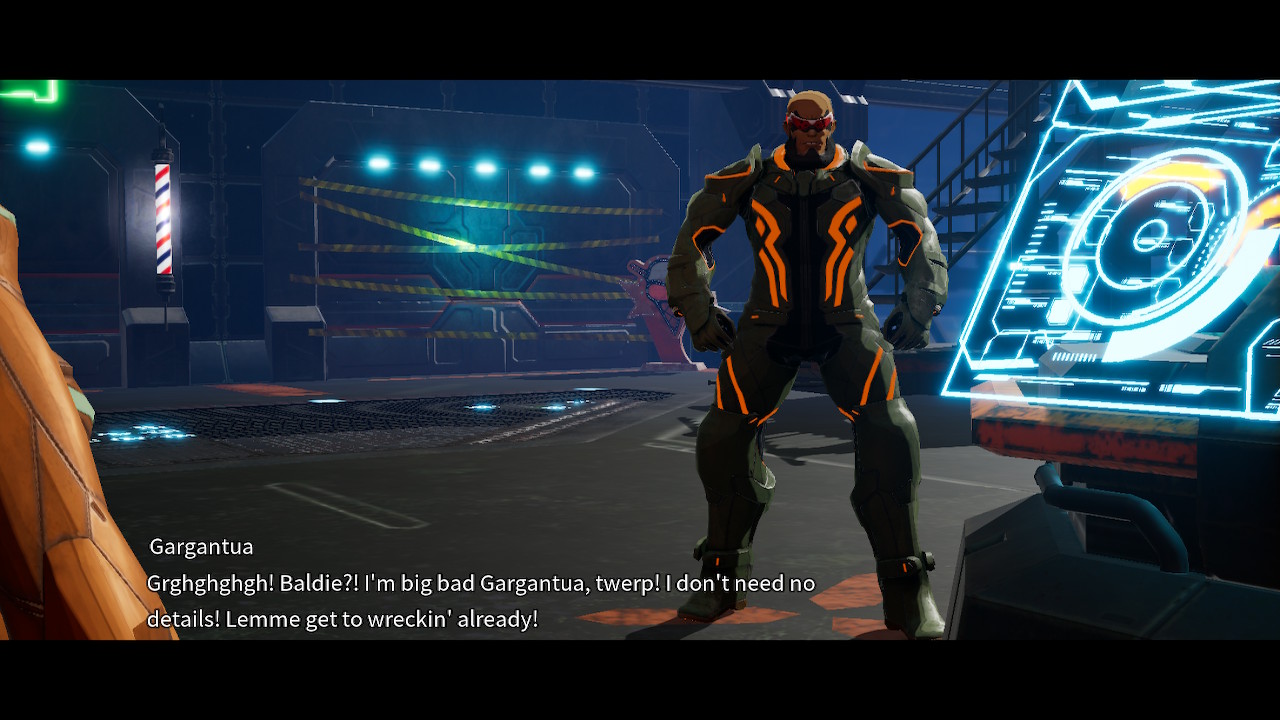
It wouldn’t be hard to believe that a working title for this game could have been Every Anime Trope Ever: The Video Game. Too many of the characters in this game made me cringe. And I mean that. I was literally cringing at the sight and sound of them. From the overly dramatic, super-serious hero type to the excitable meathead who only wanted to demolish anything and everything he could get his hands on, the scenes before and after missions were tests of my resolve to not hit the “skip” button. I couldn’t skip them even if I wanted to, actually. There was enough pertinent plot details presented during these scenes that I couldn’t chance missing anything.
As for the game’s story, it’s a true attempt to add more to the game and does help create a sense of progression at times, but it’s hardly enough to captivate an audience. The moon fell, what was left of the world was split among ruling parties, and mercenary groups were created to help defend against the rise of evil machines. All of this was the most interesting part of the narrative, which is why I already mentioned it at the beginning of the review, and it also all happened before the events of the game. The story is another case of the game needing to either dial back the role-playing vibe or make it significantly more crucial to the game’s overall experience.
Team up to take ’em down
It only makes sense that a game like this would come with multiplayer modes. The choices are online or local co-op modes, with both centering on you and other players teaming up to beat missions from the main story.
Most of the single-player campaign centers on clearing objectives with other mercenaries, so allowing friends or strangers to team up, coordinate strikes, and swiftly obliterate enemy AIs is fitting. Taking on the AIs and other mercenaries is fun own your own, but when you have the help of other people rather than computer-run allies, the show of force you can unleash on these obstacles is a welcomed experience.
The only issue is sometimes the dominance can be excessive. Depending on your team’s level of skill and strength, missions might become trivial. There can be a fine line between your group being an efficient unit or a dispassionate firing squad. This is why, though the multiplayer is fun, it may become stale or unappealing if your team finds themselves effortlessly coasting through the missions.
Could benefit from a deus ex machina
Daemon X Machina is a fun game at times, but it doesn’t do itself any favors by trying to be too many things at once. The controls and mechanics are superb, the action is engaging, and the more intense missions can get your adrenaline going. And if that was what the the game focused on, if it played like an arcade shooter and went from mission to mission with almost reckless abandon, it probably would have been amazing. But too much of the additional content feels forced and regularly drags the fun factor down, which makes staying engaged and wanting to progress difficult.
Score
7/10
Zac Pricener
Zac Pricener has been an avid Zelda fan for twenty years. The series has been a source of creative inspiration for him and fueled his desire to become a writer. That desire to write in turn led him to now serve as the Features Manager, Assistant Columns Manager, and Assistant News Manger for Zelda Universe.


 by Zac Pricener on October 23, 2019

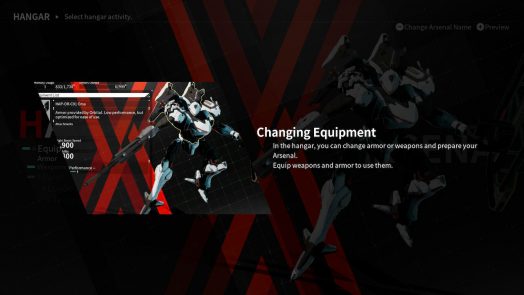 Once you complete the tutorial level, which is a type of training mission used to assess your Outer’s skill, the option to customize the Arsenal becomes available. The choice to change the Arsenal’s main components — such as its head, arms, and legs — is there, and you can also alter internal components like the system memory. These changes can have strong effect on the Arsenal’s performance in battle, but what is most important are all the options for weapons.