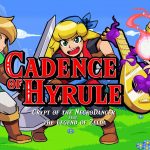
Review: Cadence of Hyrule is a rockin’ good Zelda spin-off
 by Zac Pricener on June 23, 2019
When I first heard about Cadence of Hyrule: Crypt of the NecroDancer featuring The Legend of Zelda, I honestly didn’t think it was a real game. I read other people’s discussions about it, but since I wasn’t familiar with Crypt of the NecroDancer – Brace Yourself Games and Spike Chunsoft’s first game and Cadence of Hyrule’s predecessor – I assumed everyone was talking about a fan mod or something of that nature. Eventually, I discovered what it actually was, grew excited about it, played it, and now I have a favorite Legend of Zelda indie game. It still amazes me that I am able to write that.
Cadence of Hyrule is a rhythm-based action-adventure game where the player must explore Hyrule and defeat hordes of enemies, all to the beat of the music.
Nintendo graciously provided us with a review copy of Cadence of Hyrule for the Switch.
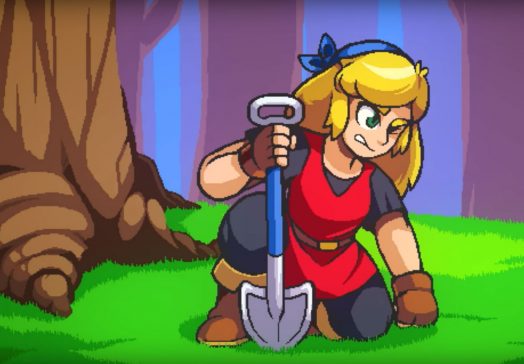
There are many versions of Link that know exactly how Cadence feels right now.
Cadence, the hero of Crypt of the NecroDancer, is transported to Hyrule by a new menace, Octavo. Now trapped in a new world, Cadence must help rescue Link and Zelda, and all three heroes must do whatever they can to stop Octavo and save Hyrule.
As I mentioned, and unsurprisingly, everything is rhythm-based in this game. Movement and attacks are all successfully (or unsuccessfully) performed in time with the music and synchronized with the movement of enemies, both of which are amazing and often intense. To get by, I had to quickly learn how to memorize enemy patterns and perform my own attacks, counterattacks, and spells to defeat them.
I say “quickly learn” because while I often enjoy playing rhythm games, I cannot say I am very good at them. I can certainly say I’m bad at them – almost to the point of it being unintentionally impressive. But I always figured things out in those previous games, and Cadence of Hyrule was no exception.
The gameplay is a blast, but there’s a learning curve
The mechanics of the game did not pander, but neither were they truly intuitive. A learning period and much experimentation needed to happen, and for me, that involved a number of game overs. But learn I did, slowly but surely, and soon I was able to freely explore Hyrule the same as in any Zelda game. The close ties to Zelda are a number of things that made improving my skills an easier feat. Cadence of Hyrule took the native challenges of its genre and mixed them with much of what I love about Zelda games. The combat teetered on being repetitive, but the music, enemy variety, references, and challenges made me want to see more of what the game had to offer, and the only way to do that was to improve. The game’s difficulty was noticeable, but not enough to prevent me from enjoying the entire experience. In addition to the default rhythm-based gameplay, there are a couple of modes that can make the game either easier (by removing the need to move to the beat) or harder (permadeath).
Aside from the beat-based battling, the most intriguing gameplay feature was probably the addition of co-op multiplayer. In this mode two of the three heroes appear on the screen at once, each being controlled by one player. It’s a common mode in many other games, but seeing it done in a Zelda game, and not being a chaotic mess (I’m looking at you, Tri Force Heroes), was amazing. Each character could move about freely, and while they could block each other’s path or blow each other up with bombs, there was never a time when I felt hassled by having another character on the screen. All it meant was enemies were dealt with twice as fast. Also, game overs did not occur whenever just one character died, which was something I was afraid would be the case. I was even able to revive an ally at any Sheikah Slate whenever they fell, which made things even easier. This mode very easily could have been awful, but it expertly danced around many pitfalls.
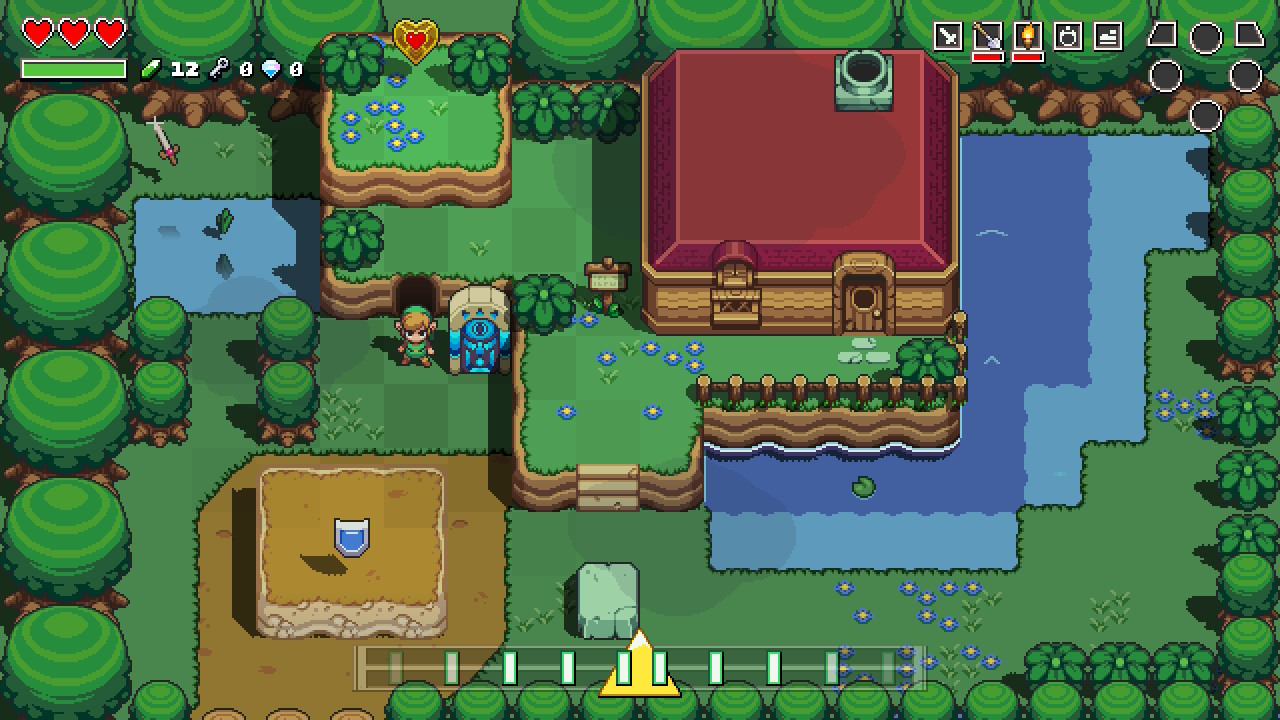
The gameplay was a blast and was made even more fun by who I played as. After a brief introduction period, I was given the option to continue as either Link or Zelda. I chose to play as Link and unlocked Zelda at a later time. Cadence of Hyrule’s Link and Zelda were fun and incredibly charming renditions of the characters and felt like they belonged to the Zelda series. There were no drastic changes to their designs, which I was happy about. Cadence, the crypt crawler extraordinaire, was equally as fun, though Link and Zelda were admittedly who I put most of my focus on.
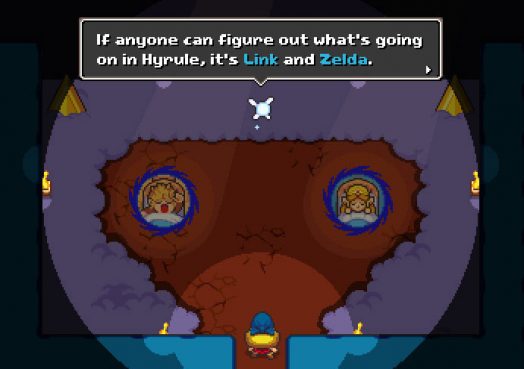
For once Link wasn’t the only one asleep at the start of a game.
Each character had their strength and weaknesses, and certain puzzles and enemy encounters were best handled by switching between them. Link had a focus on close-range combat. He could perform his signature Spin Attack and could also block attacks with his shield. Zelda, inversely, was better at a distance, thanks to the combined use of a rapier, the Din’s Fire projectile, and Nayru’s Love reflector. Cadence, who rejoins Link and Zelda later on, felt similar to Link but uses a shovel as her primary weapon. All three characters were fun, even if it felt at times like they could have had even more distinguishing features. Aside from using a character’s gimmick to solve certain puzzles, I played through the majority of the game without a need to switch from Link.
A game inspired by multiple Zelda adventures
The main characters and the (somewhat cliché) “villain attacks Hyrule” story were all familiar to me, and my appreciation for them only ever grew, but it was the added references, details, and other iconic series staples that made Cadence of Hyrule feel like a complete Zelda adventure.
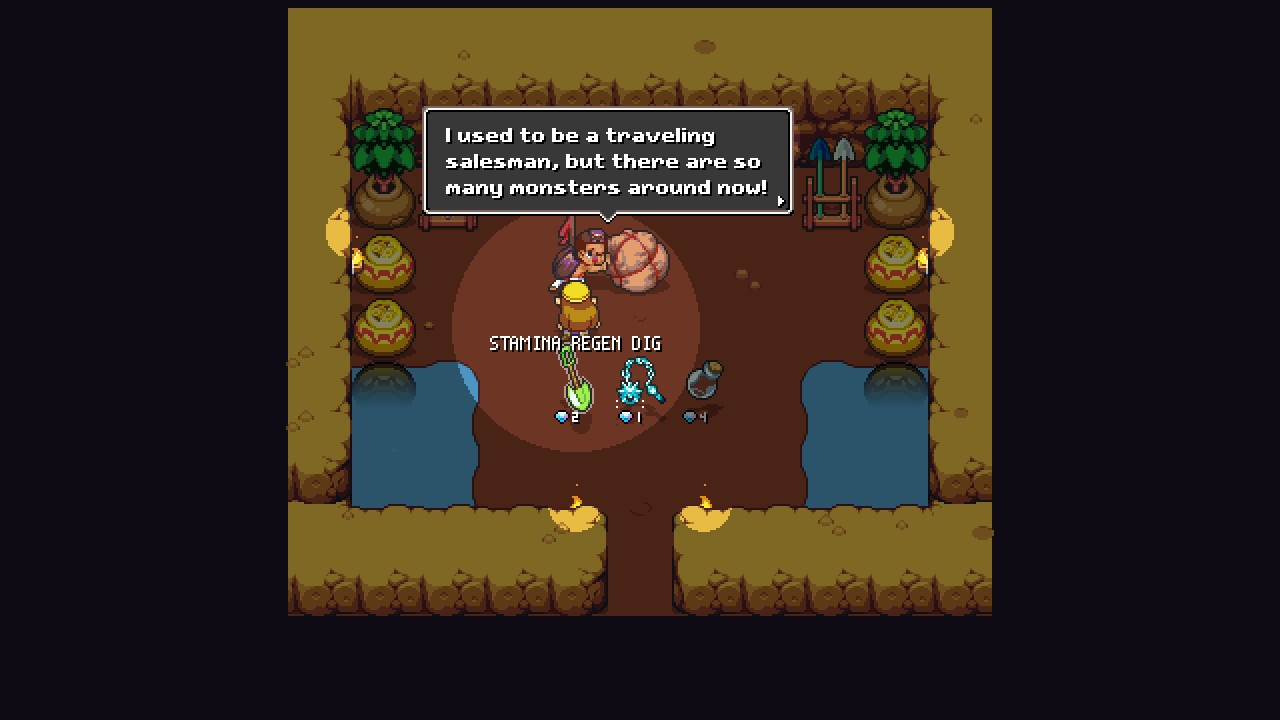
A love for the Zelda series is on display in Cadence of Hyrule.
Much of the game is comprised of elements from multiple Zelda games combined with things from Crypt of the NecroDancer. The perspective and graphics were obviously similar to games like A Link to the Past, but key features such as the Sheikah Stones, stone slabs used for fast travel and to change characters, were clear references to Breath of the Wild. Even some of the non-playable characters were enjoyable renditions of fan favorites, such as the bug-obsessed salesmen, Beedle. There was an apparent and appreciated love for the Zelda series on display in Cadence of Hyrule.
I received many options for combat weapons – such as spears, daggers, and flails – and all of them were fun and useful. Each of these also had stronger (though often temporary) upgrades that offered special bonus effects like increased power or the ability to poison enemies. Mainstays of the Zelda series were present as well. Bombs and unique items such as the Hero’s Bow provided necessary options for clearing obstacles. I could clearly see the effort taken to represent these weapons, both in terms of how they functioned and which items were available. The bombs and the bow were obvious choices, but less common weapons like the Ice and Fire Rods, and even the Deku Leaf, were present as well. The developers took every opportunity to work in as many homages to Zelda as possible, and the collectibles were no exception.
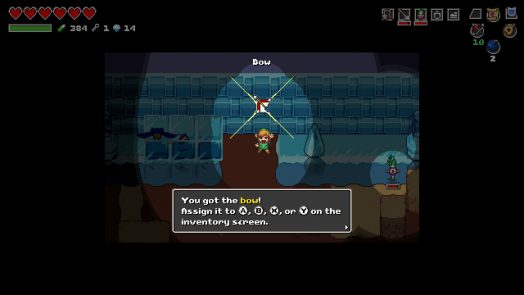
The enemies were possibly my favorite things about this game. There are some new enemies, such as the bosses, but much of this game’s rogue’s gallery was comprised of famous beasts. Lizalfos, Bokoblins, Redeads, and even Lynels were just some of the fan-favorite foes that danced their way into this game. Each had a unique pattern I needed to learn in order to end them quickly and avoid taking too much damage. Enemies could swarm quickly (almost to the point of the screen feeling cluttered with them) and being reckless could lead to defeat before there was time to react.
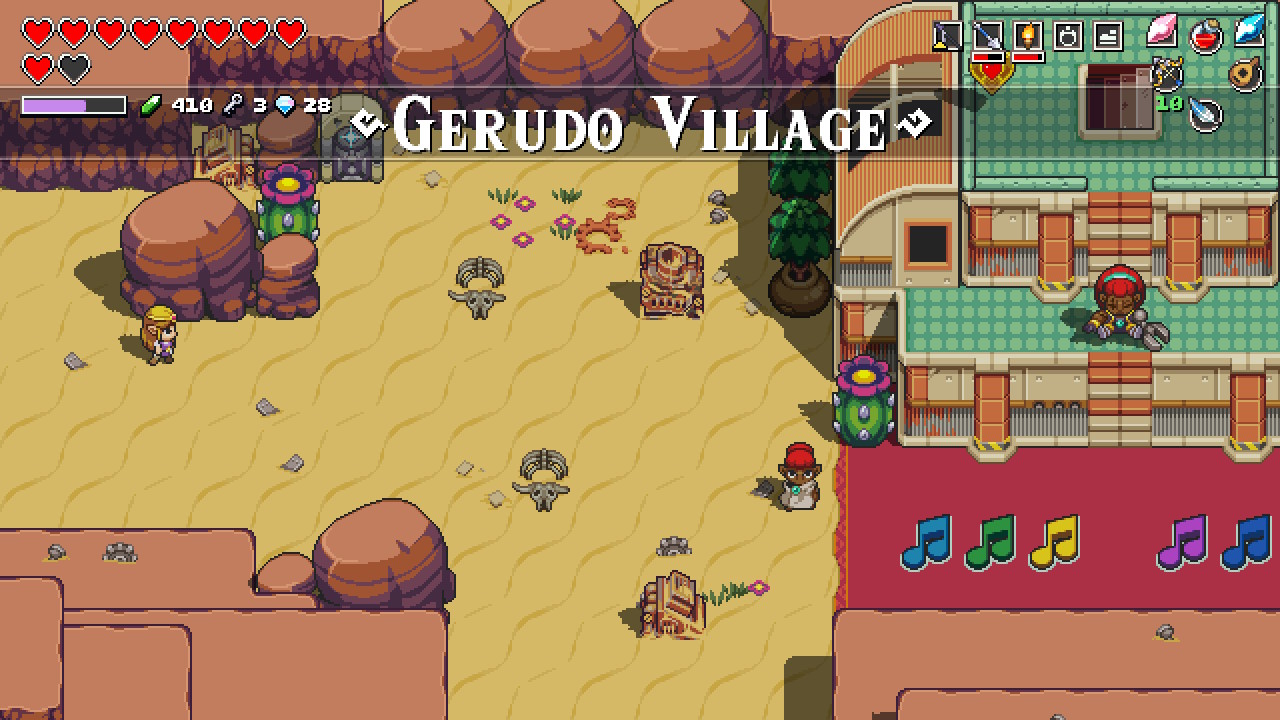
I believe this game would have fallen apart if the environment was not stellar, so I was thrilled that its version of Hyrule was like a well-crafted love letter to the versions from the main games. The overworld is uniquely generated for each file, and each region has been designed with a focus on the full enjoyment of Cadence of Hyrule’s gameplay while still showing the same captivating spirit of the locations they were inspired by. I explored locales like Hyrule Field, Death Mountain, and Lake Hylia, and they all carried the charm any Zelda fan should expect from them. Terrains changed, enemy types varied, and the non-playable characters I hoped to encounter were present. It was almost safe to assume they’d be there, but I was very happy when I made my way to the desert and found a village of Gerudos waiting for me.
Crypts and music: the backbone of Cadence of Hyrule
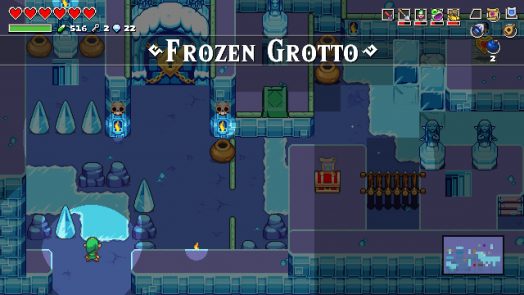
Ironically not a place to chill out and listen to some music.
Crypts, the game’s dungeons, were where to find the majority of the game’s challenge. Inspired by Crypt of the NecroDancer, the layouts of the crypts are randomly generated and matched the theme of the regions of Hyrule they were part of. Each sub-section of the dungeons is randomly generated for every single attempt, meaning that if you die or leave partway through, it will look different when you return.
Progression was more straightforward than in typical Zelda dungeons and focused on defeating hordes of enemies rather than solving puzzles. Regular keys, Boss Keys, and special items are present to match the Zelda theme. Once I cleared out all enemies, obtained any and all new gear, and found the Boss Keys, I fought the bosses – monstrous and musically-inclined versions of Zelda enemies. The bosses provided a decent challenge: Learning their patterns and staying in tune was crucial to defeating them.
Last but as far from least as anything can be, there is the music of Cadence of Hyrule. It’s the backbone of the game, and without these amazing and energetic scores the game would not have the impact it has. The music is a mix of techno and rock, and each track is a rendition of iconic melodies from the Zelda games. The themes for Death Mountain, Hyrule Field, and the Gerudo Valley were wonderful and kept me moving at all times. Tracks from Crypt of the NecroDancer’s original soundtrack also pop in, particularly in the crypts. If I needed to give credit to only one part of Cadence of Hyrule for encouraging me to play past my initial shortcomings, the soundtrack would be the obvious choice.
Cadence of Hyrule is an ambitious and amazing crossover that many gamers and Zelda fans thought could never exist. The more I played it – and the better I got at it – the more I loved what the developers did with the Zelda brand. I wish the game was longer, as it only took close to six hours to complete, but the entire time it felt like a true yet also refreshing Zelda adventure. Stylistically, it felt like it belongs alongside games such as A Link to the Past, Link’s Awakening, and Minish Cap, but incorporating elements from all across the Zelda series and with the fun addition of Link and Zelda grooving to the beat.
| Score | Similarity to Zelda games |
| 8.5/10 | Four Swords – ★★★★☆ Link’s Awakening – ★★★☆☆ Breath of the Wild – ★★☆☆☆ The Adventure of Link – ★☆☆☆☆ |