The long-anticipated sequel to Blossom Tales: The Sleeping King released on August 16, 2022. The first game captured the minds and hearts of many gamers, not just fans of The Legend of Zelda series. The Sleeping King went on to become an indie mainstay, setting the bar high for this franchise to continue as well as any other games that fit into this “Zelda” genre. Many fans have compared the first game to A Link to the Past, and they are saying the same about its sequel, Blossom Tales II: The Minotaur Prince. Does Blossom Tales II deserve this same level of recognition and adoration? Let’s find out.
The Characters and Story
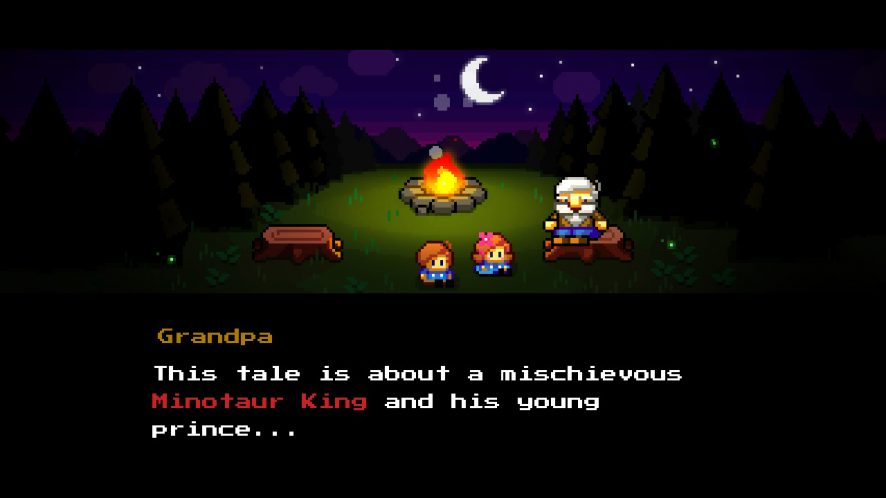
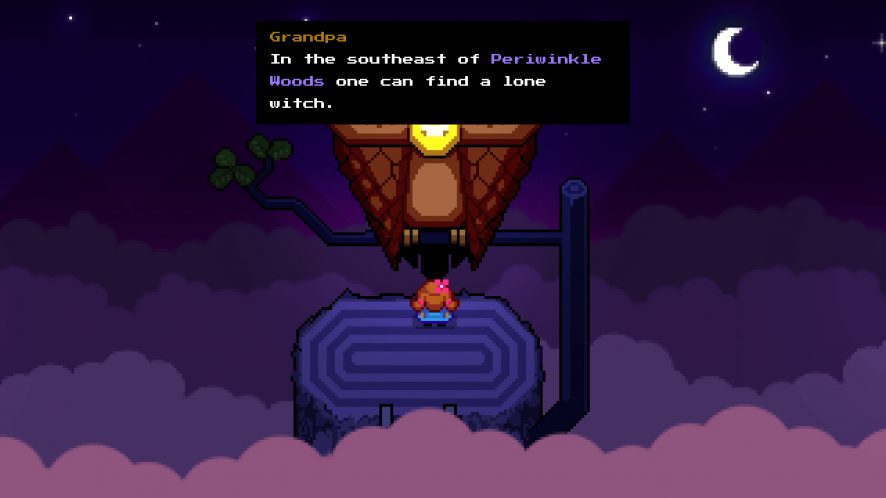
The Minotaur Prince starts off with the main characters Lily and Chrys sitting at a campfire with their grandpa. It is probably past their bedtime, but their loving grandpa wants to spoil them with a lengthy bedtime story. From the second I saw this scene, I was already invested in both the game and the land of Blossomdale. The cuteness of a grandpa being the narrator of this game hooked me instantly. He does an amazing job of setting the story up and creating an almost dreamlike sense of the game. I was also hit with nostalgic Link’s Awakening vibes: Similar to how Link experienced Koholint in a dream, the grandpa literally dreamed up the characters and land of this game.
Soon, the siblings Lily and Chrys are introduced into this story as well. Lily is the hero carried over from the first game and Chrys is depicted as the glory-stealing younger brother. Throughout the story of the game, the two siblings continue to interrupt grandpa and their personalities really start to shine. Chrys has his character cheat in a sword battle so he can beat his older sister, which leads to her wishing that the Minotaur King would come and take him far away.
This sets up the plot of the game, as now you will play as a remorseful Lily and try to rescue your brother. Meanwhile, the Minatur King corrupts Chrys and turns the boy into his prince, with Chrys no longer wanting to be rescued. The two siblings continue their sparring throughout the narration which leads to you, as the player, being allowed to make some critical decisions.
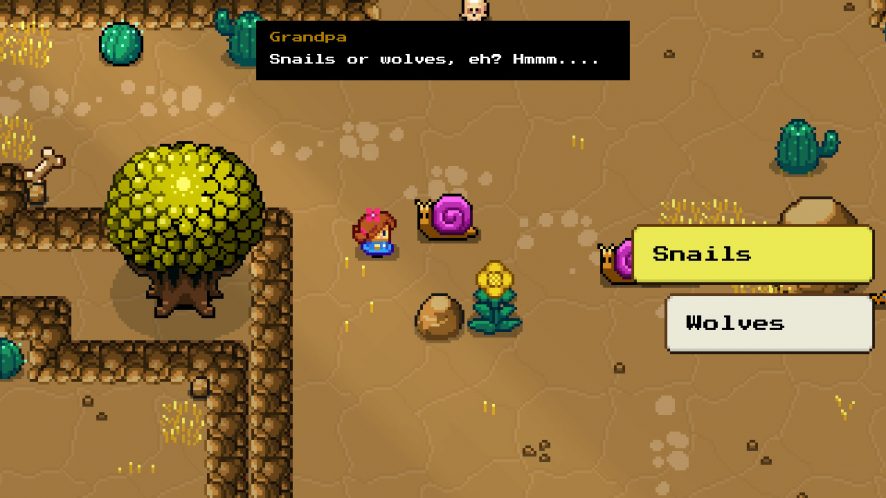
Throughout the game, you’re offered the choice to pick what either Lily or Chrys wants to add to the story. These decisions could mean the difference of battling against a pair of snails or a pair of wolves or solving a puzzle in a dungeon or battling some monsters.
None of these choices ultimately affect the major story of the game or lead to a branching of the game at all, but it is an interesting way to showcase the personalities of the two siblings and feel sorry for the grandpa who just wants to tell his story. Because of their interactions with one another throughout the game, you always feel a connection to the siblings. The grandpa even works grandma into the story and gives her a special part to play as well.
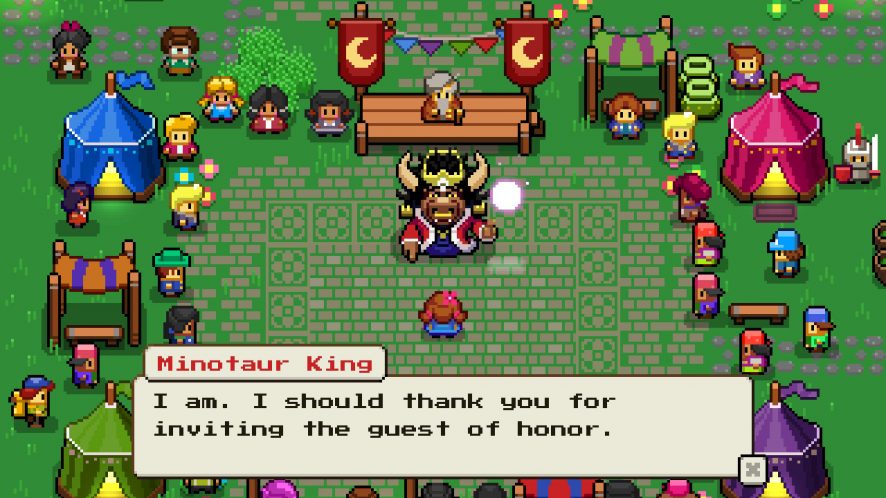
I really loved the plot and story of the game. The major characters were very much fleshed out and the world they lived in was crafted with details that bring everything to life. You feel sorry for Lily, who regrets making her brother disappear, and you also feel sorry for Chrys, who got corrupted by the dark side. No, seriously, there is an incredible nod to Return of the Jedi in here! I was invested in grandpa’s narrative skills and loved how his own story seems to change on him a lot. You also get to see the Minotaur King frequently, and let me tell you, he is quite the convincing fellow. In fact, the story is so vast that I didn’t even find every heart container or solve every sidequest. The story that developed throughout this game was the highlight for me and the strongest selling point of this game. I promise you, you will not feel disappointed throughout the many cut scenes and interactions in this game.
Gameplay
As to be expected, the game looks and plays like a top-down Legend of Zelda game. There is a button for slashing with your sword, a button for rolling out of the way (and dashing kind of too), and two mappable buttons you can use for a wide variety of weapons and tools. Just like in a Zelda game, you are given a shield, a bow, and a boomerang. These all work just like how they do in every other game that fits with the Zelda genre. In my playthrough, I didn’t even find all of the different types of tools because I never came across the shovel that can be used for digging out items such as gems. This made me wonder what else I had missed while playing the game.
Do you want to battle against snails or wolves? The choice is yours in this game.
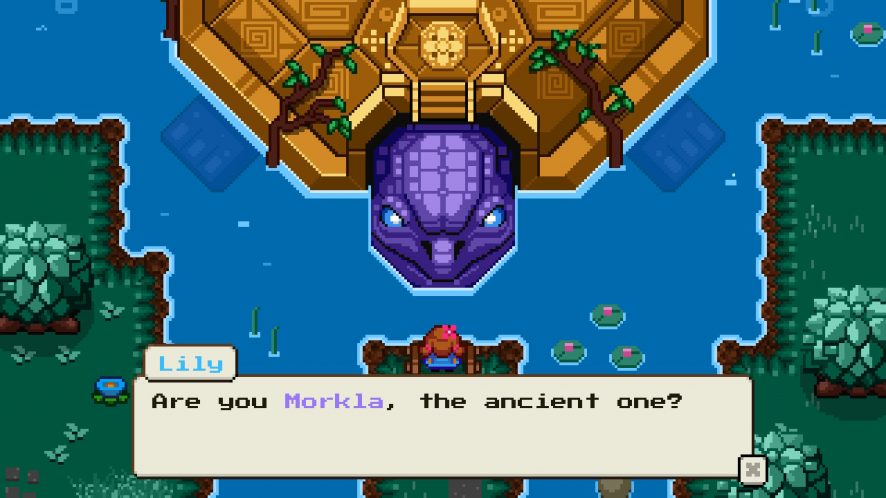
While most Zelda games give you a Hookshot, in this game you are given a yo-yo, which works in much the same way. It lets you travel across open gaps to go from wooden peg to wooden peg. Another really creative tool was a pager that lets you create teleportation points. This tool was necessary to solve many puzzles found in the various dungeons. You can also use a fishing rod in almost every body of water found in the overworld. Musical instruments also play a key role in the game and you are given a guitar that you can use to wake up characters or unlock doors.
As you traverse the world and battle in the dungeons you are constantly swapping in and out the tools you need. This led to a lot of having to go back into the menu to select which weapons you could map out a button to. While this wasn’t a deal breaker, I did have the four L and R buttons on my Switch controller that I wasn’t able to use at all. The gameplay experience would have felt smoother had I been able to assign a tool for each of those unused buttons instead of having to pause the experience in order to remap them.
Again, this gave me nostalgic vibes to Link’s Awakening and perhaps this is how the developers wanted me to feel. By letting me only map out two buttons I had to re-experience the feel of playing on an older console in the ’90s. This game was designed as a love letter to those older Zelda games, and if this is part of that love then so be it.
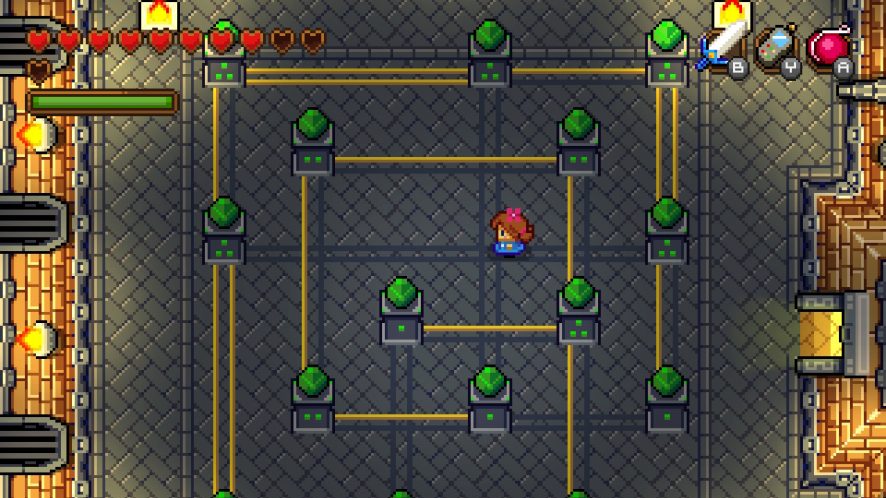
These lasers need to be lined up perfectly.
It may look easy, but there is a certain order to moving these blocks.
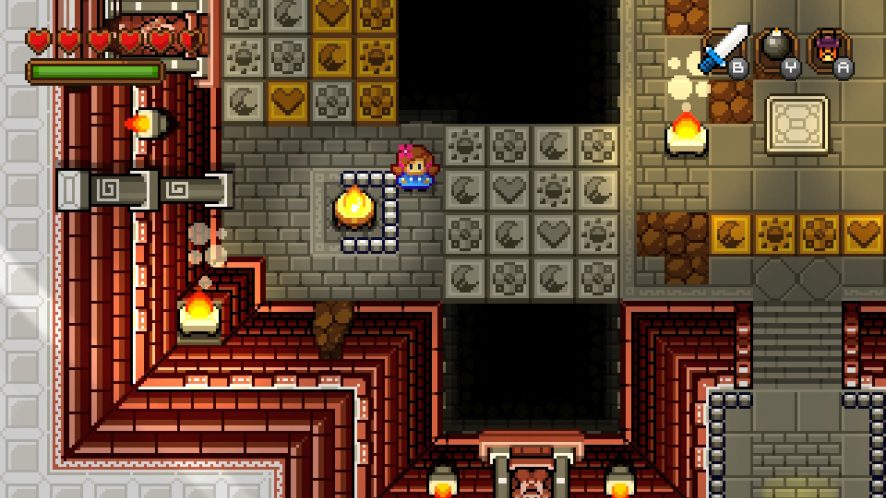
Walking along the correct pattern along multiple paths was a big challenge.
A large part of the gameplay also involves dungeons, as you would expect from a game based on The Legend of Zelda franchise. Each dungeon introduced a new type of puzzle to solve and kept some of the older ones as well. The puzzles ranged from having to step on tiles in a specific order to arranging green laser beams shooting out in multiple directions. Some of these puzzles were very challenging, which I appreciated. I was surprised at how you could solve puzzles in a variety of ways. One puzzle involves deflecting a laser beam, while standing on a narrow bridge, to certain spots in order to unlock the next area. I was able to stand sideways and carefully maneuver the laser beam to where it needed to go.
In the very next set of rooms, I hit a switch that moved the bridge I was standing on earlier, and it would have made it much easier to solve that laser beam puzzle. As well, there were multiple ways how you could connect paths along certain obstacles. One puzzle was extremely difficult and it took me close to an hour to solve it. There was a pattern on tiles that you had to follow along multiple sections. It was difficult knowing which section of the room I had to start on and which section was the next part to continue the pattern along. The dungeons always felt fresh from one another because of these new puzzle mechanics.
Very heavily inspired by Link’s Awakening.
Every dungeon also has not just one boss, but two! I was very surprised by this because the dungeons are all quite lengthy. I had made my way to the first mini-boss, defeated it, and then found out there was still more to do and explore in the dungeon. This all led eventually to the final boss of the dungeon.
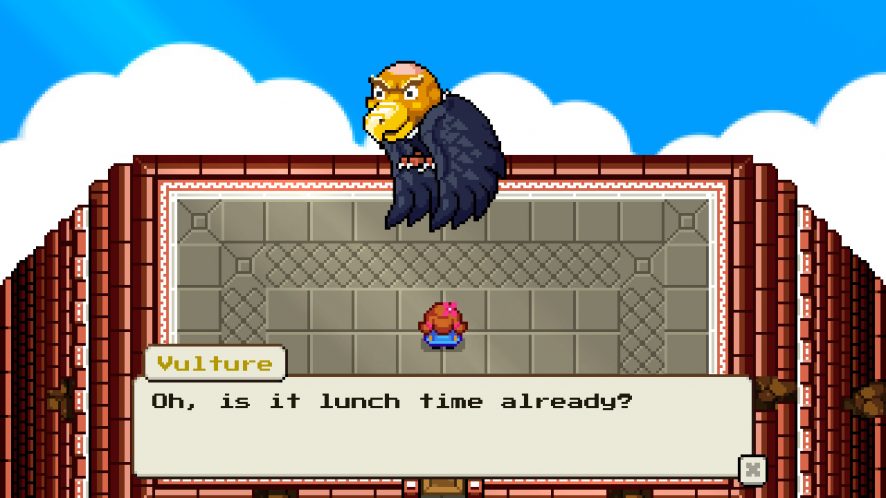
Much like in Zelda games, the bosses all had different phases. There were times when I could hit them with my sword, times when I had to keep my distance and throw a bomb at them, and times when they seemed invincible and I was dodging them or whatever arsenal they threw my way. Each boss was challenging and had some unique characteristics to them. The Vulture would fly across the screen at a fast speed while Dr. Hekyll would turn green like the Hulk and rampage across the screen.
Now, remember when I said that the dungeons were lengthy? Well, that’s only part of the problem. Most of the dungeons require you to backtrack a bit. Sometimes though, I even had to go all the way back to one end of the dungeon, unlock what I needed to, and then go all the way back to the other side. Again, this gave me Link’s Awakening nostalgic vibes, which again I’m sure the developers intended me to have. Some will appreciate the return to older-style dungeon mechanics, others may feel turned off by it. Thankfully, there is always a map of the dungeon rooms you have been too.
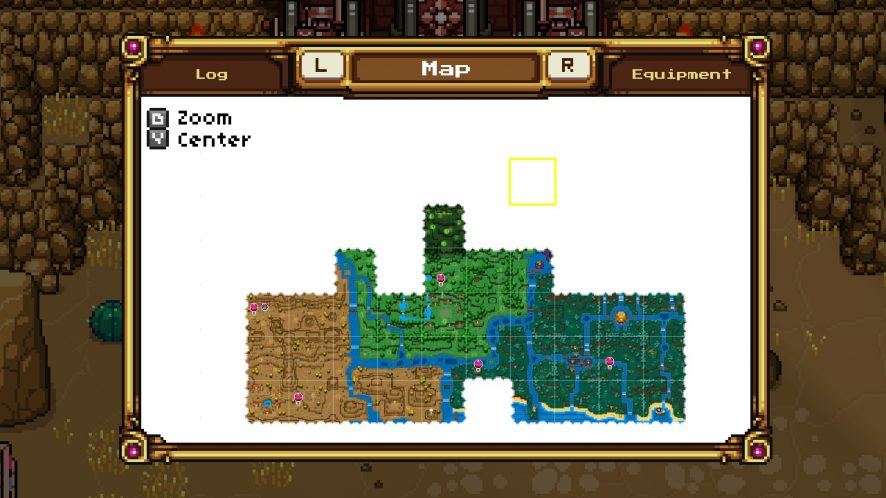
While we’re also on the topic of backtracking and the map, I had a couple of problems following the map. The game does an amazing job at telling you where to go by highlighting the square you need to travel to on the map. My main issue with this map is that you cannot zoom in enough. The game gives you three layers of zoom for the map, but perhaps due to the pixelated graphical style, the routes aren’t easy to see. I would travel to a square I had been to before thinking that a path was open to the next square, only to find out there was a ledge and I couldn’t access the part of the map I needed to go. This led me to wander around both the desert and labyrinth for longer than I would have liked.
Again, those nostalgic vibes and I am sure this is what the developers intended for me because there were sidequests to fill and NPCs to meet along the way. However, without the ability to place markers on the map or to really zoom in even further to see houses or locations, I couldn’t find most of those NPCs again.
Graphics
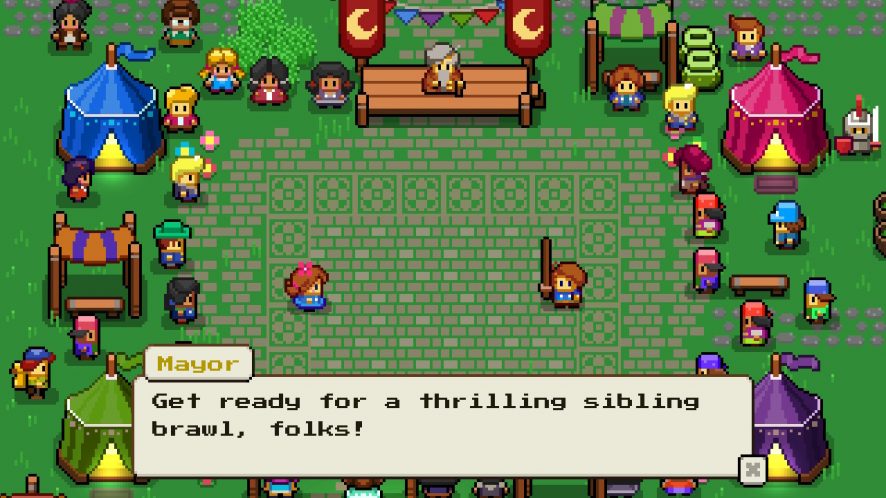
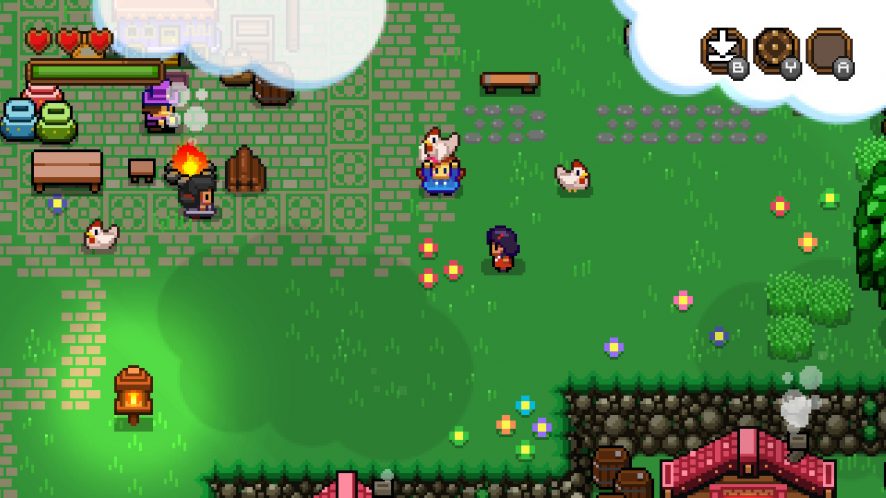
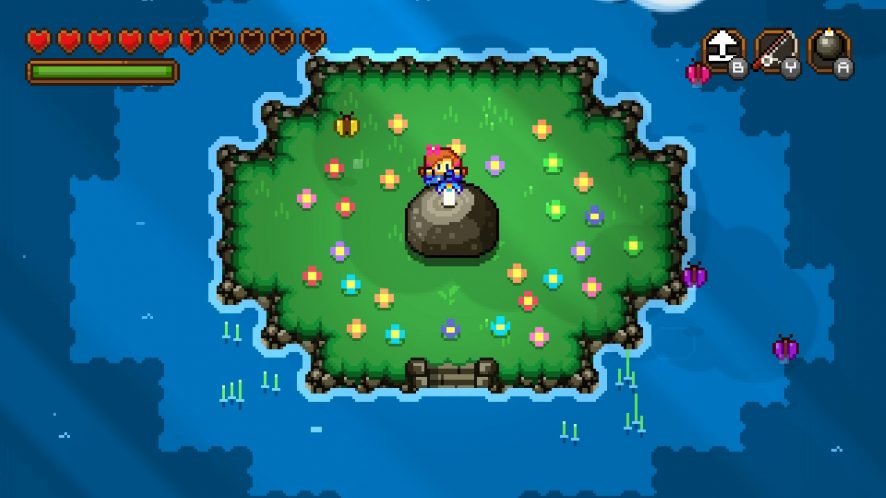
Prior to the release of this game, I heard many people online compare the graphics to A Link to the Past. I honestly think the graphics resemble a blending of Link’s Awakening and Stardew Valley. In a world where top-down games are getting the 2D-HD treatment, I enjoyed the nostalgic vibes that these graphics gave me. Despite the pixels, everything was really easy to see. The colors and visuals, especially in the main town of Blossomdale, really shined on my Nintendo Switch. They set the tone and mood regardless if I was in the overworld or in a dungeon. The opening scene at a campfire had the perfect nighttime sky.
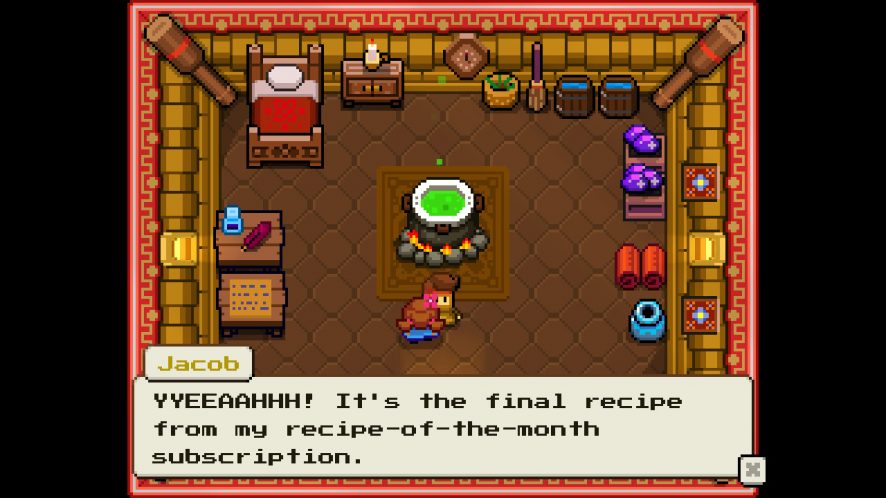
I especially loved all of the little details found in the villagers houses. There were decorations, banners, and lots of times the pots that can be broken to find hearts and coins were different colors too. It was a nice touch.
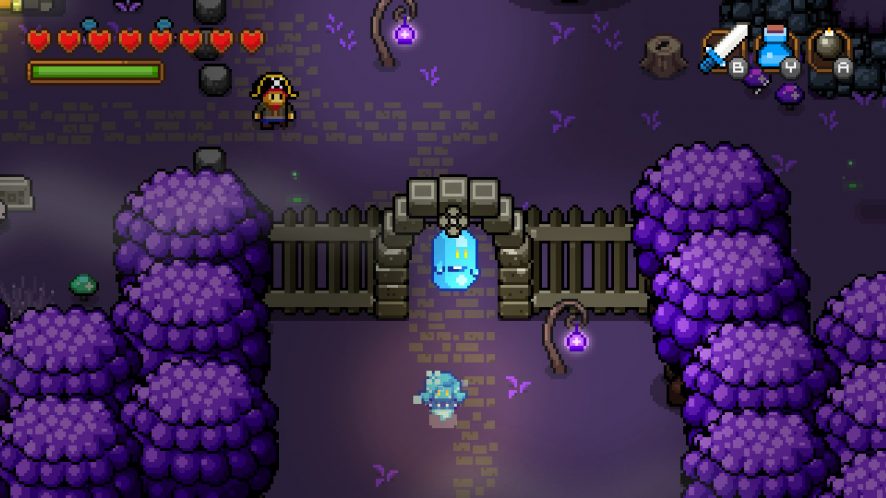
The colors were a bit darker in the dungeons which made sense because, well, you’re in a dungeon! The Haunted Mansion dungeon included some nice touches such as spider webs and a picture of Vlad outside his door. As I traveled between the various locations in the game the themes and moods of color were constantly changing, making every location feel unique and special. I played the entirety of the game on my Switch Lite and had no issues with the framerate at all. This game ran smoothly and seamlessly.
Audio and Soundtrack
Any game that is based on the Legend of Zelda series needs to do their best to create a likeable soundtrack. From the opening introduction to the final boss battle, the music in this game had me hooked. The opening track really reminded me of the introductory music in Link’s Awakening. There was a peaceful calmness to the retro-styled melody. Blossomdale had a beautiful score playing every time you entered the village. When you walked into a villagers house the music changed and I liked the distinctive feel between overworld and a location.
My favorite music track in the entire game had to be the Haunted Mansion dungeon. There were eerie sounds on top of a very scary-sounding track. I turned off all the lights in my house and popped in my headphones during this part for extra ambience. I was scared the whole time I was in the dungeon and was expecting something to come out and grab me. The music that played during boss battles also ramped up with the added pressure of defeating them. Try to beat an octopus with tentacles flying all around you as you’re also bopping your head to the phrenetic tune. Overall, the developers did a wonderful job of incorporating both peaceful and serene like music with darker and scarier tones.
The game also does a great job of using unique sounds when you grab a coin, smash a pot, burn a ghost, or swing your sword. When you think of classic games such as Super Mario Bros and Legend of Zelda, you also think back to those iconic sounds. You remember the sound of Link getting a new item and Mario jumping over a gap. While the sounds in Blossom Tales II may not be as iconic, for a game based on retro styled games it does not copy or steal those sounds outright.
Connections to Zelda
Blossom Tales II: The Minotaur King is a love letter to the Legend of Zelda series, and the developers did not shy away from that statement in this game. There are Easter eggs and callbacks to many games from the franchise, but perhaps the majority of them are toward Link’s Awakening. There is an owl that guides Lily on her quest, which even makes one of the siblings ask grandpa why it looks so familiar. The vulture battle at the top of a mountain especially harkens back to the 1993 Gameboy classic. When I entered the witch’s house the music sounded very close to the witch’s theme found in Link’s Awakening as well.
Everything reminded of the Zelda series as I had to slash with my sword, use a bow, grapple across gaps with a yo-yo, block with a shield, or lob a bomb at a crack in the wall to reveal the secrets inside. You can also dig for and collect gems in order to upgrade your sword, similar to how you could search for seashells to upgrade your sword in Link’s Awakening.
While there are many connections to Zelda, this game still retains a unique vibe and story.
The fact that you fight in dungeons, have boss battles, and solve puzzles is wonderfully reminiscent to the Zelda series and harkens back to so many memories from that franchise. So is this simply a clone of Link’s Awakening then? No, it’s not. While the mechanics and overall gameplay feel similar, the story stands on its own. The dungeons have different layouts and there are some new mechanics in the puzzles that you need to solve.
In the same way that, after playing the original The Legend of Zelda game on the NES, you still found Link’s Awakening and A Link to the Past to be different games, so too will you find this one to be engaging. If you love the franchise of Zelda and enjoy the top-down style of the older games, then this game will feel like a nostalgic treat to you.
Conclusion
From the opening screen to the closing moments, I really enjoyed playing The Minotaur Prince. The characters and story are what really sets this game apart from not just Zelda-like games, but from all other indie games. I was truly invested in Lily as a hero and Chrys as a brattier younger brother. I wanted to solve the conflict of the game and rescue Chrys from the clutches of the Minotaur King.
I was into every special moment along the journey and enjoyed using all of the tools and potions that I found along the way. I didn’t even complete all of the sidequests yet or received all of the song notes, a shovel, or all of the different types of potions that I could use. That shows you how deep the game can be.
There is a lot of lore to explore in Blossom Tales II: The Minotaur Prince, and after rolling the credits, I expect most players will continue to search the land and complete more sidequests. This is very much a game inspired by the Zelda franchise and is a love letter to it. Those that love that style of gameplay and want a fresh story should absolutely play this game today.
Score: 8/10
Ryan Peniuk
Ryan Peniuk grew up in Canada while playing on the original NES. The Legend of Zelda was one of the first games he ever played and fell in love with. He still enjoys the Zelda games today and also plays a lot of Pokemon, Monster Hunter and indie games with his son. When he is not busy gaming or writing, Ryan is a loving father, husband, dog owner and a teacher.


 by Ryan Peniuk on September 7, 2022