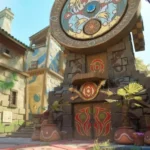
Majora’s Mask is among the best Legend of Zelda games, most notably for its atmosphere. Unlike most games in the franchise that pave the way for freedom and adventure, Majora’s Mask is a little more restrictive and melancholy. The relentless passage of time and our inability to stop it weigh heavily on Termina and its people, making every region feel different, not just in design, but in emotion. That tension and unease make it one of the most unique and unforgettable games in the series.
Woodfall
Woodfall is an overgrown swamp, shrouded in a murky bog and dark wooden structures and surrounded by toxic waters, symbolic of the area’s corruption. Woodfall has a tribal theme, fitting for the Deku. Between the Southern Swamp, the Deku Palace, and Woodfall Temple, there’s a social imbalance under the misguided, tyrannical rule of the Deku King. The Deku Princess is missing, and the King wrongly blames an innocent monkey for her disappearance. The monkey is imprisoned, bound, and threatened with execution by being boiled alive. The monkeys are helpful, sweet, and kind. Their imprisonment shows how fear and ignorance can twist justice.
Meanwhile, The Deku are anxious about the fate of their monarchy and the Deku Butler silently mourns the loss of his son, his grief hidden beneath his stoic exterior. The dense, mucky water perpetuates a symbolic sickness, as these events create a microcosm of the more significant chaos beyond the swamp. The Deku become a collective mob, assuming the monkey is guilty without evidence. Their irrational behavior and distrust for outsiders are part of that sickness. Despite how earthy tones usually make me feel grounded, the swamp instead carries a sense of hostility. Even though it’s probably the most biotic area of Termina, the Swamp is laden with an unnatural hue, making it feel somehow artificial against the endless foliage.
Snowhead
At first, Snowhead seems like a land built on heaps of snow, but beneath the ice lies its true, grassy terrain. The Gorons are slowly freezing to death, their bodies not built for the relentless cold. With their spring now frozen over, most of them stay huddled inside the Goron Shrine for warmth. However, the bitter weather isn’t their only struggle. Their leader is dead, their elder is missing, and his young son wails incessantly. The violent blizzard howls through Snowhead, obscuring our visibility and making the landscape feel even more oppressive and desolate. Even at midday, the sky remains a lifeless gray that’s devoid of life.
Snowhead’s overworld theme is both soft and piercing, it’s a melody that perfectly captures the desperation, sorrow, and hopelessness that linger here. When Link encounters Darmani III’s ghost, his story is one of heartbreak, a haunting tale of remembrance and the weight of a legacy left behind. The loss of a beloved leader leaves the Gorons directionless and vulnerable, reminding us how sudden loss can make our theoretical springs freeze over. When Link defeats Goht and the snow finally melts, the spring symbolizes new beginnings, and that even in our darkest moments, hope can still find a way to bloom.
Great Bay
Great Bay combines seaside beauty and misery, it feels like the edge of the end of the world. The coastline is jagged, making it appear more hostile than a typical tropical paradise, and despair floods the region as the theme song plays like a distant siren’s call.
After Link plays the Song of Healing next to Mikau’s disheveled body, Mikau reflects on his sorrows about losing Lulu’s eggs to the Gerudo Pirates. When he fades away, all that remains is the Zora Mask and a grave, quietly blending into the beach’s foliage.
The Zora’s, who are usually known for their grace, are disconnected and disgruntled, especially Lulu, silently suffering as she gazes into the vast ocean with grief lingering in her eyes. Trekking across the sand, I can’t help but feel painfully isolated, like something has been taken away from me.
Romani Ranch
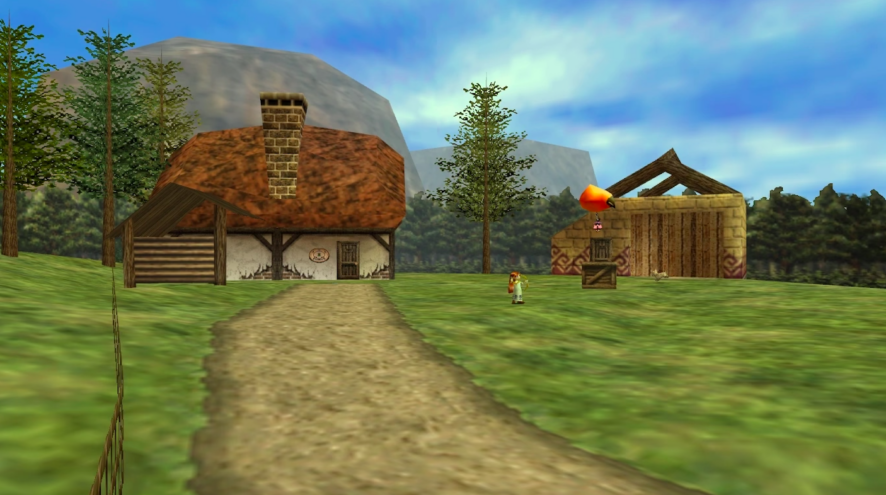
Unlike some of its neighboring regions, Romani Ranch looks peaceful and inviting. Its vivid field, scattered fences, and rustic buildings give it a classic countryside charm that makes it seem like a safe haven. Despite the Ranch not being very far from Clock Town, the massive boulder blocking its entrance isolates it from the rest of Termina and exists in its own little world. Cremia’s protective, motherly nature defines the ranch. She shields her younger sister from the harshness of the outside world, knowing all too well the pain of loss. With no one else to rely on, they have only each other. Romani Ranch carries a deep sense of nostalgia, its dreamlike melody is almost the same as Lon Lon Ranch — like a place desperately clinging to the past as it slowly fades away.
The atmosphere drastically shifts during the alien invasion side quest, or “Them”. The outcome of this event completely alters the ranch’s tone. If Link succeeds, things somewhat return to normal, but if he fails, Romani is left aimlessly wandering the fields in a daze, telling a story about lost innocence, and the ranch becomes a hollow shell of what it was. Jealousy, bitterness, and frustration play huge roles in the ranch. This isn’t just seen in the Gorman Brothers’ resentment, but also in Cremia’s quiet heartache over Kafei. Her demeanor shifts depending on the day, or if Link wears Kafei’s Mask, hinting at a love she knows will never be reciprocated.
Often alone with her thoughts, Cremia carries the weight of the ranch’s responsibilities, burdened by an inner monologue she can’t escape. Her wistful jealousy toward Anju and Kafei’s engagement isn’t just about lost love, it’s a reminder of the path not taken and proof that not everyone gets a happy ending. Beneath the ranch’s peaceful exterior lies one of the most tragic stories in the game.
Ikana
Ikana’s haunting beauty makes it one of the eeriest places in the game. Its bloodstained history lingers in the canyon walls, and death seeps from the Graveyard. Despite its desolation, the spirits of the Garo still roam the trails, who are ninja warriors haunting passersby. Igos du Ikana and the rest of the Ikana army remain trapped in denial, convinced that their bloodstained hands must keep waging war. Their restless souls are incapable of moving on. In contrast, stands the Music Box House, home to Pamela and her cursed father, one of the few signs of life in Ikana’s land of the dead. Its cheerful, windmill-like design feels sinister here, and the lively tune blaring from its pavilion adds to the unease.
Ikana is draped in a somber, autumnal palette with barren trees, dry earth, and lifeless scenery stretching in every direction, and the golden-brown hues conflict with the rest of Termina’s vibrancy. Ghostly chants echo through the air while ancient ruins and abandoned homes whisper of lost history and forgotten mysteries. Every step feels unwelcoming, as we’re intruders in a land where the living don’t belong.
Clock Town
Clock Town is a bustling, lively city, with everyone hurriedly preparing for the annual Carnival of Time. The town is brimming with colors and decorated with banners, tapestries, and festive ornaments. It’s a place of joy, where both locals and tourists share in the celebration. The streets are filled with shopkeepers, workers, and children. But beneath its spirited exterior, it’s a town of denial. The guards desperately insist that the mayor give the townspeople evacuation orders. However, the mayor cowers when Mutoh, the head of the Carnival’s Committee, aggressively argues that the Moon won’t crash, and that the idea is ridiculous. As each day passes, the atmosphere subtly shifts. By Day 2, the music’s tempo picks up while the town endures a heavy rain. By Day 3, the music spirals into an off-kilter rhythm, the drawn-out, low notes trailing behind the cheerful melody.
The Clock Tower stands at the heart of Termina, a fitting symbol of time itself. Looming over the city, it serves as both a reminder of fate and a beacon of hope. Inside the tower, time comes to a halt. The top of the tower is where Skull Kid sets the moon’s destruction in motion, transforming the dial into a boss arena, or, in a way, a place for second chances. By the morning after the Final Day, the Moon looms dangerously close. The joyous atmosphere is gone, and the inevitable weight of death becomes undeniable, something that awaits us all.
Every region in Majora’s Mask offers moments of catharsis. Just when hope seems lost, something always surfaces to show that healing is possible, even in the darkest places.


 by Camille Holder on April 18, 2025