Did you know that Shigeru Miyamoto originally intended for the pieces of the Triforce in the first Legend of Zelda title to be computer chips?
In these two newly-translated interviews from French publication Gamekult, Shigeru Miyamoto recalls that story, along with details about Link’s original design, why Link is named “Link”, and more!
Dri from Dreamnoid.com was gracious enough to translate these interviews for the database at Hyrule Interviews. Here they are in their entirety for our readers at Zelda Universe!
Miyamoto, the Wii U and the secret of the Triforce
Original interview by William Audureau at Gamekult, November 2012
Q: What was your exact role in developing the Wii U?
Miyamoto: It’s difficult to say, because in theory I’m responsible for software, but since the beginning I’ve had a say in the development of new hardware, especially the game pads. In the end, as we make the hardware and software together I found myself involved with the design of the DS and the Wii. For the Wii U, the line was really blurry between software and hardware. We gathered multiple people from those two departments to discuss the project together. I was among those who pushed for a small screen embedded in the gamepad. Beyond that, it’s quite difficult to say who did what exactly.
Q: In an interview from 2006, you related being frustrated by the edges of TV screens. Was the Wii U already in the back of your mind?
Miyamoto: It’s difficult to trace the line from words to acts! Sometimes I think out loud, but I don’t think that was in relation to the Wii U. But it’s true that with the panorama view that allows you to look around you on the gamepad’s screen, you do get out of the TV.
Q: From the start, the Wii gave the impression of a console made for sports games, especially racket sports. When we tried the Wii U and Nintendo Land, we instead got the impression it was made for board games. Was it?
Miyamoto: It wasn’t only made for board games; I think it would have required four small screens in addition to a big touch screen for that. But it’s true it’s easier to make board games on the Wii U, because you can have four players touch the screen and see the result on the big screen. Also, it includes an NFC chip. This means you can add interactions that are closer to games, and not only board games. I’m thinking about toys. And you know, what works really well on smartphones, at least in Japan, are card-collecting games. But those are virtual cards. I’m more interested in real cards. That’s why I believe the Wii U has more potential than those [mobile games].
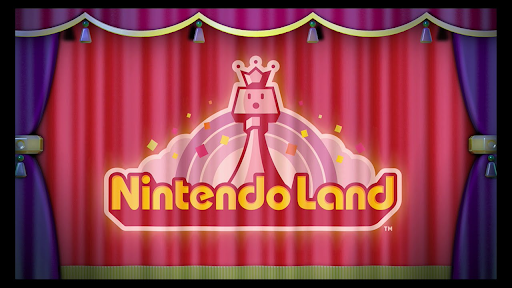
Screenshot from Nintendo Land, of a stage curtain rising with the Nintendo Land logo
Q: On the side of traditional games, you mentioned Metroid would work really well on the Wii. Were you thinking about Metroid Prime, Metroid: Other M, or something else entirely?
Miyamoto: You know, the kind of ideas I have for Metroid can already be found in Metroid Blast, the minigame dedicated to the series in Nintendo Land. Generally speaking, I’m thinking along the lines of the Wii U being an HD console, with superior graphics and more computational power. So it’s natural to imagine a beautiful HD action game… [big smile].
Q: After a quick poll on Twitter, one of the game series that French players are dearly missing is F-Zero. Nobody really understands why Nintendo did not release any new installment since 2004. Is there a chance to see the franchise on Wii U?
Miyamoto: I’m really glad to hear Twitter’s opinion, because since the first game on the Super NES there have been a few installments, but I don’t think the series evolved much. I thought that, quite the contrary, people would have grown bored with it. So now I want to say: thank you and please play the F-Zero mini-game in Nintendo Land in the meantime. I’m also very curious and would like to ask those people: why F-Zero? What’s missing that we haven’t already done?
Q: Recently, there’s been a lot of interrogations about your future. What about you? Where do you see yourself in ten years?
Miyamoto: First of all, I hope I to still be alive ten years from now! If I am, I hope I’m still working for Nintendo, doing what I love. I’m very in-demand these days, but I’m lucky that I can get younger people–well, they’re 40-year-olds–to work in my stead. They’re all talented producers who worked on games for the Wii or Wii U. Thanks to them and their talent, I can take some distance from my usual tasks, knowing those projects are in good hands. And I can focus on what’s interesting me, even if I keep supervising somewhat. Right now, I’m hanging on to finish Pikmin 3!
Q: To conclude, I would like to ask you a question that I don’t think you ever answered. You told the story of Mario’s creation many times, but never the tale of the hero from Zelda. Do you remember Link’s birth?
Miyamoto: Actually, Link’s sprite was drawn by Mr. Tezuka. At the time, as you know, the NES was very limited and we could only use three different colors [for the sprite]. And yet, we wanted a recognizable character.
What I wanted most of all was for him to use either his sword or his shield, and for them to be visible on screen. We made his weapons really big for them to be recognizable. We then had to create a hero that would still be visible next to those big weapons, despite his small size. That’s why we thought of a long hat and big ears. For us it evoked a fairy-like character, so we moved along the lines of an elf.
At the time, if you were talking about big ears you were talking about Peter Pan, and because I really liked Disney, we took inspiration from it. Not full inspiration, obviously, it wouldn’t have been nice… From there, I told myself Peter Pan’s greens would suit our character. And because we were limited by three colors and there was a lot of forest environments in the game–green on green–it fit together quite well, so we went that way.
Q: And where does his name come from?
Miyamoto: It’s not a very well-known story, but back then, when we started designing The Legend of Zelda, we imagined the fragments of the Triforce as electronic chips! It was meant to be a video game that would take place both in the past and the future. Because the hero was linking together both eras, we called him “Link”, after the English word. But in the end, Link never went to the future and it remained a heroic fantasy game. We can even say there’s absolutely nothing futuristic in the game! [laugh]
Interview with Miyamoto: “A Difficult Balance to Find”
Original interview by Matthieu Hurel at Gamekult.com, June 2016
Q: To begin with, I would like to talk about the lineage between Breath of the Wild and the original NES The Legend of Zelda. Do you still replay the first game from time to time, to see how the series evolved?
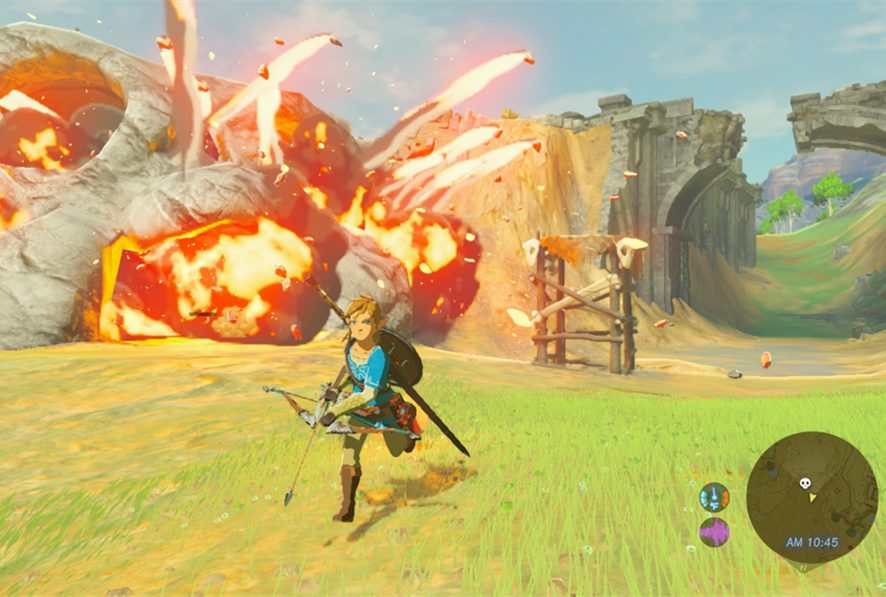
Shigeru Miyamoto: The relationship between Breath of the Wildand The Legend of Zelda mostly comes from playtesters’ feedback; we weren’t really trying to recreate the first Zelda. Back in the day it was built upon the ideas of great freedom of action and miniature gardens. As the series evolved, we turned it more and more into a game with a single path to follow. This pushed us to create bigger and more complex dungeons and to design puzzles requiring specific items, which led to very linear games. So we decided to go back to the roots of the saga and started developing the game we’re showing you today.
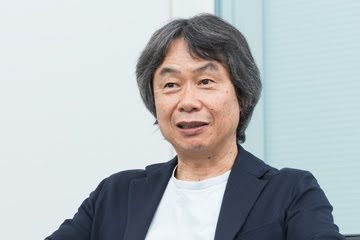
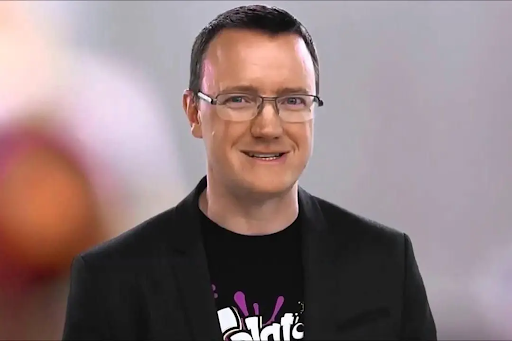
Shigeru Miyamoto, 2016. Image from Nintendo.com
Q: At first I was surprised by the focus on technology in [the world of Breath of the Wild], and then I thought back on what you said to us in an interview a few years ago about the initial concept for Zelda where Link traveled through time and the Triforce was made of electronic chips. Aren’t you, thirty years later, fully realizing this vision?
Miyamoto: To be honest, I mostly let Mr. Aonuma take care of this project and I was very surprised to see some kind of smartphone appear in the game [laugh]. At first, I told myself: “Can we really do that?” But yes, ever since the first Zelda we’ve thought about including technological elements and making Link a “link” between different times through a computer program. Now that [modern technology] has made huge leaps forward … and gotten better and better, we told ourselves it would be better suited to convey this technological idea.
Bill Trinen. Image from Eurogamer.it.
Q: Considering the director for this game is Mr. Fujibayashi and he directed Skyward Sword, did you keep the fragmented design method from that episode, with a different team in charge of each in-game region?
Miyamoto: First of all, the core of the programming team is made up of new people, gathering together the best internal talents from Nintendo. For the art team we have people who worked on older Zelda games coming back to offer a unique visual style to this game, thanks to new shaders and other homemade tools. We also made sure those nice graphics worked with the technical requirements of an open world, with few visible loading times. We had to scale up our programming and art teams to reach our objective, thanks in part to the help of people who worked on the Xenoblade series [at Nintendo subsidiary Monolith Soft]. All in all, it amounts to more than a hundred people working on the project.
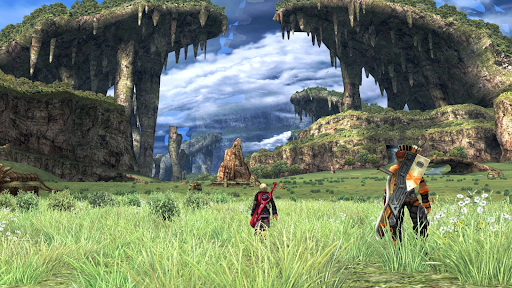
Screenshot of Monolith Soft’s Xenoblade Chronicles (2010).
Q: Are other first party studios involved in the development of this game?
Bill Trinen: There are members from other Nintendo teams who often share their knowledge with other internal studios and thus we had representatives from other studios coming to help the team in charge of Zelda.
Q: I noticed the game surfaces more numbers than usual, but on the other hand the rupee counter and money in general seems to be gone. Is it the case, and if yes, why?
Miyamoto: As we reinvented the Zelda series, we looked into rupees because we received a lot of feedback about gathering lot of rupees but not having enough interesting ways to spend them. In such a free and open game we thought they were losing their value as collectibles. They are present in the final version, in a different way that implies combinations and other surprises.
Q: How do you make sure the stamina gauge when Link runs, or the fact weapons can break, doesn’t become too much of a burden for players, to the point it breaks pacing and discourages many people?
Miyamoto: It’s true it’s a difficult balance to find, especially considering that it’s a world we explore over both big horizontal distances and in a vertical fashion. We wanted to show, in a concrete way, that the character can travel as he likes and improve over the game. For a character with an unlimited run, we would probably have just shrunk the map. Right now, we have faster ways to move around like the horse, the warp points and the paraglider, which can be used in complementary ways to make exploration more varied. Link’s ability to run and climb serves as a benchmark to decide everything else.
Trinen: There will also be mechanics to recharge your stamina faster by combining or cooking items. You will be able to find ways to increase your max stamina, temporarily or permanently. You have to keep in mind that the demo playable at E3 is only a small part of the game and doesn’t allow you to ride a horse or to use the paraglider, two ways that completely change the way you perceive distances. When you get the chance to glide over long distances and try to do the same on foot, you will see how it changes everything.
Q: What’s your involvement in such an important project for Nintendo?
Miyamoto: In the past I was hugely invested in Zelda games, whether that meant laying out the fundamentals or tweaking details as we went. With help from my team, I could deliver a fully playable game and then let them take care of the closing. Nowadays, considering the size of the game, there are many different teams involved with production. For instance, one is dedicated to integrating the physics engine. So nowadays I’m mostly performing small checks over the way Link handles and responds to player input, but after validating a checklist I’m leaving the rest to the developers. As we reach the end of development, I believe my involvement may grow to polish the game as much as possible.
Q: Mr. Aonuma recently explained in an interview that it would theoretically be possible to reach the end of the game immediately after the start, even though he believes it would be bad to experience the game for the first time this way. Does that at least mean there are incentives to play the game multiple times, like a second quest or multiple endings?
Miyamoto: Honestly, I don’t know! [laugh] That said, even with a very open game with many things to master we kept a main quest and a clearly identified final boss to defeat. Rather than a complicated approach like multiple endings, I believe it’s more important to let players choose their own way to go through the game.
Trinen: Mr. Aonuma meant to say it was possible to take on this kind of challenge—which I know because I tried it myself, but I got really scared and fled quickly! [laugh] So you can try to [finish the game quickly], but it won’t be easy at all.
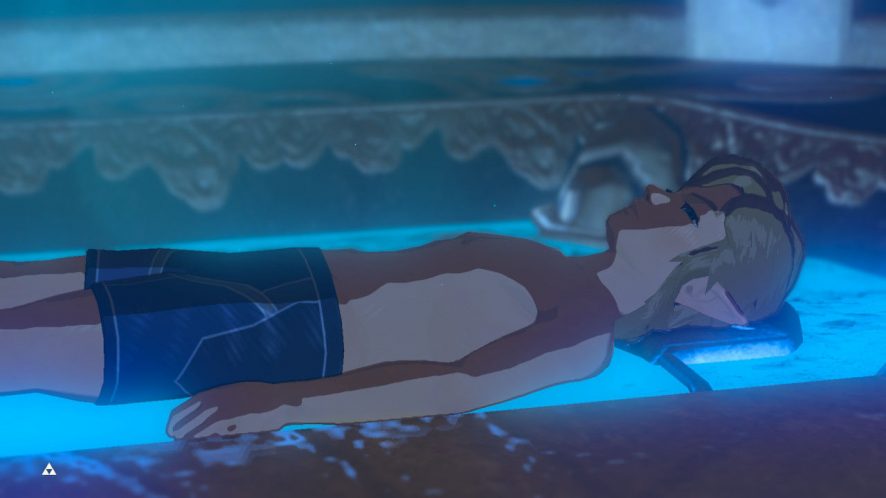
Q: Can we go through the entire game wearing only the starting underwear?
Trinen: Yes, you can! [laugh]
Q: For years now we’ve often been talking about the possibility to play as a female character in a Zelda game. Given her important role in the story and her name over the franchise, can we hope to one day see a game starring Zelda as the main protagonist? If Tingle could get two games to his name on DS, surely there’s a way to do something for her, right?
Miyamoto: We definitely had talks with the team to make a game focused on the character of Sheik, so I can’t say such a thing is impossible in the future, but in the mainline episodes of the series, Link is the hero and that won’t change. Beyond that, you will have to wait and see!


 by Max Nichols on October 18, 2024