The Legend of Zelda games, in general, have the appearance of being a long-ago fairy tale. But what would a Zelda game look like if it were set in a time closer to our own?
It seems that a lot of fans like to imagine what it would be like if “once upon a time” was our time. There is a lot of really great fan art out there showing the Zelda characters in cyberpunk or steampunk settings, or wearing clothes from today or the last few decades.
Spirit Tracks gave the first hint of this, with the introduction of rail travel to Hyrule. But Breath of the Wild, to date, appears to give us the best look at what a present-day Zelda game would look like.
In its own way, the world of the game contains computers, automatons, wireless communications, electricity, air travel, and self-propelled vehicles. Naturally, these devices as seen in the Zelda games are not quite the same as what we have in our world; the progression of history and technological advances in our world is different from that of Hyrule. Additionally, Hyrule has something that our world unfortunately does not: many kinds of magic.
The game accomplishes the modern feel by taking items that the player would be familiar with in real life and refashioning them to fit with the game’s aesthetic: making something that is fairly new look, by contrast, very old. Take the Sheikah Towers, for instance. They serve much the same function as cell towers and radio or television transmitters. The activation of a tower looks much like an antenna being extended and powered on. But the tower is designed to look like an ancient artifact.
Old and New
Much of Hyrule’s technology in Breath of the Wild is explained as being the work of the ancient Sheikah, who were making astonishing technological discoveries 10,000 years before Breath of the Wild takes place.
The game designers, in creating the general aesthetic of Breath of the Wild, drew a great deal of inspiration from the art and artifacts of the Jōmon period, which spanned roughly 14,000 BCE to 300 BCE in Japan. Incidentally, the ancient Sheikah were at work at least 10,000 years before Breath of the Wild takes place, which would have been not too far from the length of time between much of the Jōmon era and our time.
The Sheikah were responsible for, among other things, the Divine Beasts, the Guardians, the Towers, and the Shrines, and it is on these items that the Jōmon influence is most evident. But these items are also outfitted with lasers and automation. The result, then, is something that is at the same time very ancient and very futuristic.
Sheikah Slates
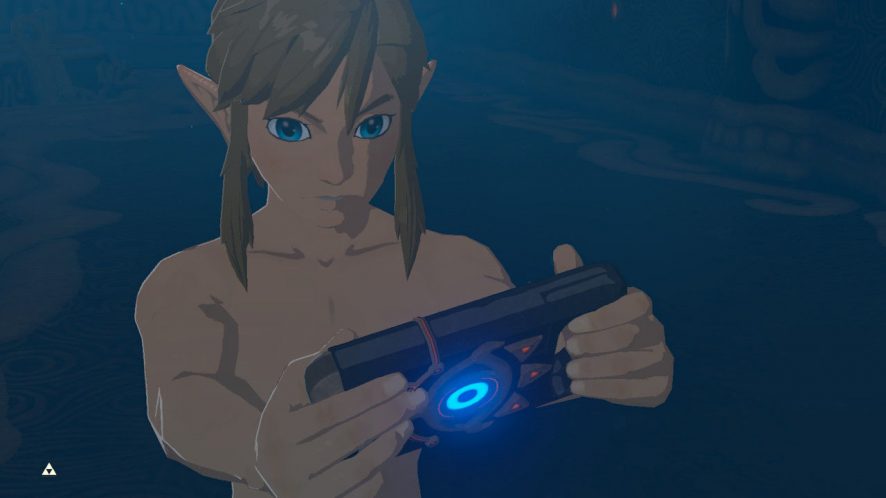
The Sheikah slate is one of the most fascinating items in the game, and perhaps the most useful. It is the item that guides Link (and the player) throughout Hyrule.
The slate appears to be about the same shape and size of the Nintendo Switch and is held in much the same fashion as the Switch when in handheld mode: most likely a key contributing factor to the slate’s design. The slate serves a variety of functions: map, camera, tracking device, electronic keycard, transportation device, encyclopedia, and so on. Once it connects to a local tower, or to a Sheikah guidance stone, the slate “downloads” new data. And it has “apps” in the forms of the different runes: Magnesis, Stasis, Cryonis, and the two Bombs. We may easily say that the Sheikah slate is Hyrule’s answer to the smartphone and the tablet (it’s a pity that our real-life devices can’t allow us to teleport the same way a Sheikah slate does, or access any of the runes.)
Divine Beasts
The Divine Beasts, I suggest, are a combination of war machines and massive computer networks. In a Chickaloo nutshell, they’re automated weapons. Like the Triforce, they can be a force for good, but if allowed to fall into the wrong hands, they become a force for evil. And the same can be said, quite frankly, for any other form of technology.
When Ganon infiltrates the Divine Beasts and infects them with Malice, it’s Hyrule’s equivalent of a Denial-of-Service attack, or a particularly dangerous computer virus. It’s bad enough to take down the entire network and turn it to evil means.
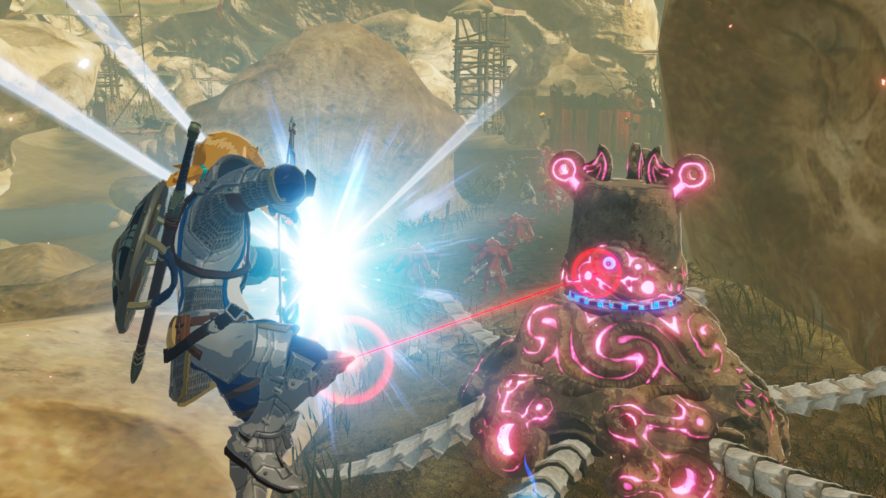
The same also applies to the Guardians. Once infected by Malice, the Guardians become rampaging killing machines rather that the protectors that their name implies. It is in the Guardians that we see parallels to countless movies and books about killer robots: anxiety over what would happen if technology was no longer under human control.
The Terminator movies have Skynet, which began as an artificial intelligence system that its creators hoped could be harnessed for the good of humanity. But eventually, it turned into a massive killing machine that slaughtered millions of people. The Divine Beasts and the Guardians, in their Malice-infected forms, are Hyrule’s answer to Skynet: good technology that has turned against its creators in the worst way – and the Calamity is Hyrule’s answer to Judgment Day.
Link using his bow to attack a Guardian.
I suggest that the corruption of the Divine Beasts could be interpreted as a cautionary tale on the dangers of being overly reliant on technology, especially where war and defense are concerned. And that is certainly a topic for an essay of its own.
Feel the Power
Breath of the Wild showed the use of electricity in a Zelda game more than any other time before. In our world, electricity is generally produced through coal-burning plants, nuclear power, and increasingly, wind and solar power. In Breath of the Wild, it seems that electricity is usually generated by harnessing lightning. Of all of Hyrule’s regions, the Gerudo region appears to be where electricity is most widely used; it is here that we find Vah Naboris, reclaim the missing Thunder Helm for Riju, and acquire Urbosa’s Fury.
Some of the Shrine puzzles, particularly in the Gerudo region, make use of portable, sphere-shaped dynamos and grids of electrical lines in the floor, and the puzzles in those shrines often involve using those items to create a working electrical circuit.
In another essay, I suggested that in times of peace (i.e., when Ganon is not running amok), Vah Naboris could be repurposed as an electrical power plant.
As for other means, it is possible that the windmills such as what we see in Kakariko and Hateno villages could be used to generate electricity from wind power as well. In a particularly tongue-in-cheek moment in the game, the player can acquire pieces of shockproof armor made from a long lost material called rubber. The game hints that rubber was manufactured at a distant point in Hyrule’s past.
Transportation
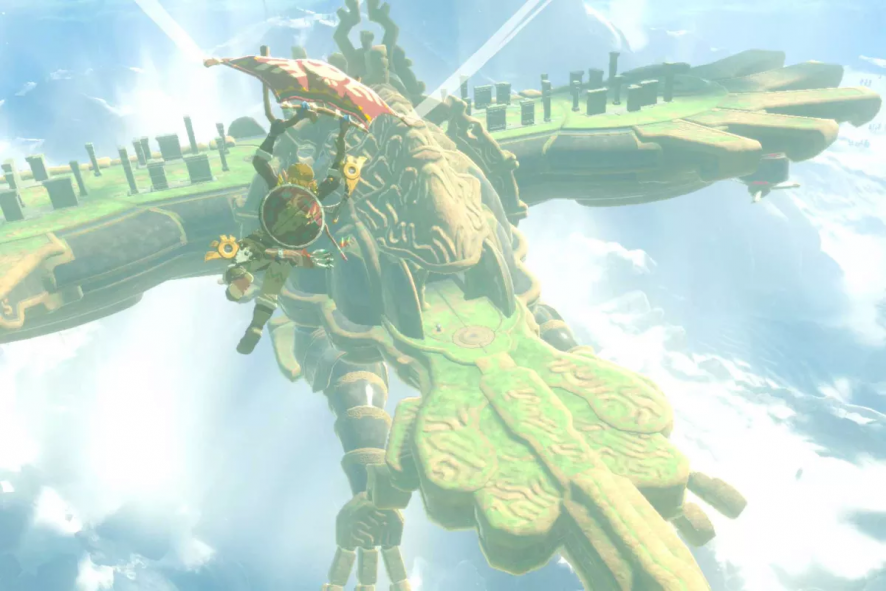
Previous Zelda games contained some forms of air travel: the Deku Leaf in The Wind Waker, and the Sailcloth and the Loftwings in Skyward Sword. But Breath of the Wild presented air travel that appeared to be more technology-based, in the form of Vah Medoh.
The game doesn’t specify exactly what it is that keeps Medoh aloft. Medoh has several propellers mounted to its underbelly, and a series of windmills on its upper deck, and we can speculate that magic plays a heavy role as well. But if it’s possible to build a flying machine the size of Medoh, it’s possible to build smaller machines as well.
For ground transportation, walking and horseback riding are usually the way to go. However, Link also has the option of riding the Master Cycle Zero upon the completion of The Champions’ Ballad DLC quest. The existence of the cycle indicates that the Sheikah had been doing work in the form of self-propelled transportation.
Mario Kart 8 took things a step further by including the Master Cycle Zero as a vehicle choice, but also a snazzy blue horse-shaped Master Cycle with the Hylian Shield fixed to its sides.
And of course, there’s also good old-fashioned warping. The action of warping looks very similar to the “beam me up” teleportation in Star Trek.
The Future
So those are some of the ways that Breath of the Wild is a “modern-day” Zelda game. It’s anyone’s guess how far into the future a subsequent game will go, or whether future games will end up going back into the distant past. But the games have demonstrated that in Hyrule, almost anything is in the realm of possibility.
Erin Roll
Erin Roll is a freelance writer, editor, and all-around slinger of words for fun and/or profit.
Erin lives at the top floor of a haunted house in Montclair, NJ. She loves music, reading, hiking, and kayaking, and spends entirely too much of her free time playing video games.


 by Erin Roll on October 12, 2022