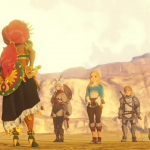
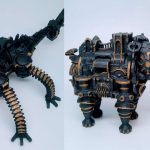
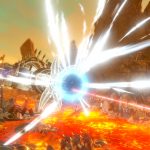
It was in Breath of the Wild that The Legend of Zelda fans were first introduced to the Divine Beasts: the four gargantuan Calamity-fighting contraptions that functioned as the game’s main dungeons. Built as protectors against Calamity Ganon, the machines turned into monsters after Ganon infiltrated them with four element-based incarnations of himself.
It was the player’s job to help Link regain control of the beasts, defeat the four Blight Ganons, and free the spirits of the four champions. Later on, players had the opportunity to pilot the Divine Beasts themselves in Hyrule Warriors: Age of Calamity, which I imagine quite a few people were excited about. (I find that for me, Ruta and Naboris are the easiest to drive, but I need a little more practice with Rudania.)
One has to wonder about something, though. The Divine Beasts are all at least 10 thousand years old by the time Breath of the Wild takes place. So there must be times in Hyrule’s history when the kingdom is not under threat from Ganon, right?
If so, that would mean there are periods when Divine Beasts would be sitting idle, not being used for Calamity-forestalling purposes. It would be a shame to have such gargantuan marvels of ancient Sheikah technology not being used most of the time.
Would it not be conceivable to imagine that the beasts’ inventors envisioned that the machines could be repurposed for other uses in eras of peace or other Ganon-free times? They could be used as power plants, waterworks, weather-monitoring stations, high-rise housing, and even amusement parks.
Herewith, a list of possible alternative uses for each of the Divine Beasts. This is a strictly tongue-in-cheek discussion, so I beg your indulgence, gentle gamers.
Vah Ruta
This magnificent mechanical pachyderm, this “gentle giant,” as Mipha affectionately terms it in Age of Calamity, towers over Zora’s Domain and the central Lanayru region. While possessed by Waterblight Ganon, Ruta tends to go into overdrive, spouting water in an endless rainstorm and spitting out spiked blocks of ice at anyone who tries to get too close. But when Ruta functions properly, the beast can be used to spout water for whatever purpose is needed.
Waterworks: We know Ruta’s trunk can power enough water to cause a heavy, prolonged rainstorm over Zora’s Domain, which means Ruta can easily send a lot of water from one place to another. If Hyrule were to have a system of piped water, it is possible to see Ruta hooked up to a network of pipes, bringing water in from the reservoir and then pumping it out to towns and villages across the region. There could also be sensors set up to monitor water levels in the event of a drought or to pick up any possible contaminants in the water — lingering effects of the Calamity, perhaps?
Water Park: Ruta’s trunk, with some overhauls, could become an amazing water slide. The control panel floor could be converted into a wave pool. Since Ruta can also produce ice along with water, Ruta’s central chamber could also become an indoor skating rink. If Ruta is based in the East Reservoir, maybe Ruta’s legs could be used to house some paddleboats or small watercraft for going out on the water. Or even rental suits of Zora Armor for people who wanted to try their luck at swimming up waterfalls?
Deep-Sea Travel: We could argue at length over just how well a giant mechanical elephant can swim. But we can see that Ruta can travel underwater as it dips beneath the reservoir on its way to take aim at Calamity Ganon. This has many possibilities for researchers and tourists alike; who knows what can be found on the sea beds around Hyrule?
Vah Rudania
Under Daruk’s guidance, Rudania slithers and crawls its way around the caldera of Death Mountain, keeping an eye on Goron City down below. Rudania seems to be an affable fire salamander; that is, when it isn’t spitting out magma bombs and causing earthquakes under Fireblight Ganon’s influence. The interior of Rudania appears to be climate controlled, so it is probably one of the few places on the summit of Death Mountain where species other than Gorons can walk around without getting toasted to a crisp.
Earthquake Monitoring: Considering all the earthquakes that happen on Death Mountain, I think it would be prudent to use Rudania as a monitoring station for earthquakes and volcanic activity. The settlements down the mountain, and even the Gorons themselves, would most likely appreciate some advance warning if Death Mountain is getting ready to rumble. Rudania could be outfitted with different kinds of sensors and monitors and let out a roar if the rumblings are getting loud enough.
Volcano Tours: Rudania can be used to take tourists for scenic rides along Death Mountain’s highest ridges and through its pools of lava. It would be the hottest — so to speak — tourist attraction in all of Hyrule. Since Rudania can move from one location to another, Rudania can be brought down the mountain to a designated boarding site with cooler temperatures, or perhaps mini Rudanias can be built to ferry non-Goron visitors up the mountain.
Tanning Salon: Rudania’s upper windows open to allow sunlight — and lava light — into the inner chambers. So for Hyruleans looking to get some rays without getting completely cooked, Rudania’s inner chambers could be outfitted as an indoor sunbathing spot, with beach chairs and blankets available. And then you could stop at one of the hot springs in the maw of Death Mountain for a dip on your way home. But don’t forget the sunscreen!
Vah Naboris
Naboris, Urbosa’s pride and joy, takes the form of a giant electrical camel. This Divine Beast roams the Gerudo Desert outside of town, calling down the lightning on all that threaten the Gerudo and their allies. When Thunderblight Ganon is in control, Naboris can do some pretty shocking things, so to speak, with catastrophic thunderstorms occurring every few minutes. But when all is well, Naboris’s electrical powers could be put to good uses for the Gerudo and all beyond.
Power Plant: This would seem to be the most obvious non-combat use. Naboris is filled with dynamos, switches, and conduits for electricity. If Hyrule were to have an electrical grid, Naboris would be the most likely venue for a power plant or substation. But it would be all the more crucial to keep it Calamity-free; just imagine what an outbreak of Malice could do to your appliances.
Weather Station: Naboris can attract and produce lighting, so it would make sense that it can detect it as well. The camel’s giant size and good views of the surrounding area would make it a good location for monitoring incoming storms; Naboris’s head could be a perfect location for weather monitoring radar and some high-powered lightning rods. Additionally, Naboris’s distinctive bellow would make a good weather alert siren, warning people to take cover ahead of a heavy storm.
High-Rise Apartments: Would you like to live inside a Divine Beast? A lot of people in Hyrule would be willing to pay top dollar — er, that is, top rupee — for an apartment with an expansive balcony view up in Naboris. The two central humps seem as if they would be especially prime real estate. Think of the ads: “Beautiful dwelling with desert views inside a magnificent, historic mechanical camel. Electrical lighting, air conditioning, and Sheikah slate-powered elevators. Convenient for Kara Kara Bazaar, Gerudo Town, and Gerudo Canyon.”
Vah Medoh
Revali would probably be a bit miffed at us saving his Divine Beast for last, but what can you do? Medoh became the terror of the skies when Windblight Ganon moved in, but now that it is Calamity-free, Medoh keeps watch over Rito Village and its citizens from atop its rocky perch. Of the four Divine Beasts, Medoh is the only one that does all its fighting from the air rather than from the ground. Therefore, Medoh’s flight capabilities and windy powers would lend it to a variety of other uses beyond aerial combat.
Wind Farm: If Hyrule were to invest in wind energy, beyond the capabilities of the local village windmill, Medoh would be the perfect spot to set up a series of wind turbines. The giant bird’s perch high above Rito Village would be a good place to catch some strong winds, and the flat top surface has plenty of room for windmills.
Paragliding School: The Sheikah Towers and assorted cliffs across Hyrule are good jumping-off places for someone looking to paraglide, and an intermediate glider could even borrow the Flight Range. But for the ultimate gliding experience, Medoh could take groups of people high up into the sky for high-altitude gliding. And if free-falling isn’t your thing, Medoh could also be used to take people on pleasure flights over Hyrule.
Storm Tracking Plane: Medoh, like Naboris, could serve a meteorological function, perhaps in the same way that a hurricane monitoring plane would. Medoh is clearly built to withstand strong winds, so it would not take much effort for Medoh to fly into the middle of a large storm and send back information about it to a monitoring station in Rito Village or elsewhere.
Those are just a very few possibilities, and the list doesn’t end here. If the escape room craze ever made it to Hyrule, the Divine Beasts — and the Shrines too, for that matter — could serve as giant versions of those puzzling attractions. Or the Divine Beasts could be used for massive games of Rock ‘Em Sock ‘Em Robots. Who knows?
But you’d still need the Divine Beasts to be around for Calamity Ganon’s next attack, wherever and whenever that may be. So these alternate uses would also ensure the Divine Beasts were getting plenty of maintenance and attention ahead of the Calamity’s next appearance.
Erin Roll
Erin Roll is a freelance writer, editor, and all-around slinger of words for fun and/or profit.
Erin lives at the top floor of a haunted house in Montclair, NJ. She loves music, reading, hiking, and kayaking, and spends entirely too much of her free time playing video games.


 by Erin Roll on May 24, 2021