I started my Live A Live experience having only a passing familiarity with the game and its history. Originally released in 1994 for the Super Famicom, it was the directorial debut of Takashi Tokita, who would go on in 1995 to release the widely beloved Chrono Trigger. Unfortunately, Live A Live was never officially translated into English, becoming a niche cult classic in the West that was enjoyed by the few who played via fan translation patches. Since I haven’t played the 1994 version, I’ll be talking mostly about my overall experience with the Switch game rather than the differences between versions, aside from a few of the more obvious changes.
The graphics have been updated for the remake, featuring the “HD-2D” aesthetic that Square Enix created for Octopath Traveler and has now begun to use as a template for remaking its old RPGs (A HD-2D remake of Dragon Quest III was also announced last year). This style can be divisive, but for what it’s worth, I think this is the best that HD-2D has ever looked, never distracting in the way that Octopath Traveler’s excessive bloom filter sometimes could be.
The variety of styles within the game allows HD-2D to portray more than just the traditional European Medieval Fantasy that it has until now.
Voice acting has also been added, with options for both English and Japanese tracks. The English-language voice acting is quite good, though if you follow Japanese voice acting, it’s worth noting that the Japanese version features a particularly star-studded cast. The soundtrack has also been rearranged under the supervision of original composer Yoko Shimomura — of particular note is the legendary boss theme “Megalomania,” which I was familiar with before playing thanks to its association with “Megalovania,” the Undertale track that it directly inspired.
A radar/mini-map has also been introduced to help you navigate the world as part of a variety of small accessibility tweaks added to the remake, but those who want the original experience can turn it off in the menu.
The Story’s Lively and Branching Paths
The most notable difference between Live A Live and most other games of its type is its format –- rather than a single RPG, it would be more accurate to call it an RPG anthology. Starting up the game, players are presented with seven different chapters to choose from, each in a different time period and location, and with a separate protagonist.
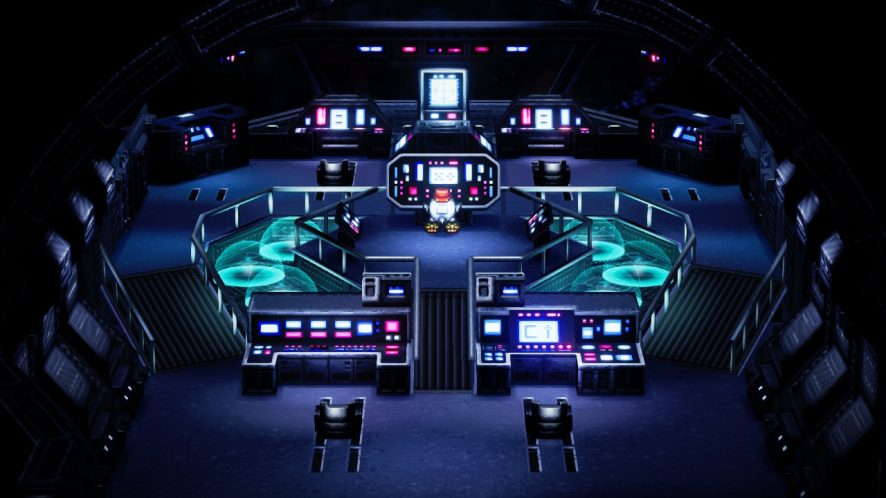
The chronologically earliest chapter has you play as a caveman in a comedically anachronistic version of prehistoric times; too primitive to have a language but apparently advanced enough to drive around in stone cars. The latest chapter is set in the far future on a spaceship very reminiscent of the movie Alien, where a small crew is attempting to transport a mysterious alien specimen to Earth. Until the final part of the game that brings it all together, the only narrative link between these chapters is that your protagonist always must face a final boss that has some variation of the name “Odio.”
What is a Wild West saloon without its own mariachi band?
Chapters are relatively short (usually one-to-three hours long), often employ different sets of gameplay mechanics, and can be played in any order. To start with, I arbitrarily selected the “Present Day” campaign, which is about a martial artist seeking to become the strongest in the world. This probably wasn’t the best first choice, as it turned out to be a combat gauntlet that jumps directly from fight to fight, and as such didn’t introduce any of the game’s more common mechanics: leveling up, investigating an environment, interacting with others, gaining party members or equipping gear.
On the other hand, it was good in some ways because it only increased my wonder at the game’s wide range when I next jumped to the Wild West and was treated to a completely different game concept, in which I worked together with the local townspeople at the Saloon to lay traps and defeat a notorious bandit. For what it’s worth, long-time fans often suggest starting with the prehistoric chapter, which has a more standard JRPG format along with a little of everything.
Initially, I was skeptical of this approach to game-making (especially since my first experience, the Present Day chapter, is the shortest by far) — would I simply be perusing a variety of game demos instead of having an experience that I could properly dig into? In the end, I was pleasantly surprised. I stayed long enough with most of the characters that I grew to like them, and the fast rotation of content meant that I was never bored by the game mechanics.
Getting The Hang Of How To Play and Fight
The one thing that does stay the same throughout every route is the combat system, and luckily, it’s quite a good one. In concept, it’s similar to the Active Time Battle system used from Final Fantasy IV-IX, in that the order of turns is determined by whose time bar has most recently filled up. However, rather than everyone just standing in place, you are moving around the battlefield in a 7×7 grid trying to find ideal locations.
For example, you’ll have better accuracy when attacking from behind, and gunslingers like the Wild West chapter’s cowboy protagonist will enjoy gaining distance from their opponents and firing diagonally. You can move as much as you like during your turn, but everyone else’s time bar will continue to fill up as you do, so you may end up fielding an extra attack while repositioning.
Gale Strike only hits on diagonal squares, but luckily Fake Hulk Hogan takes up several squares on the grid so I can still hit him.
There are several refreshing aspects to the combat system that make it easy to manage. You don’t have to worry about maintaining your health bar between battles, as you are fully healed between combat encounters. There is also no concept of magic points or a magic meter, and you can freely use any abilities you have unlocked, shackled only by the ability’s range and whether it requires time to charge up. You don’t have to worry about money either, because there are no traditional RPG-style stores or inns; your items and equipment will all be found out in the world or from fighting enemies.
Each character has their own list of elemental strengths and weaknesses, but if an ability will be resisted or super-effective that information will flash up on the screen for you, which I also appreciate. From what I’ve heard from players of the SNES original, this is one of the Switch version tweaks that was made to help you keep track of all the combat elements.
Chapters tend to also have a unique gameplay gimmick. In the prehistoric chapter, our caveman protagonist could use the Y button to sniff out items and enemies with his powerful nose, whereas the protagonist of the Mecha-inspired near-future chapter has psychic powers and can use Y to read the minds of NPCs.
The Feudal Japan chapter offers you several options for how to complete it which offer different incentives — you can use your Ninja skills to sneak through for a pacifist run, kill a few on your way into the boss, or kill every single person in the castle. In fact, to hammer home the concept of your kills mattering, each of the 100 people in the castle is given an individual name, which is a fun addition.
Exploring The Story Behind The Story’s Localization
The writing is also enjoyable, and an effort is made to translate each time period’s use of language in a distinct style. The most notable in this respect is the prehistoric chapter, which uses no words at all, communicating entirely with gestures and pictographs. Another standout was the Wild West chapter, which was more direct in its use of language than I expected at several points — the vulgar language that I expected to get a cutesy work-around was instead translated directly and then voice-acted.
In this chapter, your choice of continuing to craft or not is represented by an option between a stone ax and the Elder crossing his arms to gesture “no,” rather than a text box.
The script hasn’t been entirely left unchanged; there were a couple of points where I could tell that something had been altered. Without the Japanese text to compare it to, I’m unclear whether they were changed for the overall Switch remake or just the English translation, but there are definitely some differences from the original SNES release.
I discovered one such example when I looked up a guide for the Near-Future chapter. This chapter featured a “synthesis” system in which you could hand the professor an item and he would attempt to upgrade it, so I wanted to see which items I could successfully upgrade, and which would be a waste of time. The guide I found was for the fan translation of the SNES version, and I had some trouble trying to match up my own items with the ones in the guide, as several of them had wildly different names.
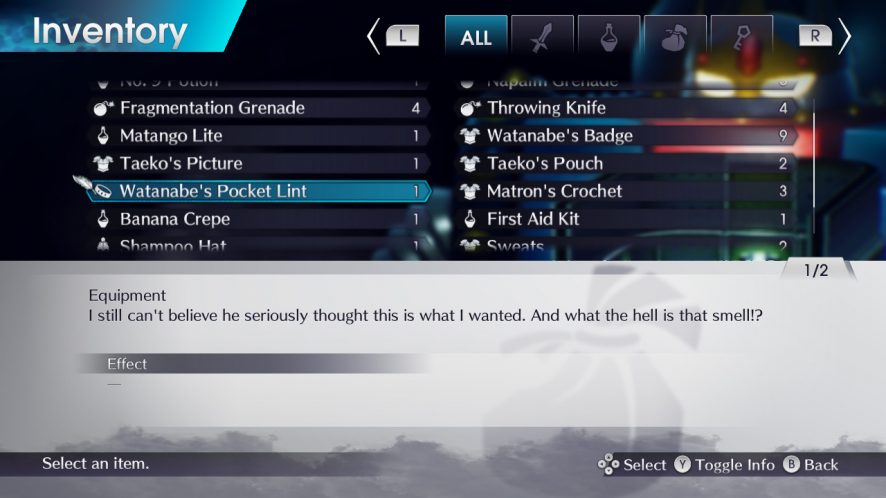
As it turned out, this is what had happened: in the Switch version, the protagonist, a teen at an orphanage, is using another younger orphanage kid named Watanabe to sneak around and try to steal some money from Taeko, the lady who works as a caretaker at the orphanage. The kid repeatedly messes things up though, giving you his own pocket lint and various other things before you get Taeko’s “secret stash,” which is implied to be money in the item description. However, these items all had different names on the SNES, because in that version it was a recurring joke about trying to steal underwear — Watanabe mistakenly gives you his own boxer shorts at first and collects a range of other incorrect clothes before eventually correctly getting Taeko’s underwear.
The mystery of Watanabe’s Pocket Lint.
I don’t have any problems with the change itself — perhaps the developers felt that ’90s anime humor about teen boys being sex pests would feel less sympathetic in a modern context and that we were beyond the days of anime boys sneaking into the women’s baths during a hot springs episode and then getting blasted away with a punch like Team Rocket.
Understanding the change, though, did help me to contextualize some aspects of the joke that were a little confusing. Why would the kid hear that you want money and instead hand over his pocket lint? Why does the pocket lint smell bad and give you a status debuff? Why can you wear Taeko’s money as armor in one of your equipment slots? Without having this coincidental experience, I probably would have simply brushed past it, but after I did experience it, I was left curious about what other changes I possibly have missed that might explain strange item information.
The Unavoidable (Though Minor) Nitpicks
As a whole, Live A Live is expertly crafted, but I do have a few nitpicks about some minor aspects of the game. The first is that the game loads too fast — I realize this seems like the kind of not-actually-a-downside that might be given as a response to “What would you say is your biggest weakness?” during a job interview, but the problem isn’t the loading itself. The issue is that during loading screens, the game will often give out little tips or trivia about the room you’re entering, and then can flash off again after 1 or 2 seconds. I can go into the menu and find it again, but it does lead to a lot of attempts to read at lightspeed.
I also have a couple of minor qualms with parts of the user interface. The equipment menu can sometimes be frustrating to navigate when you’re trying to pick out the best gear. Raw stats are shown to you immediately, but secondary effects are hidden behind the second screen (after pressing Y while the item is selected).
For example, one helm might look like a downgrade but actually gives resistance to water-elemental damage, but information like this can be lost if you’re not digging through secondary screens to check which resistance icons light up, especially later on when you’re managing a large inventory of random stuff.
Wearing the Shampoo Hat provides Water Resistance, but I’m likely to miss that unless I press ‘Y’ to toggle info.
I also had trouble understanding a couple of minor details in the combat system, which didn’t impact me enough to make the game difficult but did leave me unsure about where to put my stat distribution at times. For example, there are two separate types of attack stats on your character, Physical Attack and Special Attack. Anyone who’s played a game like Pokémon would understand the general mechanic here: punches use Physical Attack and psychic mind beams use Special Attack.
The issue was that I wasn’t sure about some of the edge cases because I couldn’t find an indicator of an ability’s physical/special status anywhere. Is it the system that the Pokémon series used prior to Gen IV, where an elemental type is inherently physical or special (i.e., Fire Punch is a special attack because it’s Fire-type) or is it the system that Pokémon uses in the modern day (i.e., Fire Punch is a physical attack because it’s a punch)? Am I increasing the power of a gun when I increase my Physical Attack? I did look through all the tutorials, but I couldn’t find much. Again, not a huge issue, but notable as a leftover artifact of the more ambiguous SNES version.
Final Thoughts
Overall, I had a great time with this game. My total playtime was slightly under 25 hours after a reasonably complete playthrough of the game. I probably could have gotten another two or three hours out of optional side content, but otherwise, I felt like I had a complete experience.
Some of the chapters were more interesting to me than others, but even when there was one that I wasn’t super-invested in, it would stay interesting without wearing out its welcome thanks to each chapter’s bite-sized length. The chapters that did hit for me left me satisfied and happy to see more, which is always a nice sweet spot for a story. I would recommend this to anyone who likes this style of Japanese RPG, especially people who generally like them but struggle with game lengths often blowing out past 80 hours.
Score: 8.5/10
Cody Davies
Cody has been involved with Zelda Universe since joining the forums in 2003, and now spends most of his time making bad polls on Zelda Universe's Twitter account.


 by Cody Davies on August 5, 2022