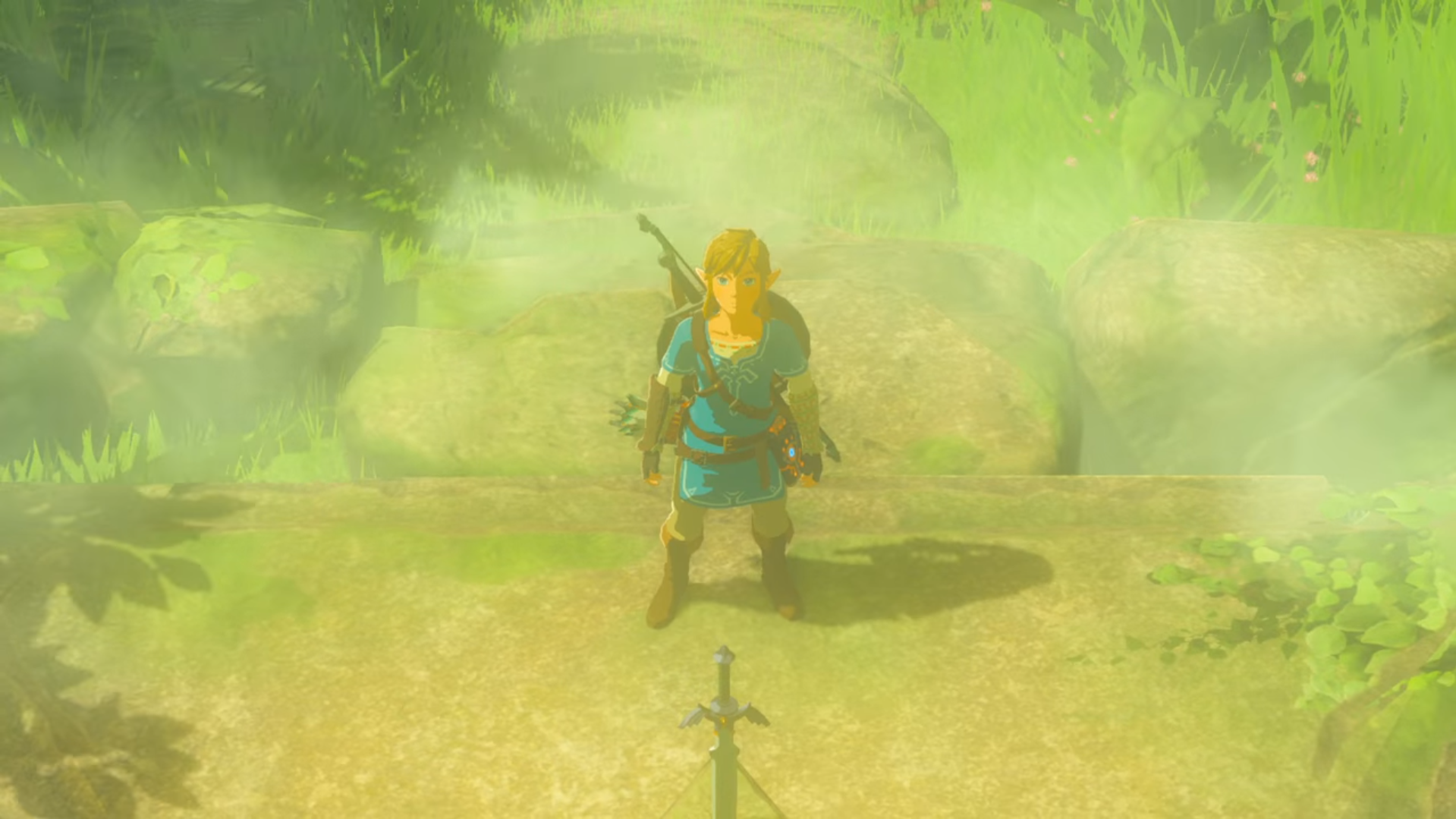
The Legend of Zelda experienced a watershed moment a little more than two years ago with Breath of the Wild’s release, and it may be on the verge of experiencing another very soon.
The debut trailer for the sequel to Breath of the Wild rightfully set the internet ablaze, its reveal taking many, if not most fans by surprise. The Legend of Zelda already had ample representation at E3 in the forms of Cadence of Hyrule and the Link’s Awakening remake ― just two of many notable titles that comprised an absolutely stacked event for Nintendo. On paper, there seemed to be no room, or perhaps more accurately, no need to show off the next 3D entry in The Legend of Zelda.
Beyond shock value of its unexpected arrival, the trailer stands on its own as an ominous, at times certifiably creepy cinematic that hints at some monumental events in the next great adventure for Link and Zelda. But for all of the mysterious sights and moments that generate questions and theories, what has riled the most intrigue in that teaser clip is how much is recognizable to a longtime follower of The Legend of Zelda, even someone whose only experience with the series is Breath of the Wild.
Nintendo finally chooses familiarity
It is the unusual case where familiarity breeds even more intrigue than the unknown does. This was not an introduction to the next iterations of the iconic heroes or the world they will be saving. According to the trailer for Breath of the Wild’s sequel, we are going back to the same Hyrule we spent countless hours venturing through over the last two years, and we will joined by, presumably, plenty of the same faces who were with us for the first journey.
The return to a familiar setting and game engine marks a significant shift in the way that 3D Zelda games are produced. While the reusing of game engines has not been unheard of for the series in recent years, with titles like Spirit Tracks and Tri Force Heroes heavily borrowing assets from a predecessor, it has not been the practice in the 3D sphere for nearly two decades. The last instance of a 3D Zelda doing this was Majora’s Mask, produced near the tail end of the N64’s life cycle. Since then, all 3D entries (Wind Waker, Twilight Princess, Skyward Sword, and Breath of the Wild) have largely been built from the ground up, their graphics, art directions, in-game worlds, and even their stories all starting anew. While Twilight Princess used Wind Waker’s game engine, Twilight Princess still ventured on its own for its visuals, overworld, and narrative. That tendency to use a clean slate has undoubtedly been one of several reasons for the lengthy waits in between many of the 3D games, the gaps sometimes being as long as five and a half years.
The sequel to Breath of the Wild is taking a step further by seemingly serving as a continuation of the events in the acclaimed Switch launch title. The time jump between the two stories may very well be shorter than the gap between the games’ releases. Whereas other direct sequels in the series like Link’s Awakening and Phantom Hourglass took the green garbed hero and any companions to new lands, the forthcoming epic is keeping things closer to home. The only other pairing of games where the original and its immediate followup maintained identifiable connections to this extent is the duo of 1986’s The Legend of Zelda, and 1987’s Zelda II: The Adventure of Link ― two games where the story and lore mostly existed inside the game manual, the supporting cast was just townsfolk and merchants, and the in-game worlds have wildly different geography.
In this regard, Breath of the Wild’s sequel will be embarking upon an unprecedented sense of continuity, which Nintendo has been averse to for more than thirty years as they have developed The Legend of Zelda software. Across multiple decades, the franchise has favored standalone experiences over sequential entries that built a connected saga, resulting in a convoluted branching timeline that often makes dramatic reaches for cohesion.
Cohesion breeds emotional investment
The next chapter in The Legend of Zelda has potential ― and likely, the intention ― to strengthen rapport with fans in a way that no previous game has ever achieved. When fans sit down to play the sequel to Breath of the Wild, there will be an investment already founded that goes well beyond the mere brand name and recognizable incarnations of Link and Zelda.
It’s easy to see how much players care for these incarnations of Link and Zelda. How exciting it will be to see them grow even further.
The task of establishing connections has already been accomplished, leaving the sequel to Breath of the Wild with a unique opportunity to bolster what attachment that the masses have to a setting and time period they were already enthralled by once before. The groundwork has been laid for the upcoming adventure to elevate the game design and drama that fans embraced, much like how many fictional trilogies exponentially gained momentum along the way, such as The Lord of the Rings, Christoper Nolan’s Batman films, and Matt Reeves’ Planet of the Apes films.
Pop culture is currently steeped in shared universes, all of which vie to successfully establish vast networks of interconnected stories that accumulate interest and passion from audiences along the way. No more prominent property exists than the Marvel Cinematic Universe, where film after film built upon what came before it until the brand became arguably the single most prestigious name in entertainment. Even highly successful, solo blockbuster outings like Black Panther, Wonder Woman, Spider-Man: Homecoming, and Aquaman had their title characters appear in earlier productions where moviegoers first became endeared to them.
Breath of the wild has a unique opportunity to bolster existing attachments now that players are connected to the characters.
It may be telling that, at least in the last few years, Nintendo has quietly abstained from further disrupting the aforementioned timeline for The Legend of Zelda. The last entry to interrupt the branching chronology was 2015’s Tri Force Heroes. In the nearly four years since then, out of the Zelda games that have been released ― Breath of the Wild and its DLC, which are said to occur at the end of the timeline; Cadence of Hyrule, a non-canon spinoff; and the soon-to-be-released remake of Link’s Awakening ― not one indulges in further tangling the messy timeline.
Breath of the Wild stands on its own
While never labeled as such by Nintendo, it is easy to view Breath of the Wild as a de facto soft reboot of The Legend of Zelda. The landmark game evokes the original production that birthed the beloved series, returning to game design that emphasized exploration and the freedom to go about that as the players pleased. Despite being jammed packed with recognizable names, phrases, races, and creatures, Breath of the Wild never cemented a direct correlation with another entry in The Legend of Zelda. Its narrative is largely optional, while staple elements of franchise lore like the Triforce, the Master Sword (particularly its necessity), the three Goddesses, among others, are either ignored or simply are on the periphery of the story.
While the Master Sword exists in Breath of the Wild and is a plot point, arguably some players will never discover it, rendering its importance muted.
Breath of the Wild was perfectly accessible for someone who had never even touched a The Legend of Zelda game before. Given the game’s remarkable mainstream success, it is almost assured that a great number of those who played it were newcomers to the series. If Nintendo does indeed plan to leave the branching timeline behind and embrace more continuity going forward, Breath of the Wild was an ideal jumping off point. The game has evidently consumed Aonuma’s thoughts since it launched, who claimed that the sequel came together because he had too many ideas for DLC.
With Malice still in play, a corpse-like figure strongly portending the return of Ganondorf, and other enigmatic forces at work, one cannot help but wonder if The Legend of Zelda series is poised to take up a lengthy stay in Breath of the Wild’s Hyrule and whatever realms may surround it.
If an interconnected saga is truly on the horizon, or the return to a familiar, lauded setting is just temporary, the sequel to Breath of the Wild already has the makings to leave an indelible impact on the series.
Jeffrey Pawlak
Jeffrey Pawlak is the Features Director for Zelda Universe, and has been a member of the website's community for more than 20 years. He is also a high fantasy author and an aspiring comic book artist.


 by Jeffrey Pawlak on July 15, 2019