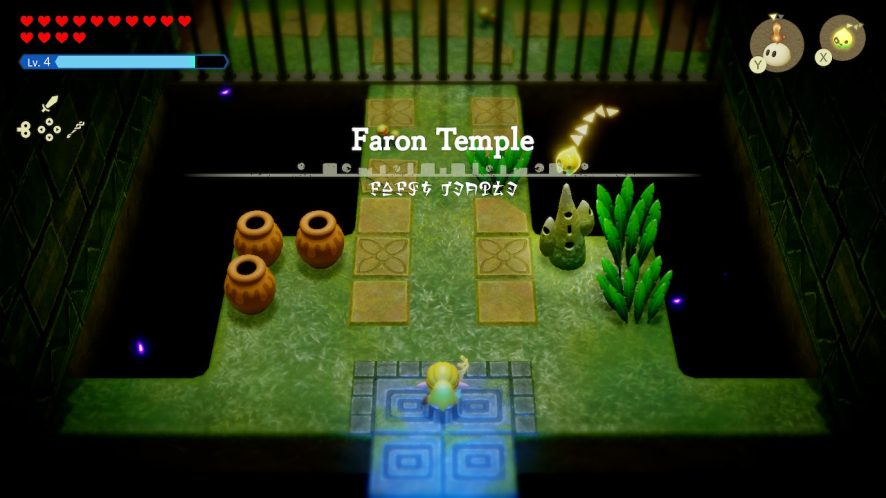
From the overworld theme filled with allusions to “Zelda’s Lullaby” to the Eldin Temple’s spicy tango and more, The Legend of Zelda: Echoes of Wisdom has some of the very best music in the entire franchise. A lot of Echoes of Wisdom’s musical charm stems from its location-based musical cues which borrow from real-world traditions. Comprising some of my favorite tracks in the game, the music associated with the Faron Wetlands borrows heavily from the courtly Indonesian practice of gamelan. As the culminating dungeon of the Faron region, and ostensibly a place of ritual for the Deku Scrubs, it fits that the Faron Temple would take the strongest influence from gamelan music.
Gamelan music in video games is generally tied to jungles and wetlands, geographical biomes that have come to be associated in Nintendo games with the Indonesian archipelago. Aside from Echoes of Wisdom, two of the most prominent examples of gamelan’s influence in Nintendo games can be heard in Super Mario Odyssey (in the Lost Kingdom) and Donkey Kong Bananza (in Mossplume Marsh). In Odyssey and Bananza, however, gamelan is used primarily as a representation of geography. In Echoes of Wisdom, it comes to represent both the Faron region and the culture of the Deku Scrubs that live within it.
While instrumentation and performance practice vary from island to island, gamelan music is characterized largely by its array of metallic percussion instruments, its rhythmic drive, and the pelog musical scale. The music of the Faron Temple seems to be influenced most by Balinese gamelan styles. This is represented in the Faron Temple music early by what sound like the Balinese gangsa and reyong, bronze instruments that mark the beginning of each four-measure phrase. Three marimbas, wooden xylophones that stand in for the Balinese gambang, provide an undeniable groove through fast interlocking rhythmic patterns called kotekan. The entire piece is composed in pelog, an Indonesian tuning system that leans into microtonality. This is most evident when the suling, a Sundanese bamboo flute, enters with an ethereal, otherworldly pelog melody.
The rhythmic drive and directionality of the Faron Temple music sets it apart from other forest-themed temples in the Zelda franchise, which like the Deku Tree and Forest Temple in Ocarina of Time, tend to focus more on ambience and creating a sense of musical space. These other forest themes are more sparsely scored with slowly moving rhythms and heavy reverb. The heavy influence of gamelan on the Faron Temple in Echoes of Wisdom speaks to the apparent function of the dungeon as a temple, not a place of mystery but of real cultural significance in the Deku-populated Faron Wetlands. And the otherworldly pelog tonality here does double duty: it furthers the gamelan aesthetic while also tying the temple to the Still World where it is initially found.

Indonesian instruments and tonality are used throughout the Faron region to musically link its locations and characters. The music of the Faron Wetlands themselves, for example, makes heavy use of a set of Sundanese percussive bamboo tubes called angklung for its melody. The smoothie-selling Business Scrubs, too, are accompanied by music that sticks to the pelog scale heard in the Faron Temple. Tying locations and characters to distinct real-world cultural music is an effective way to aurally communicate their shared identities within the game world. This kind of cultural music allows the world of Echoes of Wisdom to be a microcosm of the diverse cultures and ecologies of the real world and to really feel alive.