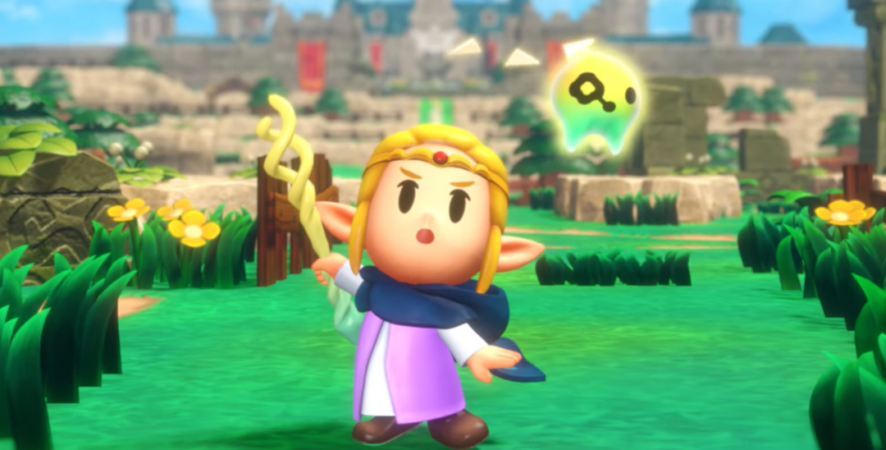
Echoes of Wisdom is a milestone for the Zelda series in a lot of ways, the most obvious being that it’s the first mainline title to feature Hyrule’s princess as the primary protagonist. Aside from the gameplay innovations, this simple change of character leads to countless subtle differences from past games. Even the soundtrack reflects the new perspective, opting for an even cuter vibe than Link’s Awakening. Of course, there are plenty of ominous tracks in the game (the dungeon themes are particularly memorable), but most of the overworld and town music has “Princess Zelda” written all over it. Although, the start of her adventure has her and her music much less confident than usual.
Spoiler Warning:
The rest of this article may contain spoilers for Echoes of Wisdom about the story, gameplay mechanics, and other details that you might not wish to see. Continue reading at your own risk.
After escaping Hyrule Castle’s prison through a raging sewer, Zelda finds herself at Suthorn Beach. The beach’s theme is driven by a string quartet and bass clarinet walking down an 8-bar chord progression. The first half ends with a satisfying ii-V-I cadence, then leaps into the second half with a burst of confidence. The bass overshoots the root here, inverting the chords and giving them a brighter feel until the final bar introduces a B major chord. That’s a foreboding tone in the key of G, normally resolving into E minor. Zelda refuses to give up though, and the loop returns to its C major beginning.
The initial melody is Link’s theme played on a clarinet and a bassoon, and it’s followed by a back-and-forth between the two instruments. They dance around with a bittersweet grace, as if Link is passing the torch to a new hero. It seems to me that Zelda is inspired by his courage from when he fought that blue monster, and she uses that memory as a motivator in this moment. That courage boost is exactly what Zelda needs in order to begin her adventure and find out what kind of hero she’ll turn out to be.
Eventually, Zelda is free of the rift-opening allegations and no longer requires her disguise. As she twirls into Hyrule Field in her new outfit, the whole woodwind chamber sings Zelda’s Lullaby for all the world to hear. The game’s main theme kicks in on clarinet, soaring around the scale with finesse. The chords in this section are joyful, staying on G major for a few bars before going into a classic pop progression. A high flute takes over the melody the second time around, accompanied by some elegant flute rhythms and a bassoon countermelody. The next section is a fleshed out version of Suthorn Beach. Beneath the new oboe melody, the string quartet and bass clarinet are exactly the same. The flute and clarinet even play some of the same back-and-forth bits from the earlier piece. The only part that doesn’t come back is Link’s theme. Zelda has established herself as the new hero and has all the confidence she needs.
I can’t help but smile every time I hear Echoes of Wisdom’s Hyrule Field. It still feels surreal that Zelda officially has an adventure to call her own. I’m glad that the game is being received well, as it and its music have quickly become very special to me. I’m also glad to have a Hyrule Field theme that’s in 3/4 (or 9/8 if you’re a super nerd like me). Regardless, it’s a wonderful time to be a Zelda fan. Whether Zelda being the main character is a one-time gig or the start of a new subseries, I can’t wait to see what comes next.