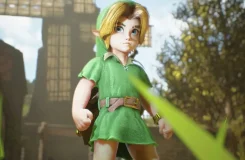
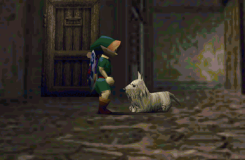
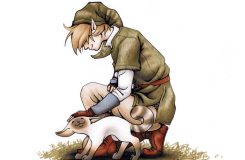
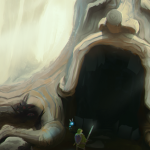
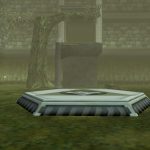
A hero’s journey could never be complete without two crucial chapters: the return home, and the “dark forest”. The former can be anything from a heartfelt reunion to a grim reminder of the evil our hero stands against. The latter is a time-tested trope of a threat unfamiliar or unknown in a treacherous place. On the week this article hits the presses, we are celebrating the 25th anniversary of the first time seeing Hyrule in 3D: Ocarina of Time.
Discovering and awakening the Sages in Ocarina of Time is no easy task for the Hero, though no chapter of his story is particularly welcoming. When it comes time to seek out the Forest Sage, Ocarina of Time makes it clear to the player that this is a place unfamiliar and unfriendly to Link, despite his upbringing under the watchful eye of the Deku Tree. Not only are the surrounding Kokiri Forest and Lost Woods infested with a greater number of Deku Babas and Scrubs, but the Forest Temple itself is quite an overrun labyrinth.
When viewing the Forest Temple as a contrast to the childlike wonder of the Kokiri Forest Link grew up in, the irony of its existence is not lost. The Forest Temple is a great brick-and-mortar monastery that does not belong in nature, and it shows. Where the inhabitants of the forest live in harmony with nature, making use of stumps and natural pathways as homes and avenues, the Forest Temple is being reclaimed by the wood. It is overgrown with vines, eroding in its courtyards and facade, and the rugs that adorn the halls are frayed and eaten. Even the variety of enemies Link encounters within the temple are telling of this reclamation by nature; the temple is infested with Deku Babas, Skulltulas, and Wolfos that may well have claimed lives whose lost spirits haunt the ruin as the resident Stalfos, Bubbles, and the Poe Sisters.

As was typical for Ocarina of Time, the Forest Temple uses verticality to its advantage, embracing the then-new 3D medium. Creeping ivy adorns many walls in the ruins, acting as a ladder to other sections and providing a purchase for the recently acquired Hookshot. The frequent Bubble enemies, including the introduction of the Blue Bubble, similarly make use of their flight to make the infamous enemy lock rooms all that more difficult for the Hero of Time, who lacks many ways to reach far away enemies before acquiring the Bow later in the dungeon. Finally, the first instance of Wallmasters in the game comes in the Forest Temple, which drop from the ceilings onto an unsuspecting Link should the Hero not be wary of shadows from above.

Just like the variety of lost souls that defend this place, Link is bound to become lost once or twice in the twisting halls of the Forest Temple. Despite the use of vertical space in the dungeon, it is doubtlessly the halls that confuse and disorient the Hero, not unlike the fallen trees of the Lost Woods. The building is symmetrical for the most part, featuring dual courtyards, a variety of small and medium rooms, and water features in the outdoor sections, including wells. Overall, a floor plan one would consider simple. Things do happen to get odd once the Bow is acquired, as the Forest Temple features a number of Eye Switches that warp the longer corridors of the home, sending Link through experiences that would make M.C. Escher proud: halls that twist dimensions and defy gravity, rooms turned on their side, falling through walls, and walking on ceilings.
Perhaps what stands out most, Escher architecture aside, is that overall the Forest Temple resembles an estate more than a place of worship like the other Temples in the game. It favors the paintings that the Poe Sisters and Phantom Ganon travel through over the guardian statues that fill all of the game’s other temples. Rather than featuring large, communal areas, the rooms are divided, joined by twisting corridors. Finally, despite the tangled sprawl of the ruin, there is a sense of everything having a place in the dungeon – both the Poe Sisters’ portraits and the inclusion of Wallmasters and Floormasters suggest that there are things that do and do not belong in certain wings, like a private collection or being a guest in someone else’s home. Overall, the Forest Temple is saved by being overgrown, or it would be antithetical to the very element it is meant to represent, and maybe that’s the point.

I started by mentioning the two chapters in a hero’s story the Forest Temple represents. It is both Link’s return home and his dark forest. Link’s return home is not a happy reunion, because the Kokiri Forest is changed. He is faced with this strange, unnatural ruin that his childhood friend enjoyed, and is excluded from his own community because they do not recognize their neighbor now, as an adult. Just as nature is reclaiming this ruin we call the Forest Temple, time is reclaiming Link. It’s a reminder that, like the undead creatures and anti-fairies that inhabit this ruin, Link does not belong in the woods, in fact as a Hylian he is as alien to them as they have become to him. It is time, not Ganondorf, that has made this place our Hero’s dark forest.

November 21st, 2023 marks 25 years since the release of Ocarina of Time! Join us in celebrating this nostalgic gem with an entire week of dedicated articles!